


Legacy System Modernization: A Practical Framework
Date Published
Reading time
16 minIn this article
- Start With "Why" – The Question Most Organizations Skip
- What Business Problem Are You Solving?
- Break Legacy Modernization Into Parallel Tracks
- Infrastructure
- Software
- Organization
- The First 30 Days: Build the Map
- The Next 60 Days: Create Safe Zones
- How AI Accelerates Legacy System Modernization
- The Right Sequence for Legacy Modernization Projects
- How to Measure Legacy Modernization Success
- Common Legacy Modernization Mistakes to Avoid
- Key Takeaways: The Legacy Modernization Framework
Every technology leader eventually faces the same uncomfortable moment: the system that built the business is now holding it back. The codebase that once represented innovation has become a source of friction, slowing down every new feature, every integration, every attempt to respond to market changes.
The instinct is to tear it all down and start fresh. Build something modern. Do it right this time. However, the truth is: this instinct is almost always wrong.
The organizations that successfully modernize their legacy systems share a counterintuitive approach: they treat the existing system as an asset to be transformed, piece by piece, rather than a problem to be replaced. They move incrementally, maintain business continuity throughout, and they never lose sight of why they're doing this in the first place.
This guide walks through a practical framework for legacy modernization — from identifying the right business drivers to sequencing the work to measuring success.
Start With "Why" – The Question Most Organizations Skip
Before touching architecture diagrams or migration tools, answer two questions honestly.
Why is this system "legacy"?
The label means very different things depending on context.
A 20-year-old monolith running on costly on-prem infrastructure, maintained by a shrinking pool of engineers who know the stack – this is a sustainability problem. The people who understand the system are retiring or moving on, and finding replacements becomes harder every year.
A 3-year-old MVP built by one developer to test the market, with no documentation, no tests, and no one else who can navigate the codebase – this is a knowledge and maintainability problem. The system works, but it's become a black box that everyone is afraid to touch.
A well-functioning system that simply runs on an older stack – this may require no intervention at all. If it's stable, secure, and meeting business needs, "legacy" might just mean "mature."
The root cause shapes the entire modernization strategy. Treating all three the same way is how projects fail before they start. Actually, McKinsey found that companies with high technical debt are 40% more likely to have incomplete or canceled modernization programs.
What Business Problem Are You Solving?
Modernization is a means to solve a specific problem. Identify which one applies:
Cost of ownership — infrastructure spend, licensing, vendor lock-in, staffing for a dying technology. The system is eating budget that could go toward building new capabilities.
Scalability — the system cannot handle growing user base, usage spikes, or geographic expansion. Success is breaking the product.
Velocity — adding features or fixing bugs takes disproportionate effort. Competitors are shipping faster because they don't have to navigate the same complexity.
Security and compliance — unpatched dependencies, unsupported runtimes, regulatory gaps. The risk profile is no longer acceptable.
Organizational friction — multiple teams stepping on each other because boundaries don't exist. Every change requires coordination across groups that should be independent.
If you cannot clearly articulate the business driver, stop. Modernization without a defined target is expensive refactoring that leads nowhere.
Break Legacy Modernization Into Parallel Tracks
Once the motivation is clear, decompose the work into three tracks. They move at different speeds, have different owners, and should proceed in parallel rather than blocking each other.
Infrastructure
The cheapest wins are often here. Before rewriting a single line of application code, ask three questions:
Can the existing system be repackaged and migrated as-is?
Lift-and-shift to cloud VMs with autoscaling may solve cost and scalability problems without touching the application. Sometimes the problem is where the software runs, not how it's built.
Can you containerize it?
Even a monolith running in Docker on Kubernetes gains orchestration, reproducible environments, and better resource utilization. You don't have to break up the application to get operational benefits.
Can you separate stateless compute from stateful storage?
This alone opens the door to horizontal scaling and reduces single points of failure.
Infrastructure changes carry lower risk, validate faster, and often deliver measurable ROI before application-level work even begins.
The hidden benefit of starting here: your team learns to work together on modernization before the stakes get high. Moving a monolith to containers is complex enough to build new muscles, but recoverable enough that mistakes become lessons rather than disasters.
Software
Here's where most modernization efforts go wrong: they attempt to rewrite everything from scratch.
The essential complexity of legacy system functionality is almost universally underestimated. Hidden in that spaghetti code are solutions to specific business cases that have been long forgotten but are still needed. Edge cases that only surface once a quarter. Integrations that work for reasons no one fully understands. Business logic that accumulated over years of responding to real customer problems.
A blank-page rewrite throws all of this away and forces you to rediscover it through production incidents.
Identify the most painful component – the one that causes the most incidents, blocks the most feature work, or carries the most technical debt. Extract that piece first.
Build an adapter layer between the legacy system and the extracted service. The rest of the system should neither know nor care that something changed behind the interface.
Follow the Strangler Fig pattern – new functionality wraps or replaces old functionality incrementally. The legacy system shrinks over time rather than being replaced in one shot. You create new modules, new APIs, and new services that coexist with old code. Traffic gradually shifts to the new components, and the old ones are used less and less until they can be safely retired.
Then examine the data layer, because data is the core of the system. Ask whether the problem lies in the structure of the data (schema design, normalization, storage engine limitations) or in the business logic around the data (tangled rules, duplicated logic, inconsistent state management). If the data layer is sound, consider keeping it and rebuilding the business logic on top.
One of the most common mistakes teams make is treating the data migration as an afterthought. They focus on rewriting application logic first, assuming data can be moved later. This approach surfaces integration complexity late in the project, often after months of coding. Undocumented data formats, hard-coded assumptions, and fragile dependencies create cascading failures when the new system finally connects to production data.
Start with data quality. Understand what you have before you try to move it.
Organization
Software is written for people to operate. The modernization target must match the organization that will own and run the result.
Small team, modest roadmap: If you have 5–10 engineers and the software is ancillary to your core business, do not over-engineer. There is no reason to decompose into dozens of microservices or design for five-nines availability. A well-structured modular monolith with solid deployment practices may be the right answer – and it will cost a fraction of a distributed system to build and operate.
Large organization, multiple teams: If you have (or plan to have within 3–5 years) over 50 engineers in 5+ teams working on the same product, then you need clear domain boundaries, well-defined API contracts, independent release pipelines, and CI/CD automation. Without these, teams will block each other, and velocity will collapse regardless of how modern the stack is.
The question is what this organization actually needs and what it can realistically operate.
Consider Shopify's approach. They started with a monolith. As they scaled, they didn't rush to microservices. They evolved into a modular monolith – preserving a single codebase while enforcing clear boundaries between components like orders, shipping, inventory, and billing. This gave them the organizational benefits of service boundaries (teams could work independently) without the operational complexity of distributed systems (no network calls between services, no distributed transactions to manage).
The architecture matched the organization. That's the goal.
The First 30 Days: Build the Map
Goal: Establish shared understanding of what you're working with.
Legacy modernization rarely fails because a team picked the wrong framework. It fails because the system is a museum of real business decisions: edge-case rules no one remembers, integrations that only break at 2 a.m., and data that behaves differently depending on which report is asking.
Inventory everything: services, repos, schemas, pipelines, infrastructure, ownership. Document who knows what.
Build a system knowledge ledger: architecture docs, contracts, dependencies, runtime behavior. Make the implicit explicit.
Model the system visually: Context diagrams, container diagrams, component diagrams. Get the whole team looking at the same picture.
Establish baseline metrics: How often do you deploy? How long do changes take? What's your incident rate? What does this system cost to run?
The outcome is a reliable mental model shared across teams. This foundation prevents the most common failure mode: discovering critical dependencies only after breaking them.
A practical technique: trace a single request through the entire system. Follow a customer order from the moment it's placed to the moment it's fulfilled. Document every service it touches, every database it writes to, every external API it calls. Do the same for two or three other key workflows. These traces reveal the actual architecture – which is often quite different from the architecture people think they have.
The Next 60 Days: Create Safe Zones
Goal: Reduce change risk while building confidence.
Identify low-criticality, high-friction components as first targets.
Start where the risk-reward ratio is most favorable. A successful extraction here gives the team experience with the process before tackling higher-stakes components.
Surface hidden dependencies through controlled changes.
Legacy systems rarely operate in isolation. They interact with databases, external services, reporting systems, and third-party APIs in ways that aren't always documented. Small, deliberate changes reveal these connections before they become production surprises.
Introduce contract boundaries.
Wrapping code through APIs creates stability for the parts of the system that aren't changing yet. New components can evolve independently without breaking existing functionality.
Establish automated safety nets.
Deterministic builds. Automated tests. Reproducible environments. Observable deployments. These aren't nice-to-haves; they're the infrastructure that makes incremental change possible.
The outcome is predictable change and faster feedback loops. The team has built confidence in the process before tackling the components that really matter.
A useful rule of thumb: your first extraction should take no more than 6-8 weeks from decision to production. If it takes longer, you've picked something too ambitious. If it's shorter, you may not have learned enough. The goal of the first extraction is organizational learning as much as technical progress.
Use feature flags to run the old and new implementations in parallel. Compare outputs. Build confidence through data, not hope.
How AI Accelerates Legacy System Modernization
AI-assisted tools are changing the economics of modernization work. They can analyze undocumented legacy systems and produce technical specifications. They can automate significant portions of code refactoring. They can predict the impact of proposed changes before implementation begins.
The practical applications are becoming clear. AI can turn legacy code into plain-English documentation, making it easier for teams to understand systems they didn't build. It can generate test cases for code paths that were never properly tested. It can identify patterns in codebases that would take human reviewers weeks to find.
Some organizations report that AI handles the majority of code edits during large-scale migrations, cutting project duration significantly. Testing frameworks powered by machine learning can reduce validation timelines from weeks to days.
The pattern is consistent:
AI becomes a multiplier for strong engineering.
When experts define scope, constraints, and acceptance criteria, AI compresses discovery, refactoring, and testing. When those guardrails are missing, AI can amplify risk and create subtle, hard-to-find defects.
AI augments understanding. It does not replace architectural judgment. The humans still need to decide what to modernize, why, and in what order. AI accelerates the execution once those decisions are made.
The Right Sequence for Legacy Modernization Projects
The order of operations matters. Here's the sequence that works:
Audit – Map the system: components, dependencies, data flows, ownership, operational cost, incident history. Understand what you have before deciding what to change. Most modernization projects that go over budget do so because they discover complexity late. Front-load the discovery.
Define the target state – Articulate a realistic architecture that solves the identified business problems and fits the organization's capacity to operate. Build for the next 18 months with the option to evolve. The target state should be specific enough to guide decisions, but not so detailed that it becomes a straitjacket. You will learn things along the way that change your understanding.
Infrastructure first – Migrate, containerize, or re-platform the existing system if that addresses part of the problem. Quick wins, lower risk. These changes also build organizational capability: the team learns to work together on modernization, and you establish the deployment pipelines and monitoring that will support everything that follows.
Extract and isolate – Pull out the highest-friction components. Build adapters. Validate in production with feature flags and parallel runs. Start with components that cause pain but aren't mission-critical. Learn the process before applying it to the systems that can't go down.
Iterate – Expand scope only after the first extraction is stable and the team has built confidence in the process. Each successful extraction makes the next one easier. The team develops institutional knowledge about how to do this work. The risk decreases as capability increases.
How to Measure Legacy Modernization Success
Most organizations track the wrong things during modernization. They count lines of code migrated, or services deployed, or sprints completed. These metrics feel productive but tell you nothing about whether the modernization is actually working.
The metrics that matter are the ones that connect to the original business driver. If you started this project because changes took too long, measure time-to-safe-change: how quickly can the team ship a modification with confidence it won't break production? If velocity was the problem, track deployment frequency over time – are you deploying more often as modernization proceeds?
Two other metrics deserve attention. Mean time to understand impact tells you whether the system is becoming more comprehensible. At the start, assessing a proposed change might take days of investigation. As you isolate components and document dependencies, that time should shrink. If it's not shrinking, your modernization isn't making the system more manageable.
The percentage of changes touching isolated components reveals whether you're actually achieving decoupling. Early on, every change ripples across multiple services. As you extract and isolate, changes should become more contained. And finally, track the reduction in undocumented dependencies. Is the system becoming more knowable? Can new team members ramp up faster than they could six months ago?
These metrics won't appear on a vendor dashboard. You'll have to define and track them yourself. That's the point – they measure what matters to your organization, not what's easy to count.
Recap:
Time-to-safe-change: How quickly can the team ship a modification with confidence it won't break production?
Deployment frequency trend: Is the team deploying more often as modernization proceeds?
Mean time to understand impact: How long does it take to assess whether a proposed change is safe?
Percentage of changes touching isolated components: Are changes becoming more contained over time?
Reduction in undocumented dependencies: Is the system becoming more knowable?
Common Legacy Modernization Mistakes to Avoid
After watching modernization efforts succeed and fail across industries, the failure patterns become predictable. Knowing what to avoid is as valuable as knowing what to do.
Rewriting from scratch – unless the existing system is truly unsalvageable and you can afford to run both systems in parallel for an extended period. Attempts to rewrite everything at once usually fail.
Modernizing without a measurable goal – "make it modern" is not a success criterion. Define what changes in cost, velocity, reliability, or capability.
Copying someone else's architecture – Netflix's infrastructure solves Netflix's problems. Understand your own constraints first.
Ignoring the human side – team structure, hiring plans, on-call capacity, and institutional knowledge matter as much as technology choices.
Over-designing for a future that may not arrive – build for the next 18 months with the option to evolve.
Optimizing performance before stabilizing behavior – getting the system predictable comes before getting it fast.
Chasing full domain redesigns early – partial transformation with clear boundaries beats ambitious rewrites that stall.
Adding tools without enforcing process discipline – new platforms without workflow change just create additional maintenance burden.
Key Takeaways: The Legacy Modernization Framework
Legacy systems usually encode the company's competitive advantage and its operational risk. Full rewrites fail because they discard system knowledge, underestimate dependencies, and reset delivery confidence to zero.
Modernization must be incremental, observable, and reversible.
With structured system knowledge and clear business drivers, modernization becomes an engineering process with predictable outcomes.
The most expensive option is letting the architecture decide for you. Every month of delay compounds the problem. The talent pool for legacy technologies continues to shrink. The security risks accumulate. The gap between what customers expect and what the system can deliver widens.
The organizations that succeed treat modernization as core to their strategic planning — they invest intentionally, move incrementally, and never lose sight of why they started. They don't wait for a crisis to force their hand. They recognize that transformation is easier when you can control the timeline than when circumstances dictate it.
Your legacy platform can stop setting the ceiling and start acting as a launchpad. The difference is in how you approach the work.
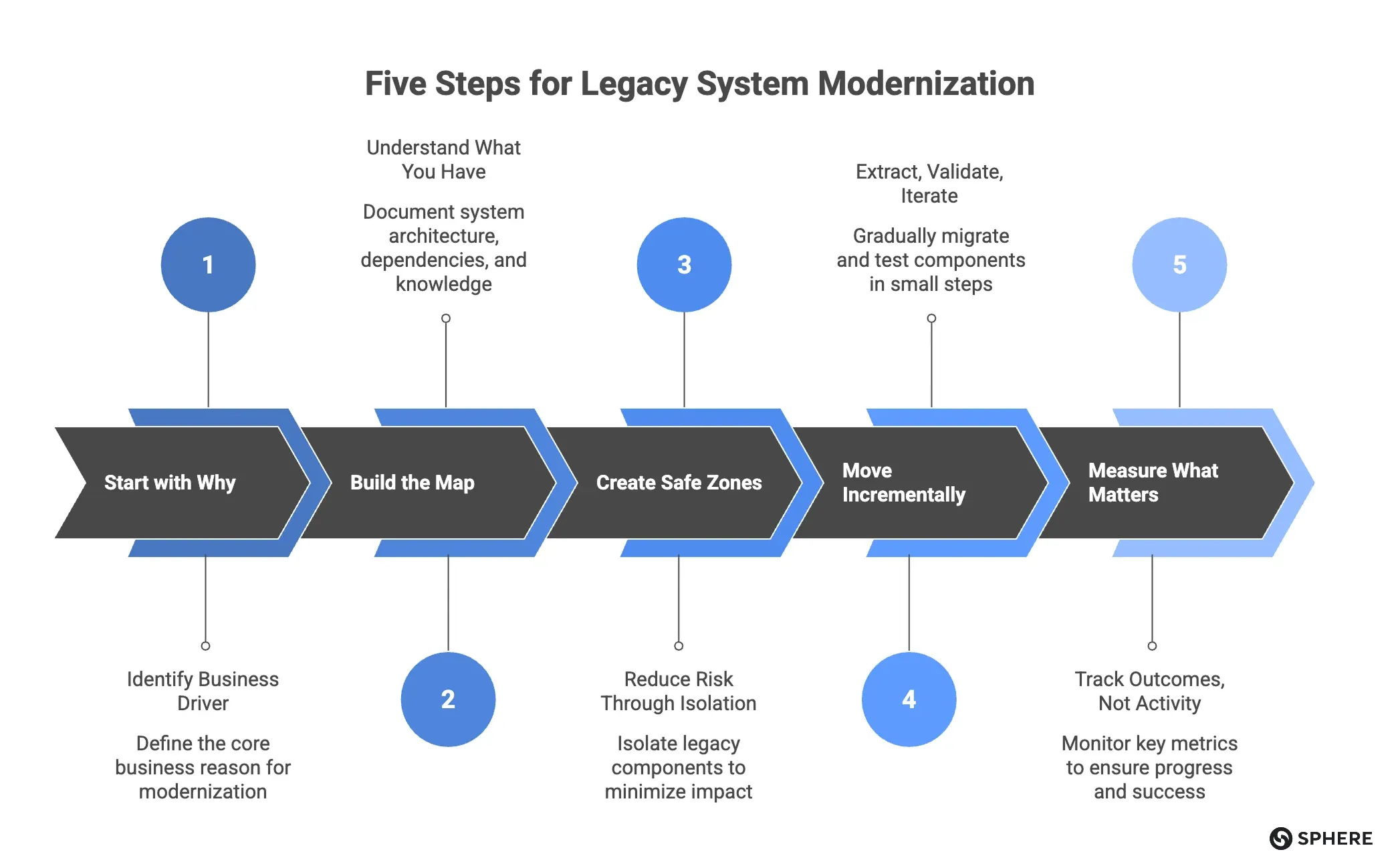
The framework in five steps:
- Start with why — identify the business driver
- Build the map — understand what you have
- Create safe zones — reduce risk through isolation
- Move incrementally — extract, validate, iterate
- Measure what matters — track outcomes, not activity
The system that built your business can become the foundation for what comes next.
Looking for help with legacy system modernization?
Contact Sphere to match the approach to your organization's specific constraints, capabilities, and business objectives.
Frequently Asked Questions
Part of
Related posts

Healthcare and life sciences organizations reach a turning point where legacy infrastructure, siloed workflows, and fragmented data can no longer support the pace of change. True transformation comes from strengthening the foundation: modernizing core systems, building integrated architectures, and aligning people around a clear strategy. Companies that invest in clarity, robust infrastructure, and disciplined execution unlock sustainable innovation and long-term resilience — without silos, shortcuts, or wasted momentum.
