


Technical Due Diligence for Startups: A Checklist
Date Published
Reading time
15 minIn this article
- Technical Due Diligence Defined
- Who Conducts A Startup Technical Due Diligence?
- When Do You Need A Startup Technical Due Diligence?
- What Investors Focus On at Each Stage
- Technical Due Diligence Checklist Startup Ideas
- Core Technical Elements
- Code Quality & Development Practices
- Security & Compliance (Critical in 2025)
- Infrastructure & Scalability
- AI/ML Specific (If Applicable)
- Business & Competitive Analysis
- How to Prepare for Startup Technical Due Diligence
- Preparation Timeline
- Red Flags That Kill Deals
- What To Expect From A Startup Technical Due Diligence Evaluation
- What Happens After Startup Technical Due Diligence?
- Real-World Impact: Why This Matters
- Get Expert Due Diligence Support with Sphere
Every tech startup needs investment to grow its business. But no experienced investor will risk their capital without due diligence. This is why startup technical due diligence is important.
Before you get to your pitch deck, you need to know your startup inside and out. It is essential to understand each line of code, your market position, challenges to overcome, and your long-term vision. Many companies find this difficult to complete because of daily work demands and lack of resources. However, a technical due diligence checklist startup guide can help you get started.
The stakes are high:
Technical issues discovered during due diligence can reduce your startup's valuation by up to 20%, and nearly 60% of investment deals fall through due to problems uncovered in the technical review. But with proper preparation, technical due diligence becomes your competitive advantage rather than a barrier.
Here, we will cover everything you need to know to undertake a successful startup technical due diligence project.
Technical Due Diligence Defined
Technical due diligence evaluates a startup's:
- Product
- Technology
- Architecture
- Security & Compliance
- Finances
- Management
Investors conduct technical due diligence before a financing or M&A deal to guide their decision-making process.
A startup technical due diligence achieves several goals, including:
- Check the product's code quality in its current version
- Ensure the product and the technology organization can scale up
- Verify security measures and regulatory compliance meet industry standards
- Identify any red flags before investing in the startup
- Assess technical debt and infrastructure costs
Why It Matters More in 2025:
With the rapid adoption of AI/ML technologies, cloud-native architectures, and increasingly strict data privacy regulations, investors are scrutinizing technical foundations more carefully than ever before.
Who Conducts A Startup Technical Due Diligence?
Technical due diligence should begin with the startup long before they get an investor's attention. Unfortunately, most startup companies have limited time and team members to tackle technical due diligence internally, which makes this challenging.
The best practice is to build a habit of documenting everything as early as possible, such as:
- Diagrams
- Code backups
- Meeting minutes
- Invoices
- Security audit reports
- Compliance certifications
- Architecture decision records
- Plus many more operational functions
Keep this data in a centralized and accessible location, then use it when you need to prepare for your due diligence process.
That said, the startup technical due diligence itself depends on the size of your business and the type of investor. For example, a small startup may only need one-on-one meetings with an investor.
A bigger startup seeking a merger and acquisition deal with a corporate business will meet with a selected group of professionals. These typically include lawyers, accountants, technologists, and security experts that can help meet due diligence requirements. Investors may also hire third-party due diligence evaluators with the legal and technical expertise to understand your startup.
Note:
The information needing to be revealed during a startup technical due diligence is often very sensitive. Think of:
- Trade secrets
- Intellectual property
- Algorithms
- Forecasting data
- Commercial information
- Customer data and privacy practices
- Security vulnerabilities and mitigation plans
Consider signing a non-disclosure or confidentiality agreement with your potential investors before undertaking any technical due diligence engagements.
When Do You Need A Startup Technical Due Diligence?
The most common reason to begin a technical due diligence startup process is before a financial investment. The need for due diligence can be from an individual investor, private equity, or venture capital firm.
A startup may attract investment at any stage:
- Pre-seed: Trying out the market after completing product development
- Seed: The product meets the consumers' needs as intended
- Series A: A rapidly scaling, well-established product in the marketplace
- Series B+: A high-profile product with an established market niche
Note:
Your business may need due diligence if industry compliance regulations change or if there's a data breach because of cybercrime. Startups must always be ready for due diligence in case of any unexpected circumstances.
What Investors Focus On at Each Stage
The depth and focus of technical due diligence varies significantly depending on your funding stage:
Pre-Seed/Seed Stage:
Investors primarily want to know if you have a real product and whether your team can execute. They'll focus on your MVP functionality, founder technical competency, basic architecture decisions, and whether you have clear IP ownership. At this stage, having organized code and a scalable foundation matters more than perfect documentation.
Series A:
At this stage, investors ask tougher questions: Can your architecture handle 10x growth? Is your development velocity sustainable? They'll examine your testing practices, security measures, infrastructure costs, and whether you're accumulating technical debt faster than you can pay it down. Expect detailed code reviews and performance benchmarking.
Series B+:
Now investors want to see enterprise readiness. This means SOC 2 Type II certification, robust security features like SSO and audit logs, multi-region deployment capability, 99.9%+ uptime with clear SLAs, and a technical leadership team that doesn't depend solely on founders. Your technical sophistication needs to match your market ambitions.
<span data-mce-type="bookmark" style="display: inline-block; width: 0px; overflow: hidden; line-height: 0;" class="mce_SELRES_start"></span>
Technical Due Diligence Checklist Startup Ideas
Every company and investor are different. Therefore, there's no one-size-fits-all checklist for startup technical due diligence. However, there are some essential elements that each startup needs to prepare for due diligence.
Use the checklist below as a guide to building your company's personalized due diligence database.
Core Technical Elements
- Company team with clear roles and responsibilities
- Product design, features, and capabilities
- Startup technology stack and architecture
- Development approach, such as agile, scrum, kanban, or DevOps
- Deployment approaches, such as CI/CD, GitOps, progressive delivery
- System workflow diagrams
- System monitoring and notifications
- System automation and administrative tools
- Third-party SaaS inventory and integration dependencies
- Quality control and assurance processes
- Backup and disaster recovery processes
- IT best practices and infrastructure as code
Code Quality & Development Practices
- Test coverage percentage (investors typically look for 70%+ on critical paths)
- Code review process and standards
- Technical debt measurement and remediation roadmap
- Static code analysis results and trends
- Git workflow and version control practices
- Deployment frequency and lead time metrics
- Bug tracking and mean time to resolution (MTTR)
Security & Compliance (Critical in 2025)
- Data encryption at rest and in transit (TLS 1.3+, AES-256)
- Authentication protocols (MFA, SSO, OAuth 2.0)
- SOC 2 Type II certification status
- GDPR/CCPA compliance documentation
- Security audit and penetration testing reports
- Vulnerability management and patching schedule
- Incident response plan and security runbooks
- Access control policies (RBAC)
- Open source license compliance audit
Why This Matters:
A single security gap can kill a deal. Investors know that startups with poor security practices face not just technical risks but legal and reputational disasters. In 2025, security isn't optional—it's a baseline requirement.
Infrastructure & Scalability
- Cloud provider and multi-cloud strategy
- Current infrastructure costs and cost per user
- Scalability testing results and breaking points
- Database architecture and optimization strategy
- Caching implementation and CDN usage
- Auto-scaling configuration and thresholds
- Performance metrics (response times, throughput, uptime)
- Disaster recovery RTO/RPO targets
AI/ML Specific (If Applicable)
If your startup uses machine learning, artificial intelligence, or advanced data science, investors will dig deep into these areas:
- Data Quality & Sources: Where does your training data come from? How do you ensure quality and compliance?
- Model Performance: What are your accuracy, precision, and recall metrics? How do you validate models?
- Bias & Ethics: What measures prevent algorithmic bias? Do you have an AI ethics framework?
- Model Operations: How do you version, deploy, and monitor models in production?
- Data Pipeline: Can you demonstrate robust ETL processes and data lineage tracking?
- Explainability: For regulated industries, can you explain model decisions to auditors and customers?
Tech startup investors are already aware of AI/ML fields and will approach your business with extra caution. They know that poorly managed AI systems create massive technical debt and regulatory risk.
Business & Competitive Analysis
- Competitive analysis and technical differentiation
- Target audience analysis, such as customer profiles, demographics, and psychographics
- Product-market fit validation and metrics
- Customer acquisition costs and retention rates
- Current technical and security concerns, such as software deficiencies, vulnerabilities, and technical debts
- Current and future company needs, such as HR, platforms, hardware, and services
- Ongoing business challenges that need funding to resolve
How to Prepare for Startup Technical Due Diligence
It's always best to prepare for your startup technical due diligence before you meet potential investors. Make time in your business schedule to create a due diligence deck with the above checklist. Summarize your items on each slide, then fill in the details from your records.
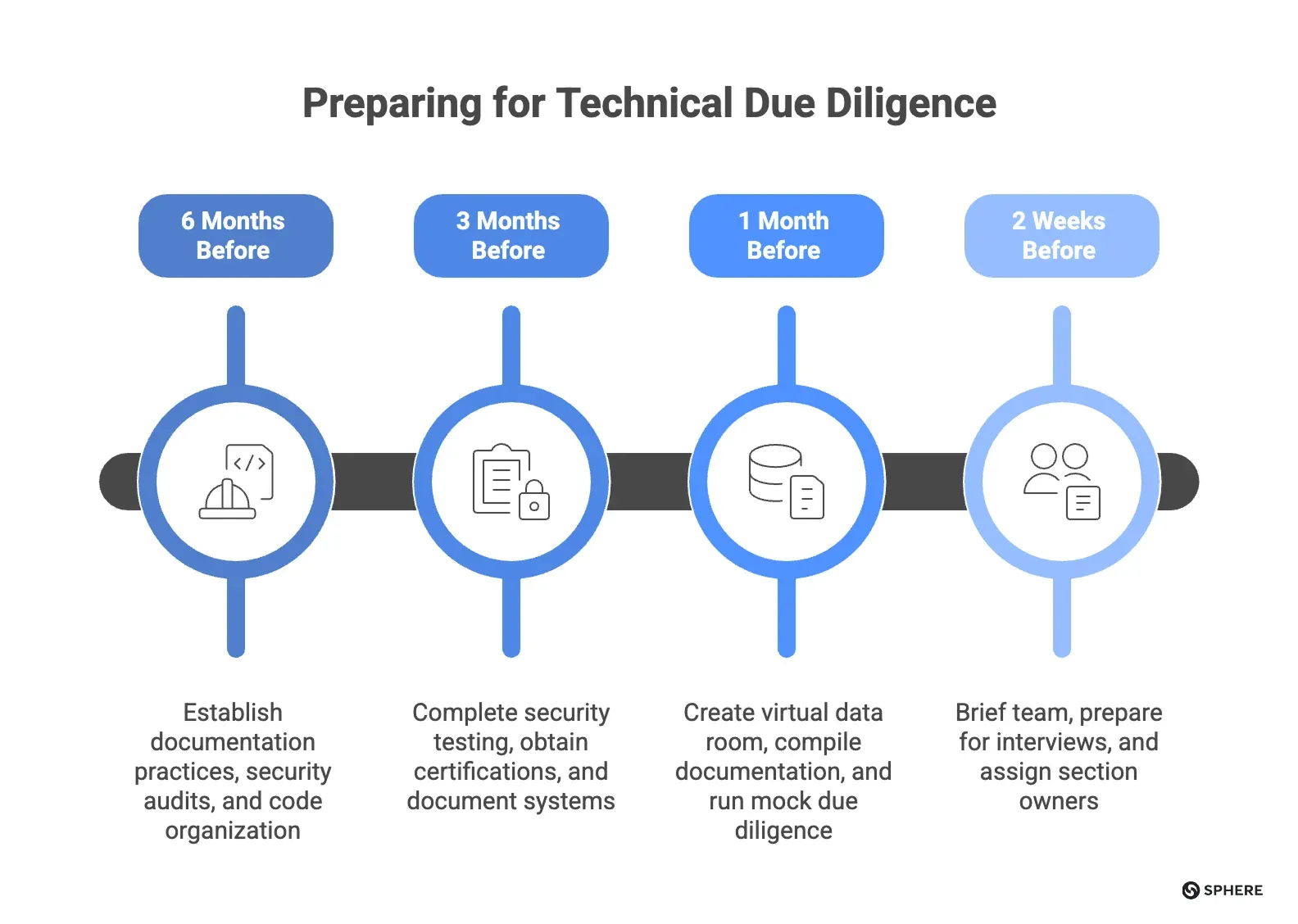
Preparation Timeline
6 Months Before:
Start early. Establish documentation practices, begin security audits, address major technical debt, and organize your code repositories. This is when you fix the big problems that would otherwise be deal-breakers.
3 Months Before:
Complete security testing, obtain necessary certifications like SOC 2, prepare comprehensive architecture diagrams, and document all systems and processes. If you're missing certifications, start the process now—they take time.
1 Month Before:
Create your virtual data room, compile all documentation, run an internal mock due diligence with advisors, and address any gaps you discover. Practice your technical presentations.
2 Weeks Before:
Brief your team on the due diligence process, prepare for technical interviews, review all materials for accuracy, and assign section owners who can answer detailed questions.
Here are some extra tips to prepare for your due diligence meeting:
Visual Communication:
Include images, videos, and graphics that help to explain your business and products to your investors. Architecture diagrams, performance dashboards, and demo videos are more compelling than text alone.
Know Your Numbers:
Be ready with specific metrics: test coverage percentages, uptime statistics, deployment frequency, customer growth rates, infrastructure costs, and technical debt estimates. Vague answers raise red flags.
Domain Expertise for Emerging Tech:
Know the facts about your startup if you're involved in bleeding-edge technology fields like machine learning, artificial intelligence, cryptocurrency, or blockchain. Investors in these spaces will have technical experts who can spot weaknesses quickly.
Design Your Presentation:
Design your due diligence presentation like an onboarding packet. You want to get your investors up to speed with your business as fast as possible, just as you would with a new team member. Make it scannable, logical, and comprehensive.
Continuous Updates:
Keep updating your technical due diligence checklist startup ideas as you lead up to the pitch day. The more comprehensive your business information, the better the chances of winning investor confidence.
External Validation:
Get external feedback from a trusted party, preferably with experience in startup technical due diligence. Use the input to improve your pitch deck and practice for the big day. Consider hiring a fractional CTO or technical advisor if you lack senior technical leadership.
Always Be Ready:
Keep some supporting materials with you, even for brief discussions with potential investors. These could be slides, high-level diagrams, deployment tools, and more. Create the impression that you're always ready for opportunities to grow your business.
Balanced Confidence:
Be confident but realistic about your startup and abilities. Clearly state your deficiencies and how the investor can help you overcome them without apologizing for your startup journey. Transparency builds trust; hiding problems builds suspicion.
Learn and Iterate:
Learn as much as possible from experience and polish your technical due diligence checklist startup pitch for future investment opportunities. Even if a deal doesn't close, the due diligence process teaches you what investors value most.
Red Flags That Kill Deals
Some issues are immediate deal-breakers. Avoid these at all costs:
Unclear IP Ownership:
If founders or contractors haven't assigned all code to the company, investors will walk away. This is non-negotiable.
GPL or Copyleft Violations:
Using restrictive open source licenses incorrectly can make your entire codebase legally toxic. Audit your dependencies carefully.
No Security Testing:
If you've never conducted penetration testing or vulnerability assessments, investors assume you're a breach waiting to happen.
Missing Compliance:
Not having required certifications (GDPR, SOC 2, industry-specific) shows either ignorance or negligence.
Single Point of Failure:
If only one person understands critical systems, what happens when they leave? Investors see this as catastrophic risk.
Unscalable Architecture:
If your system would require a complete rebuild to handle 10x growth, investors question your technical judgment from day one.
Poor Documentation:
No architecture diagrams, no runbooks, no code comments means knowledge lives only in people's heads. This makes your startup nearly impossible to value accurately.
The Cost of Poor Preparation:
Startups with disorganized code spend 30-40% more on bug fixes and maintenance. Nearly 40% of startups lose their first major customers due to performance issues. These aren't just technical problems—they're business problems that directly impact your valuation and fundraising success.
What To Expect From A Startup Technical Due Diligence Evaluation
So far, we understand that startups need to be pitch-ready to find funding opportunities. However, investors come in all types, and you can never know whom you'll encounter for your startup technical due diligence meeting.
Be ready to meet some of these due diligence professionals:
Mastermind:
This evaluator is very knowledgeable in all areas of tech startup investments and M&A. This is a valuable quality, but it might mean they're hard to please. The mastermind will need convincing since they believe they know better about your business and needs than you do. Come prepared with data and be ready to defend your technical decisions with solid reasoning.
Prosecutor:
This evaluator focuses on the details rather than your startup's bigger picture. The prosecutor often reveals elements about your due diligence preparation that you may have missed. However, they will not let go of the nitty-gritty until you fully resolve them. Don't try to gloss over problems—address them head-on with remediation plans.
Bookkeeper:
This evaluator pays more attention to your budget and bottom line than your startup's technical elements. The bookkeeper is great at discovering new ways to make your startup profitable, but they may not fully understand what your startup is truly about. Help them connect your technical investments to business outcomes.
Wildcard:
This evaluator meets with your startup through a referral rather than any official investment avenue. The wildcard has the resources your business needs. Still, they may be the perfect mix of technical and financial knowledge or clueless about the startup world. Either way, you must win this investor, so always be ready for anything.
Note:
A startup technical due diligence is a chance for you to evaluate your potential investors as well. How they carry out the meetings, the questions they ask, and their general attitude will help you decide whether they are a worthy partner for your company. You want the best-fit investors for your startup for long-term success, not just the additional money they bring to the table.
Pay attention to how they treat your team during technical interviews. Do they ask thoughtful questions or try to intimidate? Do they understand your technical decisions or dismiss them without consideration? These signals tell you what kind of partner they'll be after the investment.
What Happens After Startup Technical Due Diligence?
As you already know, the tech startup world is highly competitive, and investors have plenty of businesses to evaluate based on due diligence. After your meeting, the evaluator creates a detailed due diligence report about your startup. This report identifies all your business assets, potential risks and flaws, and the overall value of your systems. Based on this report, the evaluator may ask for a technical follow-up or additional discussions about your company.
If things go well:
The investor will move forward with term sheet negotiations. Your strong technical foundation may even give you leverage to negotiate better terms—investors pay premiums for de-risked opportunities.
If issues are found:
Expect a remediation list. Some items will be deal-breakers that must be fixed before investment. Others might reduce your valuation or become post-investment requirements. Be prepared to discuss realistic timelines and costs for addressing each concern.
Prepare for rejection too.
Ask for details about why your due diligence report didn't meet their expectations. Use the experience to improve your startup's technical due diligence posture. Every "no" makes you stronger for the next "yes."
Real-World Impact: Why This Matters
Consider these scenarios from actual due diligence processes:
Success Story:
A Series A fintech startup spent three months preparing for due diligence. They obtained SOC 2 certification, documented their security practices thoroughly, and addressed technical debt proactively. When investors arrived, they found a company that took security seriously. The startup not only closed their round but secured a 15% higher valuation than initially expected.
Cautionary Tale:
A promising SaaS company lost 20% of their expected valuation when due diligence revealed their database architecture couldn't scale beyond current user levels. What investors saw as a three-month, $200K problem became a negotiating point that cost the founders millions in dilution.
Near Miss:
An AI startup initially failed due diligence because they couldn't demonstrate data lineage or explain their model's decisions. They took six months to implement proper MLOps practices, document their training data sources, and build explainability tools. When they returned to investors, they closed their round successfully.
The lesson? Technical due diligence isn't just a hurdle—it's a forcing function that makes your startup better.
Get Expert Due Diligence Support with Sphere
A startup technical due diligence process presents many benefits for your company, regardless of its outcomes. It validates your startup, refines your business goals, and makes you more aware of financial and data security risks.
Whether you’re testing the waters or already established in the marketplace, a startup technical due diligence process can accelerate your business growth exponentially.
At Sphere, we want you to be ready to get the investor funds you deserve to drive your startup forward. Our consultants help you prepare for your technical due diligence process to make your company investor-ready.
Reach out to an expert today.
Part of
More to read

Mergers and acquisitions (M&A) have become the catalyst of business growth. But, a successful M&A requires far more than getting the financial numbers right


Many surprises come up during M&A technical due diligence. It’s always better to find them—and manage them appropriately—sooner than later.