Story · AI Knowledge Systems · Life Sciences & GxP Facilities
The Question That Used to Take 45 Minutes Now Takes 9 Seconds — Even Inside a Cleanroom
The Old Way: Tribal Knowledge in a Zero-Tolerance Environment
The client provides cleanroom and GxP facility solutions to pharmaceutical, biotechnology, and medical device companies. Keeping a regulated cleanroom environment in spec depends on technicians finding the right answer fast — but in a GxP setting, “fast” has always competed with “documented and defensible.”
A differential pressure alarm trips in a Grade C cleanroom suite at 2am. The on-call technician needs to know which AHU serves that suite, what its validated setpoints are, and whether this is a deviation that could put a batch at risk. They pull up a controlled-document system, scroll past scanned validation protocols with names like “HVAC_VAL_REV4_FINAL.pdf,” and start piecing it together.
Across every site, this was the routine:
Excessive time locating equipment specs, calibration records, and validated procedures across controlled-document systems and shared drives
Heavy dependence on tribal knowledge held by senior facilities engineers — who know which AHU really serves which suite
Slow, inconsistent onboarding for new technicians who must learn cleanroom classifications, critical utilities, and panel hierarchies under regulatory scrutiny
Audit and inspection prep risk: scrambling to pull documentation evidence the moment an auditor asks “show me”
The mandate: give technicians immediate, trustworthy answers — with every answer traceable back to the current-revision, approved source documentation regulators expect to see.
The New Way
Same alarm, different shift. The technician opens the assistant and asks one line: “What AHU serves Suite 204 and what’s the differential pressure setpoint?” Nine seconds later, they have the answer — pulled straight from the current validated HVAC drawing and the suite’s environmental monitoring SOP, with a citation back to both.
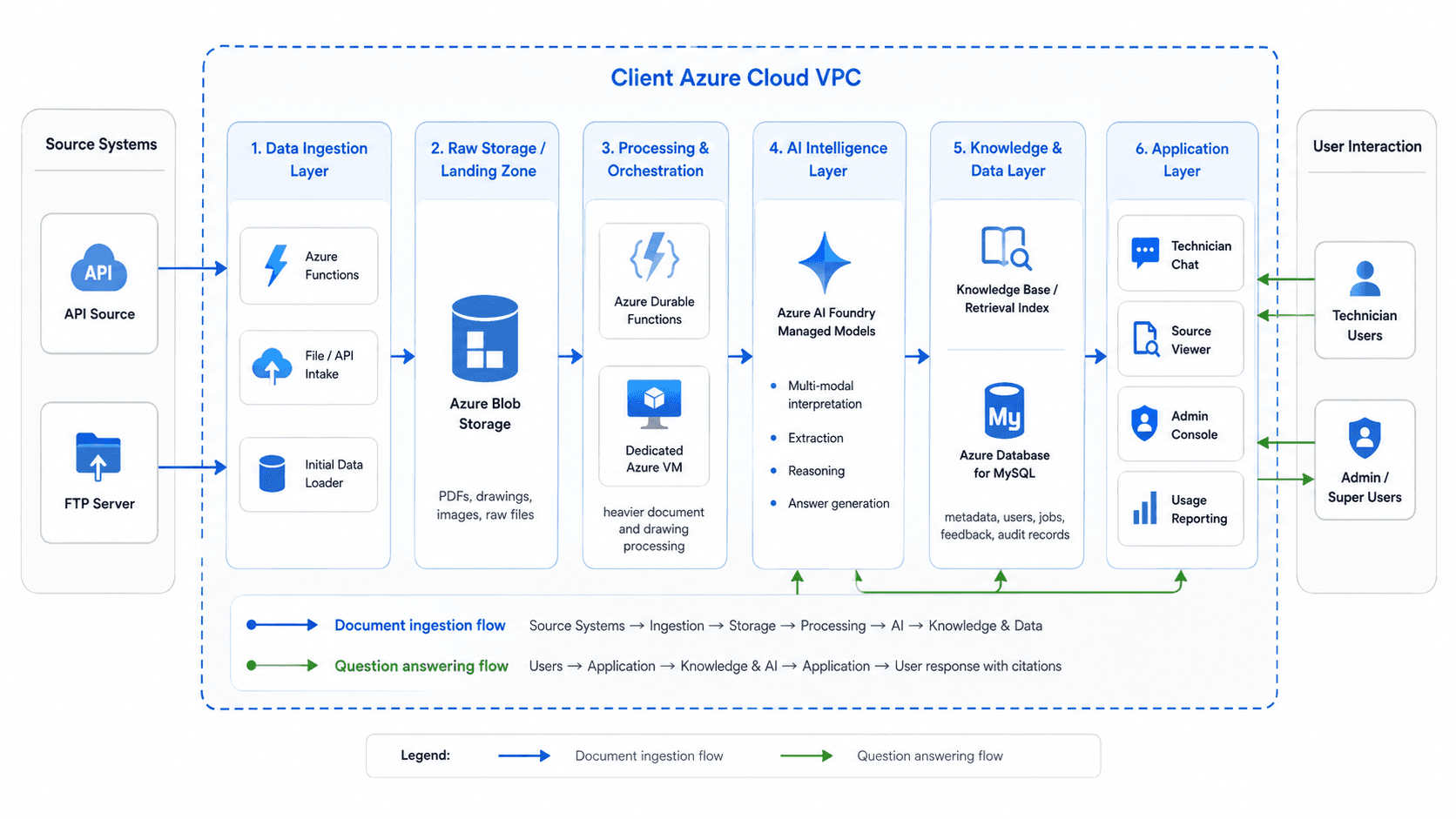
Sphere designed and delivered an AI-Powered Technician Knowledge Assistant combining document intelligence, computer vision, retrieval-augmented generation (RAG), and workflow automation in a single technician experience — built to deploy inside the client’s existing cloud environment, with the data residency and access controls a regulated quality system requires.
How It Was Built
Four layers, deployed in sequence, each one building on the last — and each one deployable inside any cloud environment the client already runs.
01. Document & Drawing Intelligence
An AI extraction engine processes HVAC validation drawings, electrical schedules, scanned diagrams, and SOPs — automatically correcting orientation, enhancing quality, extracting structured knowledge, mapping equipment-to-suite relationships, and preserving source traceability for every insight.
02. AI-Powered Knowledge Layer
Extracted content feeds a centralized repository with vector-based semantic search, context-aware retrieval, equipment metadata relationships, and governance controls — deployed natively inside the client’s own cloud environment and tenant, whether that’s a major public cloud or on-premises infrastructure.
03. Conversational Assistant
Technicians ask questions the way they’d ask a senior engineer — about AHU and FCU assignments, breaker circuits, critical utility routing, and panel hierarchies. Every response is grounded in current-revision documentation with source citations attached.
04. Integrated Ticketing — One Workflow
Sphere integrated the assistant with the client’s enterprise maintenance ticketing and quality systems, letting technicians create, view, and update work orders without ever leaving the assistant — eliminating system switching entirely.
Ask It Anything — If It’s In the Drawings, It Knows
Technicians query HVAC validation drawings, electrical panel schedules, and cleanroom floor plans for the specific suite — asking about AHU assignments, breaker circuits, critical utility equipment, and panel hierarchies in plain language.
Real technician queries from the field
AHU-7 serves Suite 204 — supply and return — maintaining ISO 7 classification. 📎 HVAC Validation Dwg M2.3 · AHU Schedule M0.2
FCU-3-08 supplies the Suite 3 gowning room, ducted from the Level 1 mechanical gallery. 📎 Mechanical Dwg M1.4 · FCU Schedule M0.2
Breaker 6 on Panel EPNL-L12 feeds the autoclave — a dedicated 60A circuit. 📎 Electrical Panel Schedule E4.1 · Equipment Schedule EQ-014
The WFI skid runs from Panel CP-2, breaker 4, on critical utilities. 📎 Electrical Panel Schedule E3.2 · Critical Utilities One-Line CU-001
MSB-2 feeds DP-2 (critical utilities distribution), which steps down to CP-2 and LP-2A through LP-2D across the suite. 📎 Electrical One-Line Diagram E0.1
What Would Faster Searches Be Worth to Your Team?
This engagement reduced technical search time by 60–80%. Use your own numbers to see what that range could mean for your facilities team.
The Outcomes
Following implementation, the client unlocked measurable operational improvements:
Reduction in time to find technical information
Increase in technician productivity
Reduction in mean time to repair
Reduction in new technician onboarding time
Reduction in ticket creation & update effort
Improvement in first-time fix rate
Increase in documentation utilization
Significant reduction in knowledge retention risk
Our newest technicians are finding answers faster than our veterans used to look them up from memory. That’s not only a productivity story — it’s a risk story we just solved.
Why Sphere
Sphere combines deep expertise across generative AI, document intelligence, enterprise search, knowledge management, cloud architecture, and systems integration — delivered with our Precision-Driven Engineering methodology and a speed-to-value engagement model. Every deployment runs inside your own cloud environment and tenant, whichever provider you’ve standardized on, with the governance and traceability that quality and compliance teams in regulated industries require.
Hear from
our clientsHear from our clients

Lee Ebreo
VP of Engineering at Credit Ninja
These things would not have been achievable if we did not build our own in-house system and if we did not partner with Sphere to help us achieve our goals.

Selah Ben-Haim
VP of Engineering at Prominence Advisors
Our experience with Sphere and their team has been and continues to be fantastic. We keep throwing new projects at them, and they keep knocking them out of the park (including the rescue of a project that was previously bungled by another vendor).

Ben Crawford
Senior Product Manager at Enova Financial
I would expect to be delighted. It's been a really positive experience, working with Sphere, and I would expect you to have the same.

Mark Friedgan
CEO at CreditNinja
Sphere consistently prioritizes the needs of their clients, demonstrating both agility and teamwork. As an offshore team, they have been an integral part of our organization and we plan to continue growing with them.

René Pfitzner
Co-Founder at Experify
Sphere provided excellent full-stack development manpower to augment our team and help push our product forward. They are easy to work with, tech-savvy and proactive.

Bruce Burdick
Chief Information Officer at Integra Credit
We've been working with Sphere and its excellent consultants since our founding. I've found that they are true partners in the success of our business.

Jemal Swoboda
CEO at Dabble
The resources and developers that Sphere Software provides are skilled and have the required technical expertise, but more importantly, they have helped us build a culture of excellence within our team.

Arthur Tretyak
Founder and CEO at IntegraCredit
With Sphere, we were able to migrate in half the time it would take to train an additional FTE… and for a fraction of the cost. Our experience with Sphere has been exceptional.
Lee Ebreo
VP of Engineering at Credit Ninja
These things would not have been achievable if we did not build our own in-house system and if we did not partner with Sphere to help us achieve our goals.
Selah Ben-Haim
VP of Engineering at Prominence Advisors
Our experience with Sphere and their team has been and continues to be fantastic. We keep throwing new projects at them, and they keep knocking them out of the park (including the rescue of a project that was previously bungled by another vendor).

TOP AI CODE GENERATION COMPANY UNITED STATES 2025

TOP AI TEXT GENERATION COMPANY FLORIDA 2025

TOP APP DEVELOPMENT COMPANY MANUFACTURING 2025

TOP ARTIFICIAL INTELLIGENCE COMPANY UNITED STATES 2025

TOP CHATBOT COMPANY UNITED STATES 2025

TOP RECOMMENDATION SYSTEMS COMPANY UNITED STATES 2025

GLOBAL RECOGNITION AWARDS 2026

BEST IN AI FOR DOCUMENTATION VALIDATION 2026
BEST IN AI POWERED INVOICE AUDITING 2026
GLOBAL TECH WINNER 2026
MOST INNOVATIVE TECHNOLOGY CONSULTING FIRM 2026
GLOBAL GENERATIVE AI AWARD 2026 WINNER
See What Your Documentation Could Do
Frequently Asked Questions
A conversational platform that transforms HVAC validation drawings, electrical panel schedules, SOPs, calibration records, and maintenance procedures into searchable, citable knowledge. Technicians ask natural-language questions and receive answers grounded in approved source documentation via retrieval-augmented generation (RAG).
Anything traceable to the underlying documentation — AHU and FCU assignments, breaker and panel circuits, critical utility routing, panel hierarchies, calibration due dates, and cleanroom classification setpoints. See real examples above in “Ask It Anything.”
Yes. Every answer is grounded in and cited to the current-revision, approved source document, which supports data integrity expectations and makes it faster to produce documentation evidence during an inspection or audit.
Retrieval-augmented generation grounds every response in retrieved enterprise documents rather than the model’s general knowledge. Each answer includes citations back to the source drawing, SOP, or procedure, so technicians can verify the information before acting on it.
Yes. Sphere’s extraction engine uses document intelligence and computer vision to correct orientation, enhance quality, and extract structured knowledge from scanned engineering drawings, validation protocols, and legacy controlled documents.
No. Sphere deploys natively inside your own cloud environment and tenant — Azure, AWS, Google Cloud, or on-premises infrastructure — with enterprise-grade security, governance, audit logging, and access controls.
Sphere’s fixed-scope, speed-to-value model typically delivers a working pilot on a priority document set within weeks, then scales ingestion and integrations (including CMMS/QMS) from there. Book a free assessment for a timeline based on your documentation landscape.
Your Technicians Are Searching. They Should Be Fixing.
Find out what an AI-powered knowledge assistant would look like on your documentation — in a free 30-minute working session with Sphere’s AI engineering team.
Organizations around the world trust us