Topic hub
Data & Analytics
Data engineering, governance, modernization, and analytics — building the trustworthy data foundation that AI and decision-making depend on.
73 articles in this topic.
- 300+
- Satisfied clients
- 21+
- Years of experience
- 88%
- Client retention
- 600+
- Projects delivered

Digital Twins: Use Cases, Technologies, and More
See real digital twin use cases across manufacturing, aerospace, and healthcare, the tech behind them, and how Sphere builds custom digital twin solutions.
Read the article
Enterprise Data Services: A Complete Guide to Data-Driven Business Transformation
A practical guide to enterprise data services: integration, governance, security, and analytics, with benchmarks to help you build a data-driven organization.
Read the article
Engineering Data Management Without The Headaches
What engineering data management (EDM) software does, how it differs from PDM/PLM, plus best practices, tool comparisons, and case studies for engineering teams.
Read the article
Reranking and RRF: Getting the Right Chunk to the Top
An AI answer is only as good as the chunk it was built from, and the right chunk isn't always the one a single search method ranks first. Reciprocal rank fusion and reranking are how you get the best evidence to the top before the model ever sees it.
Read the article
Source of Truth, Not Source of Leaks: Governing What AI Is Allowed to Read
An AI assistant pointed at your company knowledge is either your best source of truth or your worst source of leaks, and the deciding factor is one thing: whether you govern what it's allowed to read. Access governance is the precondition, not the polish.
Read the article
ACLs That Survive a Resync: Keeping Connector Permissions Correct
The hard part of permission-aware AI isn't checking access once — it's keeping the source system's permissions correct as connectors re-sync. A naive integration can quietly turn a restricted document into an open one.
Read the article
Connecting Slack, SharePoint, Salesforce, and Drive Without Leaking Scope
Connecting your AI to every system of record is where enterprise value lives — and where governance most often breaks. Governed ingestion means pulling content from Slack, SharePoint, Salesforce, and Drive while carrying each source's permissions with it.
Read the article
The Over-Sharing Trap in Enterprise Search, and How to Close It
An AI assistant is a confused deputy: it acts with more access than any single user should have. Point it at your documents without per-user permission enforcement and it becomes an over-sharing engine. Here's the trap, and how to close it.
Read the article
Our Ledger Said It Had Been Tampered With. It Hadn't.
Our tamper-evident general ledger started reporting broken entries. Nobody had touched them: the same exchange rate was hashed one way on the way in and another on the way out. A control that raises a false alarm is not partially working — it is harmful.
Read the article
BYOK, Properly: Bring-Your-Own-Key Across Every Model in One Boundary
Bring-your-own-key is often a checkbox that means little. Done properly, it means your keys stay in your custody, work across every model provider, and never make any single vendor the place your data or your leverage lives.
Read the article
Self-Hosted vs API-Only AI: A Real Cost and Control Comparison
API-only AI is faster to start; self-hosted gives you control you may be required to have. This is the honest comparison — on cost, control, compliance, and continuity — without pretending one answer fits everyone.
Read the article
Data Residency for AI: Keeping Prompts and Embeddings In-Region
Data-residency rules don't stop applying because the processing is AI. Prompts, embeddings, and the records of both are personal data with a location — and keeping them in-region is a requirement most hosted AI quietly violates.
Read the article
Air-Gapped AI: Running a Governed Assistant With No Data Leaving the VPC
For the most sensitive environments, the only acceptable amount of data leaving the boundary is none. Air-gapped AI runs inference, retrieval, and governance entirely inside your own perimeter — a governed assistant that never phones home.
Read the article
Sovereign AI for Regulated Industries: The Control-Plane Argument
For a regulated institution, renting AI as a black box you can't inspect, govern, or fully account for is a structural problem. Sovereign AI — owning the boundary the AI runs in — is the alternative, and it's an argument about control, not hosting.
Read the article
Conformity Assessment for AI: What "Ready" Looks Like Before the Audit
A conformity assessment checks that a high-risk AI system meets its requirements before it goes to market. Most of the pain is producing the evidence. Here's what 'ready' looks like — and how to be in that state before the assessor arrives.
Read the article
Why "We Log Everything" Is Not the Same as Auditable AI
Logging captures what happened. Auditable means someone else can verify it, unaltered, in scope. The four properties that separate a pile of logs from AI you can actually audit — and why most stacks have only the first.
Read the article
From Annual SOC 2 Scramble to a Continuous Query
Periodic security and compliance audits turn into a multi-week evidence scramble because the evidence is gathered after the fact. When controls record their own operation continuously, readiness becomes a standing query.
Read the article
The Audit Binder Is Dead: Continuous Evidence for AI Decisions
Compliance teams still assemble evidence into a binder for a point-in-time audit. AI decisions happen continuously, and the gap between the binder and reality is where enforcement lives. Continuous evidence closes it.
Read the article
eDiscovery for AI: Producing an AI Conversation That Holds Up
When an AI interaction becomes evidence in a dispute or investigation, you have to produce it in a form that holds up — complete, unaltered, and verifiable by someone who doesn't trust you. Here's what that takes.
Read the article
ISO 42001 vs the EU AI Act: What Overlaps and What Does Not
ISO 42001 and the EU AI Act are often mentioned together and are genuinely different things: one is a voluntary management-system standard, the other is law. Here's where they overlap, where they don't, and why one set of controls can serve both.
Read the article
One Ledger, Four Readers: Scoping Disclosure to Each Audience
A complete AI record raises a fair objection: not everyone should see everything. The answer is scoped disclosure — one tamper-evident ledger, four different views, each showing a reader exactly what they're entitled to and no more.
Read the article
RAG for Healthcare: HIPAA-Compliant AI Knowledge Systems
Clinicians trust sources, not summaries — which makes RAG a natural fit for healthcare and its hardest test. HIPAA safeguards, de-identified ingestion, and human review have to be architecture, not disclaimers.
Read the article
Institutional Memory AI for Financial Services: Domain Intelligence for Compliance-Heavy Organizations
In financial services the cost of a wrong answer is regulatory, reputational, and customer-trust cost — the answer has to be accurate, current, citable, and auditable. A Domain Intelligence Engine configured for the firm's compliance posture delivers governed answers: domain ontology, domain filters at retrieval, veteran-verified calibration, and a five-element audit trail on every query.
Read the article
A Model Registry a Regulator Can Read
You can't govern AI you can't list. A model registry catalogs every model you run — its purpose, data, limits, version, and owner — in a form a regulator can actually read, and keeps it current instead of letting it rot in a spreadsheet.
Read the article
A DPIA That Stays Current: A Living Data-Protection Impact Assessment
A data-protection impact assessment written in Word is accurate the day it's signed and drifting from reality by the next sprint. When the processing it describes is captured by the runtime, the DPIA can be a query against what's actually happening.
Read the article
RAG for Financial Services: Compliance-First AI for Banking and Insurance
In banking and insurance the question isn't only whether a RAG system works — it's whether you can explain it to an examiner. Auditability, permission control, and model risk management have to be architecture, not afterthoughts.
Read the article
Technical Documentation by Construction: The Annex IV File That Writes Itself
The EU AI Act's Annex IV technical file is usually written by hand, after the fact, from memory. Much of it can instead be assembled from what the system already records — turning documentation into a byproduct rather than a project.
Read the article
Article 50 in Practice: Auto-Generating the AI Disclosure Block
Article 50 asks you to tell people when AI is in the loop. A policy that depends on someone remembering will have holes; a disclosure the system emits wherever AI was used will not — and it proves itself.
Read the article
The 30-Day Statutory Clock, Answered in Ninety Seconds
A data-subject request starts a statutory clock, and for AI decisions most organizations spend it scrambling across systems. When the record is complete and queryable, the same request becomes a lookup instead of a race.
Read the article
Answering an Article 22 Complaint: "What Did Your AI Decide About Me?"
Under GDPR Article 22, a person subject to an automated decision can demand an explanation. Most organizations can't answer truthfully or quickly. Here's how a complete, verifiable record turns that dreaded request into a query.
Read the article
Signed Decision Receipts: Letting Anyone Verify an AI Outcome Offline
A signed decision receipt is a portable, cryptographically verifiable record of what an AI decided and why. Anyone holding it can check it against a published key — offline, with no access to your systems and no need to trust you.
Read the article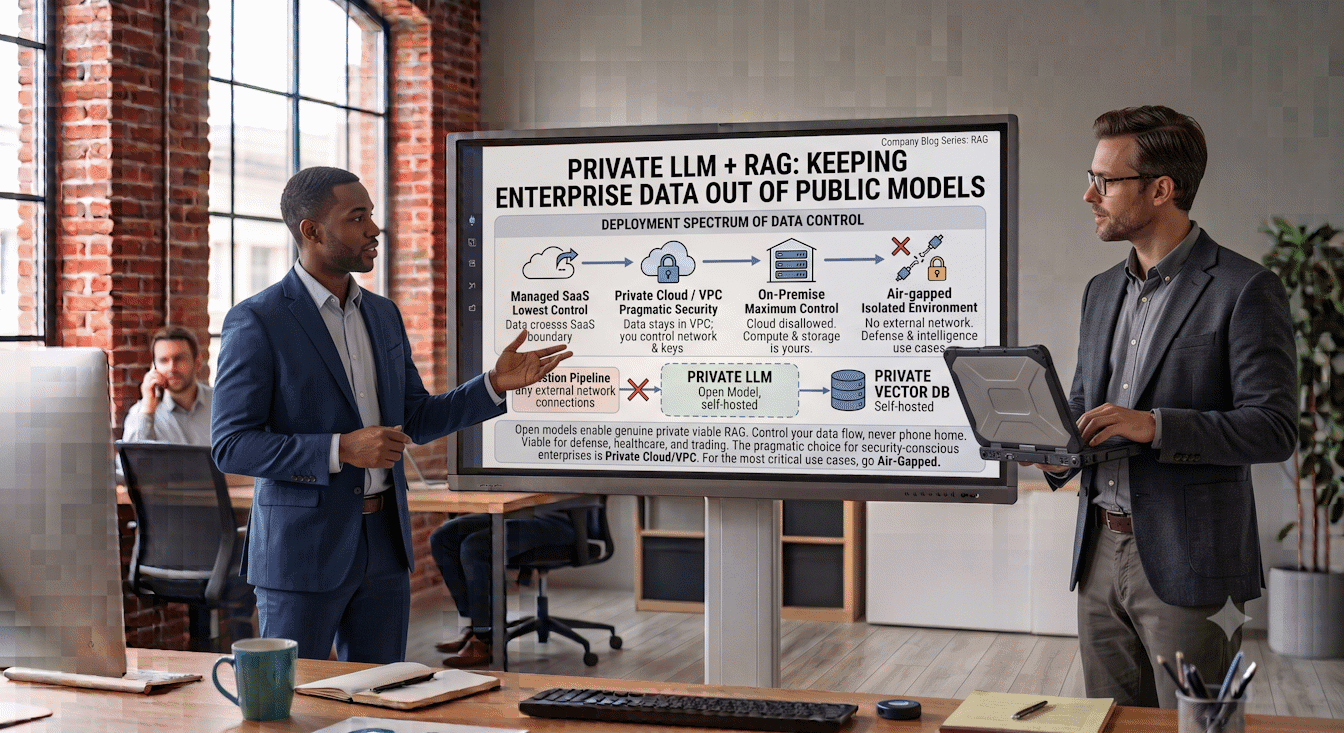
Private LLM + RAG: Keeping Enterprise Data Out of Public Models
For a defense contractor, a hospital, or a bank's trading desk, the prompt is the sensitive data — "send it to OpenAI" is a non-starter. Here's the architecture for a fully private RAG stack: a self-hosted open model, a self-hosted vector database, and in-boundary ingestion, with nothing routed through a third-party LLM — plus how to decide how far down the privacy spectrum (VPC, on-prem, air-gapped) you actually need to go.
Read the article
Provenance for Every Answer: Citation, Retrieval, and Redaction on the Record
An AI answer without provenance is an opinion. With it, every answer carries what it was based on — which sources, under what access, with what redactions — so a decision can be traced back to its inputs.
Read the article
The High-Risk AI Obligations Checklist You Can Actually Execute
The EU AI Act's obligations for high-risk AI systems read like a compliance essay. This checklist does the opposite: it maps each obligation to a runtime control you can operate and demonstrate — not a document you write once and hope no one tests.
Read the article
Column-Level Encryption for AI Data: Sealing What the Model Touches
Full-disk encryption is table stakes and also nearly useless against the threats that actually matter — it protects against a physically stolen drive and does nothing once the database is mounted and readable. For the sensitive fields an AI system stores, you want something stronger: encryption at the level of the individual column, so the value is sealed even from someone with broad access to the store.
Read the article
Governing Shadow AI Without Banning It
Shadow AI — employees using unsanctioned AI tools with company data — is the governance problem every organization has and few admit. The instinct is to ban it. But bans don't stop the usage; they hide it, pushing sensitive data into consumer tools you have no visibility into. The move that actually works is to make the sanctioned path more useful than the shadow one.
Read the article
Permission-Aware RAG: Why Your AI Must Forget What the User Can't See
The fastest way to turn a helpful AI assistant into a data breach is to let it retrieve without checking permissions. If your assistant reads every document and then answers everyone, it will eventually tell someone something they were never allowed to see. Permission-aware retrieval closes that gap: an answer can only ever be built from sources the person asking is already entitled to open.
Read the article
One Privacy Boundary, Six Capabilities: The Control-Plane Thesis
Most enterprises assemble AI from separate tools — a chat vendor, a vector database, a security add-on, a compliance spreadsheet. The control-plane thesis is that chat, memory, security, compliance, audit, and carbon accounting should share one privacy boundary and one record. When they don't, the gaps between them are where your risk lives.
Read the article
What a Hash-Chained AI Ledger Actually Proves to a Regulator
A hash-chained AI ledger is an append-only record where each entry is cryptographically linked to the one before it — so any change to history is detectable. To a regulator, that proves three things a pile of logs cannot: that a record exists, that it hasn't been altered, and that a specific decision happened exactly as shown.
Read the article
Wiring Claude Directly Into NetSuite for Analytics? Here's the Expensive Mistake Hiding in That Shortcut
A few hard-won lessons from sitting in rooms with CFOs and controllers who tried the fast way first.
Read the article
CSRD AI Emissions Reporting: A Practical Step-by-Step Guide for Sustainability Teams
You need to report the carbon footprint of your organisation's AI usage under ESRS E1. Your AI vendors provide none of the data. Here is exactly how to gather it, calculate it, and produce an auditable disclosure — with or without automated tracking.
Read the article
CSRD and AI Carbon Emissions: What 50,000 EU Enterprises Are Required to Report
The Corporate Sustainability Reporting Directive requires disclosure of AI carbon emissions under ESRS E1. Ten of thirteen major AI vendors provide zero environmental data to customers. Here is what the regulation requires and how to build the numbers without vendor cooperation.
Read the article
The Rise of Physical AI: What Actually Works and What You Need to Know
Physical Intelligence raised $600 million at a $5.6 billion valuation for software that acts as a universal brain for robots. The hype is real, but so is the gap between lab demos and production reality. We break down what actually works in Physical AI today, the three hard problems nobody's solving yet, and why investors are betting billions on robot brains instead of robot bodies.
Read the article
LLM Observability: Jagged AI, Real Economics, and the Work of Making It Real
LLMs aren’t “bad” or “overhyped” – they’re jagged: impressive on benchmarks, brittle in real workflows. This article explains why that gap shows up as real cost in production, and why LLM observability is the foundation for turning capability into predictable throughput. You’ll see how observability, evaluation-driven development, guardrails, RAG, and agentic checkpoints work together to make GenAI reliable, governable, and worth scaling.
Read the article
AI Memory vs. Context Understanding: The Next Frontier for Enterprise AI
Most enterprise AI failures in 2025 had nothing to do with model quality. They failed because the systems didn’t understand context — who the user was, what problem they were solving, and how information related across departments and data silos. Adding more “memory” didn’t fix it. Persistent chat logs and vector databases only stored facts; they didn’t create meaning. The next generation of enterprise AI must treat context as a living system: continuously curated, governed, and shared across every model and agent in the organization. When context becomes a core design principle, AI stops guessing and starts reasoning. It stops recalling text and starts connecting knowledge. That’s when ROI appears — not from bigger models, but from smarter architectures that integrate data, identity, and governance into every answer.
Read the article
Predictive Maintenance in Manufacturing: IoT Data to AI-Driven Cost Savings
Predictive maintenance is no longer a theory — it’s how modern manufacturers are keeping production lines running. By combining IoT sensor data with AI analytics, companies can predict equipment failures before they happen, cutting unplanned downtime by up to 50% and reducing maintenance costs by a quarter. In this article, Sphere explains how to move from reactive fixes to proactive intelligence — and what it takes to turn machine data into measurable ROI.
Read the article
Contact Center Transformation and Modernization: From Cost Center to Loyalty Driver
Every interaction in your contact center shapes customer trust. Too often, companies treat it as a cost to cut rather than a strategic driver of loyalty and growth. This article explores how modernization—powered by AI, cloud migration, CRM optimization, and data unification—turns your contact center into a competitive advantage.
Read the article
Automated Business Intelligence: How to Move Beyond Dashboards
Most dashboards end up ignored. The future of business intelligence is not about prettier charts, but about real-time decision feeds, AI copilots, and automated actions that drive results. This article explores how companies are moving from being simply data-driven to truly data-powered.
Read the article
Successful AI Adoption for Your Organization
AI succeeds when people trust it, understand it, and see it improve their work. This guide outlines Sphere’s approach to enterprise AI adoption—pairing domain leaders with data talent, making systems explain themselves, and focusing on the last mile that differentiates your business. From clear rules to partner-led delivery, learn how to build AI solutions that teams embrace and results that last.
Read the article
How to Prepare Your Healthcare Data for LLMs (Without Breaking Compliance)
Large language models hold transformative potential for healthcare — from clinical summarization to real-time risk detection — but only if used responsibly. In this guide, we outline a step-by-step roadmap to prepare your healthcare data for LLM use without risking compliance violations. From tackling data silos to securing PHI, and from model fine-tuning to governance best practices, discover how to move from fragmented data to safe, AI-ready infrastructure. Plus, learn how Sphere Data Agent helps organizations deploy LLMs up to 3x faster while staying HIPAA-compliant.
Read the article
Synthetic Data: Fake With Benefits
Synthetic data promises better privacy, faster experimentation, and scalable AI training — but only when done right. At Sphere, we’ve seen that the real differentiator isn’t the generation technique itself, but how and where it’s applied. In this article, we unpack what makes synthetic data valuable, when it works best, and what to look for in a partner.
Read the article
Digital Transformation: Tech Investments for 2025
Leon Ginsburg, CEO at Sphere, shares his perspective on how 2025 will be a defining year for digital transformation. From bridging talent gaps to leveraging AI-driven solutions, Ginsburg highlights the critical factors shaping success, the risks of falling behind, and why ROI-driven tech investments will set leaders apart from laggards.
Read the article
Migration from Dropbox to Microsoft 365: A Journey for Enterprises
Is your team juggling disconnected tools for collaboration, storage, and communication? Discover how migrating from Dropbox to Microsoft 365 can revolutionize your workflows with integrated tools, enterprise-grade security, and unmatched scalability. Say goodbye to siloed systems and hello to seamless productivity.
Read the article
How Predictive Analytics in Healthcare is Transforming Patient Outcomes
Predictive analytics in healthcare is revolutionizing patient care by providing data-driven insights that allow healthcare professionals to anticipate medical issues and make proactive decisions. By identifying at-risk patients, optimizing hospital resources, and preventing costly equipment breakdowns, predictive analytics plays a key role in improving patient outcomes and reducing healthcare costs. Explore how hospitals and healthcare providers are using this technology to deliver personalized treatments, reduce readmission rates, and streamline operations. Learn how predictive analytics is driving the future of healthcare by enhancing patient care and operational efficiency.
Read the article
Reuters Digital Health 2024 Conference: Key Takeaways
In a significant move towards enhancing operational efficiency and patient care, the conference showcased how Generative AI is being adopted within clinical settings. Experts like Sarah McKinley MD demonstrated Dyna AI's impact in reducing clinical response times by 20%, heralding a new era of intelligent healthcare solutions. Simultaneously, discussions led by Jessica Hauflaire emphasized the critical role of integrating clinical data to support value-based care, ensuring a comprehensive approach to patient management.
Read the article
Future of Insurance USA 2024: Sphere Partners' Key Learnings and Insights
At the Future of Insurance USA 2024 in Chicago, Sphere Partners gained deep insights into the evolving landscape of the insurance industry. Key discussions highlighted the significant impact of AI in transforming insurance processes, from claims handling to underwriting. With detailed case studies from industry leaders and our own advancements in Gen AI solutions, Sphere demonstrated its commitment to leveraging technology to enhance operational efficiency and customer interaction. This event underscored the essential role of innovative technology in overcoming industry challenges and shaping the future of insurance. Join us as we continue to drive forward with strategic tech initiatives designed to modernize the insurance sector and deliver superior service to our clients.
Read the article
Data+AI Summit: Visiting the Partners
Sphere's leadership, Leon Ginsburg and Mario Schwarts, will be at the Data+AI Summit 2024 to gather insights and share their expertise on the evolving landscape of data and AI. From platform health checks to advanced data engineering strategies, their mission is to enhance Sphere's offerings and drive digital transformation for clients.
Read the article
Optimizing Wealth Management: Leveraging Automation, Analytics, and AI for Better Client Outcomes
The wealth management industry is embracing artificial intelligence (AI) and automation to drive better client outcomes. As the Wealth Management EDGE conference approaches in Florida, industry leaders are focusing on AI's role in transforming wealth management, with Gartner projecting a 23.8% compound annual growth rate (CAGR) for AI in wealth management through 2027. Sphere's GenAI Readiness Program prepares wealth management firms to leverage AI through educational workshops, technology assessments, and pilot projects. Key applications of AI in wealth management include "next best action" recommendations, personalized financial planning, real-time market insights, and AI-powered customer interactions. The adoption of AI is poised to offer competitive advantages, with firms that invest in digital capabilities expected to thrive in this rapidly evolving sector.
Read the article
How to Use Gen AI for Your Clients: The Guide for Service/Portfolio Companies
Read the article
Adopting Data and AI Governance in Healthcare
The transformative potential of data and AI governance is still creating a buzz in modern healthcare. Despite this excitement, many practitioners are uncertain about practical implementation and its significance. Through my interactions with clients and colleagues, I have identified several key aspects to address these concerns. In this concise guide, I am excited to share these insights.
Read the article
Transformative Tech: Walmart Boldly Integrates Generative AI Into the Workplace
As businesses across industries rush to understand and embrace AI to help streamline operations and create new opportunities and efficiencies, Walmart’s move makes it clear that organizations will need partners like Sphere to help synergize human expertise with AI capabilities.
Read the article
M&A Success Is Impossible Without Proper Data Integration
Mergers and acquisitions (M&A) have become the catalyst of business growth. But, a successful M&A requires far more than getting the financial numbers right
Read the article
Data is Not a Gold Mine
Every patient, test, scan, diagnosis, treatment plan, medical trial, prescription and final health outcome produces a data point that can help improve how we deliver care in the future.
Read the article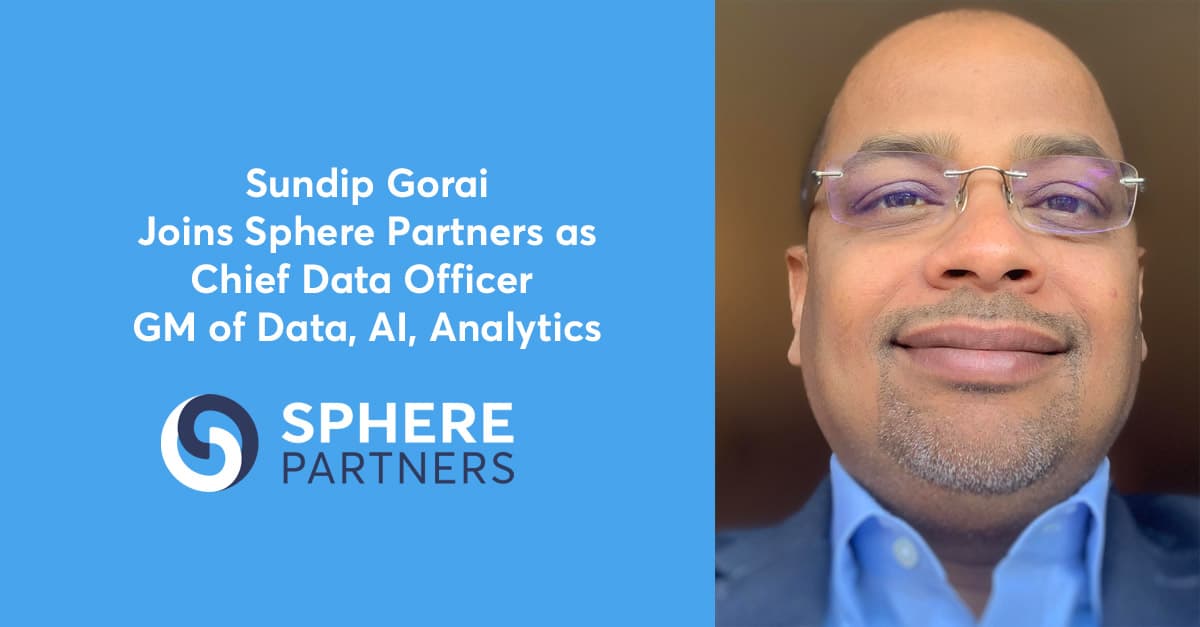
Sphere Partners Strengthens Data and AI Footprint with New Practice Lead: Sundip Gorai Joins the Team
Sphere Partners is excited to announce the appointment of Sundip Goral as Data, AI, & Analytics Practice and Chief Data Officer.
Read the article
AI Trends in 2023: Analyzing Current AI Data Solutions and Business Integrations—and Predicting What Artificial Intelligence Evolutions May Follow
Read the article
Learn with Sphere: Business Analysis: Common Mistakes and Best Practices
Read the article
BI Tools Comparison: Choosing the Right BI Tool For Your Business
Read the article
GA4 Migration Guide
Read the article
The Fundamentals of Data Storytelling
Read the article
3 Innovations from SuiteWorld 2021 to Power Growth in 2022
The SuiteWorld 2021 conference in Last Vegas was filled with many takeaways and NetSuite founder and executive vice president Evan Goldberg shared three innovations to power your company’s growth in 2022.
Read the article
Data Governance Is More Important Than Ever: Best Practices And Examples
To create a strong, well-supported data governance strategy, you need to secure internal buy-in across the organization. Data governance also allows companies to make the most of the data they hold.
Read the article
Data Maturity Models - Comparing Approaches to Data Maturity
An understanding of data maturity can guide a company's transformation from being clueless about data to taking advantage of its full potential. In this post we compare different approaches to data maturity.
Read the article