


AI-Powered Software Maintenance
Keep software running without pulling your team off the roadmap.
Sphere combines AI agents with senior engineers to own maintenance across code, security, releases, support, infrastructure, and compliance. Every consequential action is reviewed and approved by a human.
Read-only onboarding. Supervised proof period. Approval-gated production.
Built on Sphere's existing enterprise delivery experience


The Maintenance Gap
Shipping software is only the beginning.
The work after launch never stops. Bugs, vulnerabilities, support tickets, release work, infrastructure issues, and audit requests compete with the same engineers responsible for product growth.
Roadmap work slips
Experienced engineers spend time on recurring operational work instead of customer-facing improvements.
Security work queues up
Dependencies and CVEs wait behind feature deadlines, increasing risk and release pressure.
Ownership fragments
Support, product, engineering, DevOps, and vendors each handle part of the issue while no one owns the final outcome.
Knowledge becomes a bottleneck
Critical workflows live in tickets, chat threads, and individual memory, making every change slower.
The Sphere Model
One accountable operating layer. No loose ends.
Sphere connects the full maintenance workflow so every item has context, an owner, approval, evidence, and a verified closeout.
More than code
We handle intake, investigation, implementation, testing, documentation, release preparation, validation, and closeout.
Ownership from signal to resolution
One Sphere team carries each approved item across engineering, support, security, infrastructure, and release workflows.
AI speed. Human authority.
Agents accelerate repetitive analysis and preparation. Sphere engineers validate the work. Your authorized people approve consequential actions.
Service Coverage
All of software maintenance, handled.
Configure the engagement around the applications, environments, workflows, and operating pressure your business needs Sphere to own.
Each engagement defines the systems, environments, coverage window, priority levels, approval roles, and escalation paths before live operation begins.
Bug fixes and corrective maintenance
Reproduce issues, assemble context, prioritize impact, prepare fixes, run tests, document changes, and verify resolution.
Security and CVE patching
Assess exposure, trace dependencies, prepare patches, validate compatibility, and coordinate approved release windows.
Releases and hotfixes
Prepare branches, test changes, create release notes, manage approvals, support deployment, and maintain rollback readiness.
Support and ticket triage
Classify, enrich, route, investigate, resolve, and close tickets with clear ownership and documented outcomes.
Infrastructure, DevOps, and monitoring
Respond to alerts, maintain pipelines and environments, troubleshoot configuration, and improve operating reliability.
Compliance evidence and audits
Maintain change records, approval history, test evidence, release documentation, and control-supporting activity logs.
Not sure which workflows to start with?
Talk to an ExpertHow It Works
Prove the model before it touches production.
Sphere starts with read-only learning, demonstrates the work in a supervised environment, and moves into live operation only after the workflows, permissions, approval matrix, and success criteria are accepted.
Learn
Sphere connects approved systems in read-only mode and maps architecture, dependencies, operating workflows, failure patterns, access boundaries, and priorities.
Prove
Agents prepare investigations, fixes, tests, and runbooks in draft mode. Sphere engineers validate every output. Your team scores the work. No production changes are made.
Operate
Once the launch criteria are accepted, Sphere manages the agreed workflows in live mode. Consequential actions follow the approval matrix and every result is tested, logged, and reported.
No production changes during Learn or Prove. Live authority begins only after the agreed launch criteria are accepted.
Guide
Evaluating AI-powered software maintenance for your team?
Read the guide built for engineering and IT leaders comparing this model against traditional MSPs and in-house teams.
The Maintenance Loop
Evidence at every step.
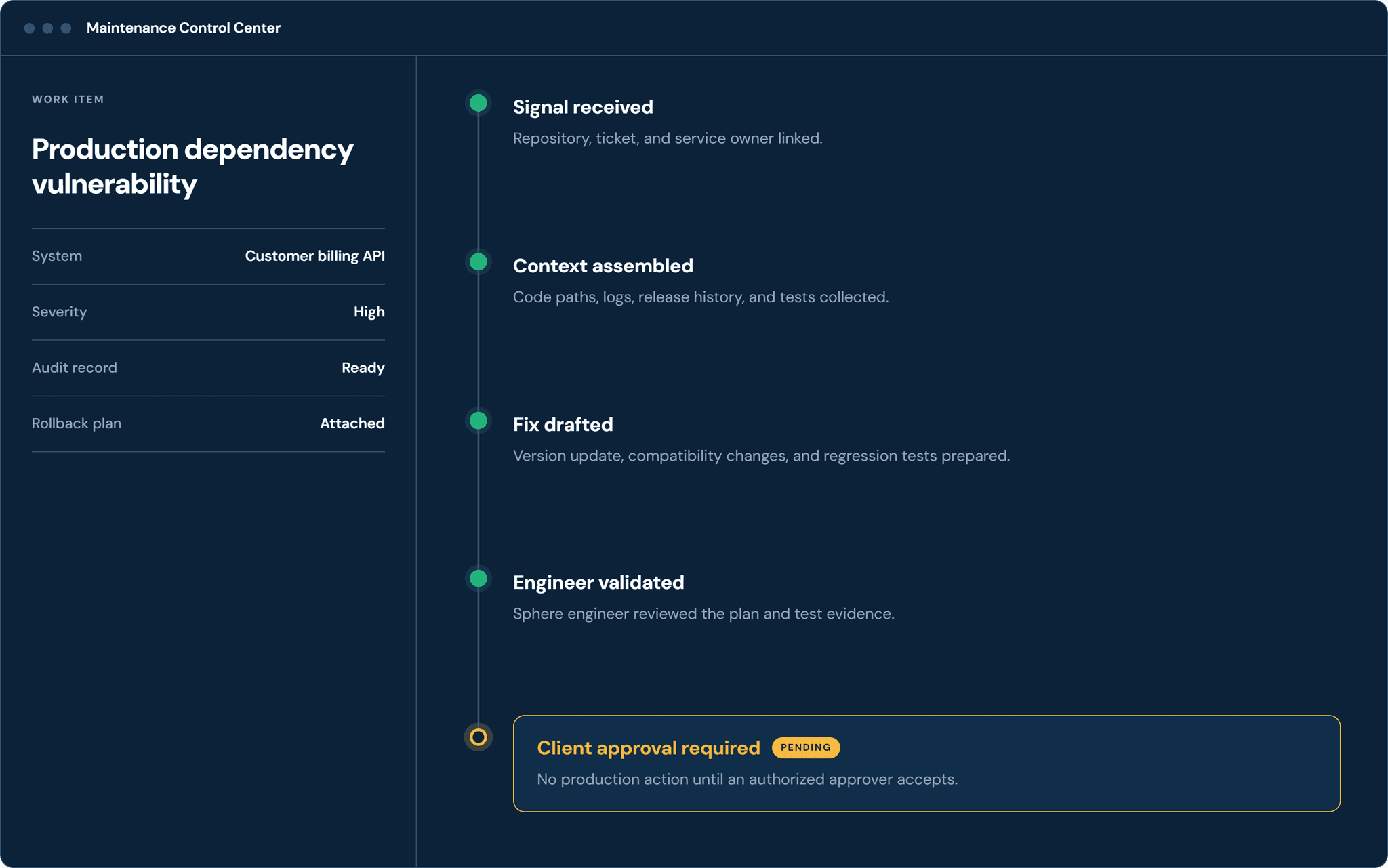
Each maintenance item moves through the same controlled path — from the first signal to a tested, approved, and documented closeout.
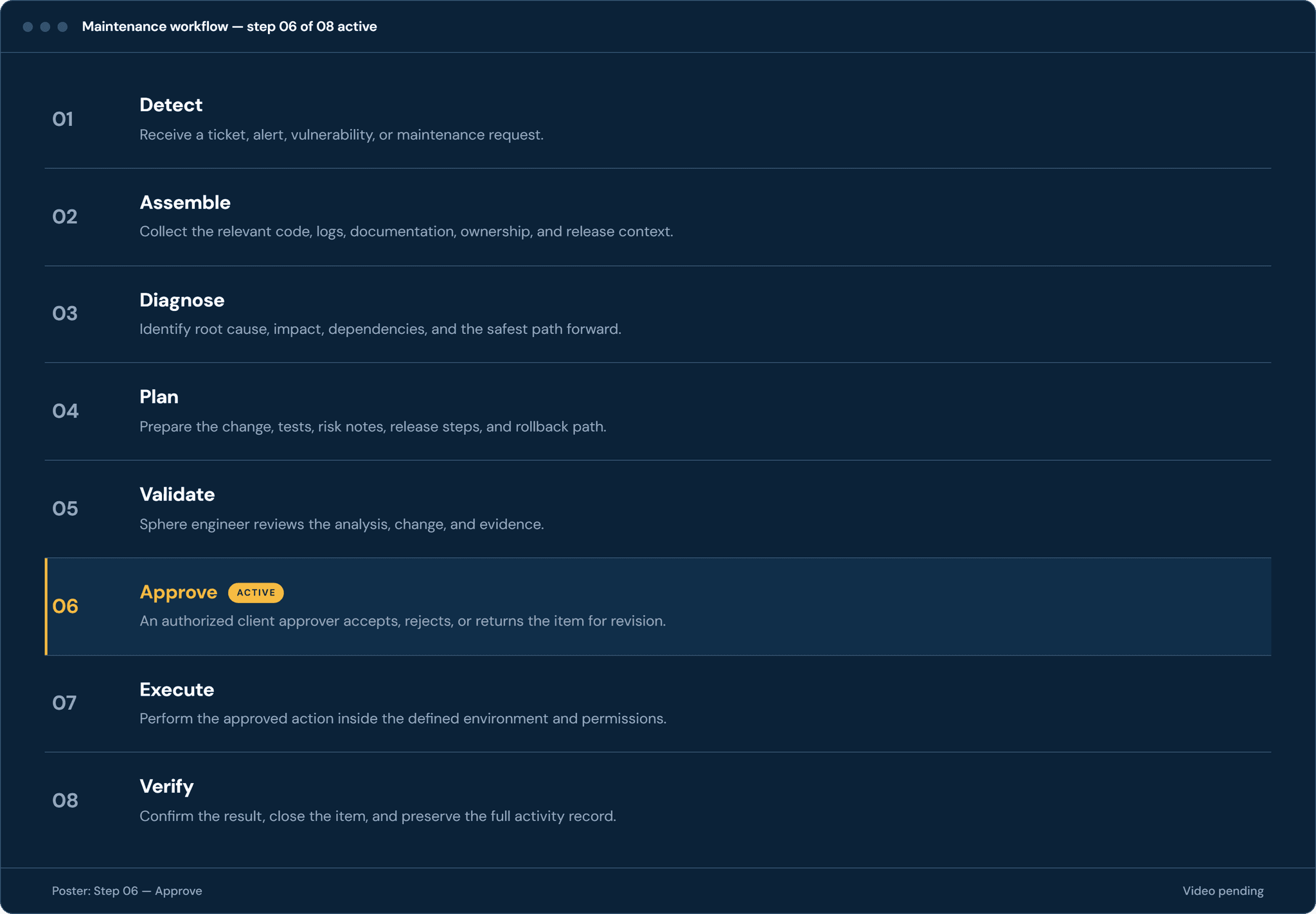
Human-in-the-Loop Control
AI works inside defined boundaries.
Permissions, approvals, testing, traceability, and rollback are built into the operating model. AI accelerates the work; people retain authority over consequential actions.
Least-privilege access
Access is limited to the approved systems, workflows, environments, and actions required for the engagement.
Human approval gates
Merges, deployments, infrastructure changes, production data actions, and other consequential steps require an authorized approval.
Human Approval Required
Testing and rollback
Every live change includes defined tests, success criteria, and a stop or rollback path.
Complete activity record
Source context, proposed actions, reviews, approvals, tests, execution, and results are recorded for traceability.
Operating Results
Measure maintenance like an operating system.
Sphere establishes a baseline during Learn and reports on the work that shows whether maintenance is becoming faster, safer, and easier to manage.
Backlog volume and age
Open maintenance work, oldest unresolved items, and closure rate.
Time to acknowledge
How quickly work is recognized, classified, and assigned.
Time to resolve
Resolution performance by work type and priority.
Security patch lead time
Time from validated exposure to approved remediation and release.
Release success and rollback rate
Change outcomes, failed releases, and recovery events.
Engineering capacity returned
Internal effort shifted from maintenance back to roadmap priorities.
Initial baseline confirmed during Learn. Operating targets agreed before Operate.
Want to see how these metrics would apply to your stack?
Talk to an ExpertDesigned for Live Software
Built for teams carrying continuous maintenance pressure.
Product companies
Roadmap teams that need bugs, security work, support, and releases handled without adding another internal management layer.
Enterprises with custom or legacy applications
Organizations that depend on critical software but have fragmented ownership, scarce expertise, or a growing maintenance backlog.
Private-equity portfolios
Portfolio companies that need a repeatable maintenance model, stronger operating visibility, and controlled use of AI across software workflows.
Recognize your team in one of these?
Talk to an ExpertFAQ
Frequently Asked Questions
Is Sphere's software maintenance service fully autonomous?
No. AI agents accelerate investigation, preparation, testing, documentation, and routine workflow steps. Sphere engineers validate the work, and consequential actions follow the client's approval matrix.
What does the service cover?
The service can cover bug fixes, corrective maintenance, security and CVE patching, releases and hotfixes, support and ticket triage, infrastructure and DevOps work, monitoring response, and compliance evidence. The exact scope is defined before live operation.
Does Sphere make production changes during onboarding?
No. The 14-day Learn stage is read-only. The 30-day Prove stage operates in draft mode. Production authority begins only after the launch criteria, permissions, workflows, tests, and approval rules are accepted.
Can Sphere work alongside our internal team and existing vendors?
Yes. Sphere can own the agreed maintenance workflows while working with your product, engineering, security, support, infrastructure, and vendor teams through defined handoffs and approval roles.
What systems does Sphere connect to?
Sphere connects only to the repositories, ticketing systems, documentation, monitoring, deployment tools, and environments approved for the engagement. The access plan is defined during Learn.
How do we get started?
Submit the maintenance assessment form. Sphere will review the systems, workflows, maintenance load, risk, and operating constraints, then schedule a scoping conversation for the Learn stage.
Hear from
our clientsHear from our clients

Lee Ebreo
VP of Engineering at Credit Ninja
These things would not have been achievable if we did not build our own in-house system and if we did not partner with Sphere to help us achieve our goals.

Selah Ben-Haim
VP of Engineering at Prominence Advisors
Our experience with Sphere and their team has been and continues to be fantastic. We keep throwing new projects at them, and they keep knocking them out of the park (including the rescue of a project that was previously bungled by another vendor).

Ben Crawford
Senior Product Manager at Enova Financial
I would expect to be delighted. It's been a really positive experience, working with Sphere, and I would expect you to have the same.

Mark Friedgan
CEO at CreditNinja
Sphere consistently prioritizes the needs of their clients, demonstrating both agility and teamwork. As an offshore team, they have been an integral part of our organization and we plan to continue growing with them.

René Pfitzner
Co-Founder at Experify
Sphere provided excellent full-stack development manpower to augment our team and help push our product forward. They are easy to work with, tech-savvy and proactive.

Bruce Burdick
Chief Information Officer at Integra Credit
We've been working with Sphere and its excellent consultants since our founding. I've found that they are true partners in the success of our business.

Jemal Swoboda
CEO at Dabble
The resources and developers that Sphere Software provides are skilled and have the required technical expertise, but more importantly, they have helped us build a culture of excellence within our team.

Arthur Tretyak
Founder and CEO at IntegraCredit
With Sphere, we were able to migrate in half the time it would take to train an additional FTE… and for a fraction of the cost. Our experience with Sphere has been exceptional.
Lee Ebreo
VP of Engineering at Credit Ninja
These things would not have been achievable if we did not build our own in-house system and if we did not partner with Sphere to help us achieve our goals.
Selah Ben-Haim
VP of Engineering at Prominence Advisors
Our experience with Sphere and their team has been and continues to be fantastic. We keep throwing new projects at them, and they keep knocking them out of the park (including the rescue of a project that was previously bungled by another vendor).

TOP AI CODE GENERATION COMPANY UNITED STATES 2025

TOP AI TEXT GENERATION COMPANY FLORIDA 2025

TOP APP DEVELOPMENT COMPANY MANUFACTURING 2025

TOP ARTIFICIAL INTELLIGENCE COMPANY UNITED STATES 2025

TOP CHATBOT COMPANY UNITED STATES 2025

TOP RECOMMENDATION SYSTEMS COMPANY UNITED STATES 2025

GLOBAL RECOGNITION AWARDS 2026

BEST IN AI FOR DOCUMENTATION VALIDATION 2026

BEST IN AI POWERED INVOICE AUDITING 2026

GLOBAL TECH WINNER 2026
GLOBAL GENERATIVE AI AWARD 2026 WINNER
Maintenance Assessment
Put software maintenance on an operating model.
Start with a focused review of the applications, workflows, risk, and maintenance load putting pressure on your team.
What happens next
- Sphere reviews the information submitted.
- A software operations specialist schedules a scoping call.
- You receive a proposed Learn-phase scope.