Case Study
Centralised Dashboards
Overview
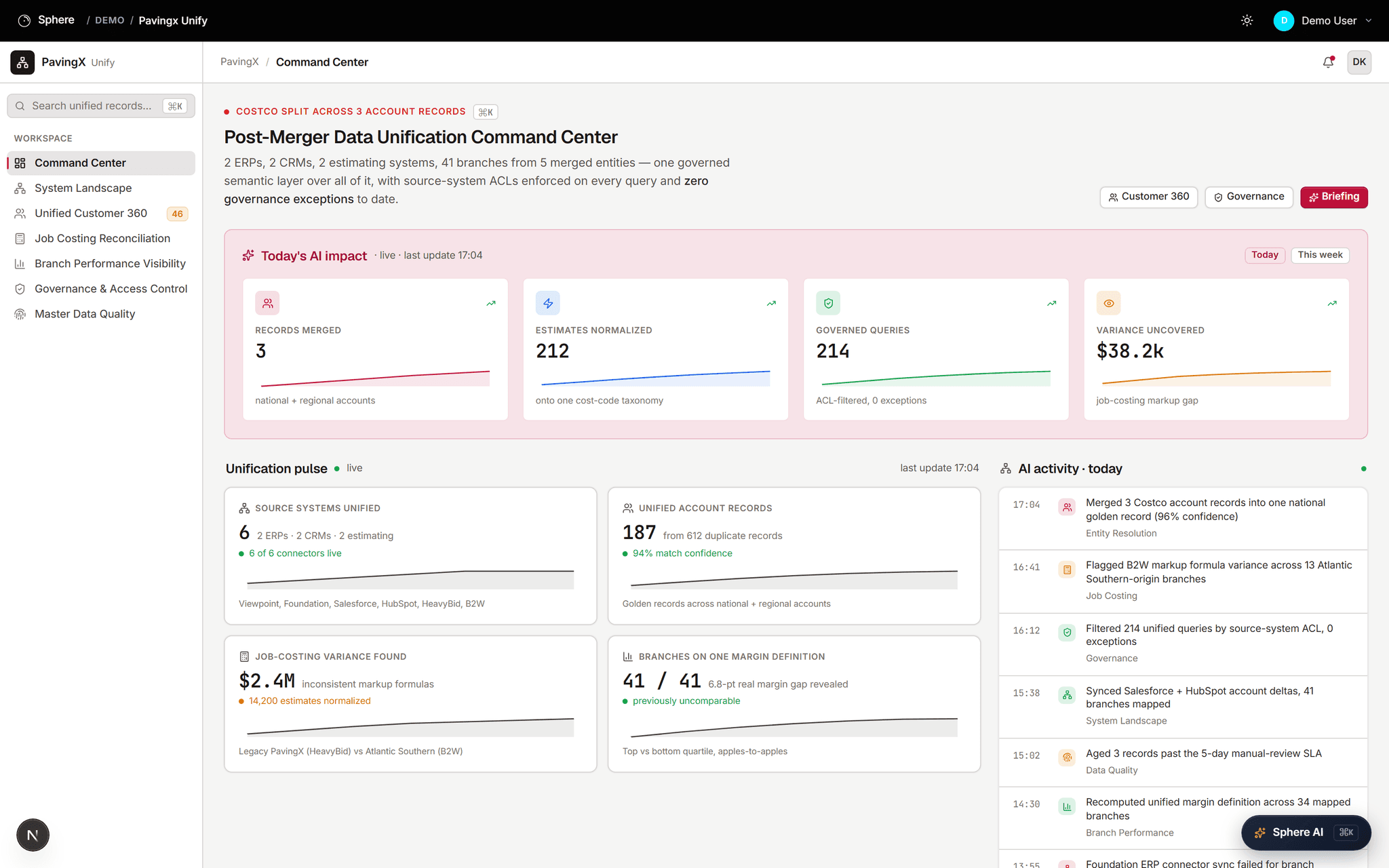
The client’s subcontractor ecosystem was fragmented: each project team used separate spreadsheets, vendor portals and project-management tools to track subcontractor commitments, performance, change-orders and payments. Executives lacked a unified view of subcontractor health, cost impact and risk. Leadership was making decisions with outdated or incomplete data, leading to delayed responses, cost overruns and scheduling conflicts.
The contractor engaged Sphere to break down data silos, unify subcontractor-related information across ERP and field updates, and deliver a live dashboard layer. So leadership could make faster, more confident decisions regarding subcontractor performance, allocation and cost.
Challenges
− Subcontractor agreements, commitments and performance lived in the ERP; field updates and punch lists were managed in separate project systems or spreadsheets. − No single repository or view of subcontractor cost vs. performance across projects.
− PMOs compiled subcontractor performance and cost data manually each quarter; reporting lagged by 5-7 business days. − Inconsistent metrics and definitions (e.g., “subcontractor delay” or “corrective cost”) reduced trust in the data.
− Without early warning mechanisms, subcontractor issues (poor performance, high change-orders, corrective work) caused ripple-effects on schedule and budget. − Cross-project benchmarking of subcontractor performance was impossible.
− Executives lacked up-to-date metrics on subcontractor schedule adherence, change-order frequency, corrective work or cost variance. − Delays and overruns often surfaced too late to be addressed proactively.
Our Solution
We delivered a 10-week engagement broken into key phases:
Outcome: A single governed data warehouse in Snowflake served as the authoritative source for subcontractor analytics — replacing spreadsheets and manual exports entirely.
Outcome: Executives gained live access to accurate subcontractor data, refreshed nightly. Field directors could track under-performing subs in real time, and PMOs no longer prepared static Excel reports.
1. Data Collection and Staging We connected to…
Data Collection and Staging We connected to the client’s ERP (financials, POs, invoices), and Excel field logs using Fivetran and custom Python ETL jobs. Raw data was staged in a Snowflake Lakehouse environment hosted on AWS.
2. Database & Schema Design
Database & Schema Design
3. Built a star
schema model with dimension tables for subcontractors, trades, projects, and cost categories.
4. Created fact tables for commitments, change
orders, corrective work, and schedule adherence.
5. Designed cross
system ID mapping to standardize subcontractor names and vendor codes.
6. Establishing the Data Pipeline
Establishing the Data Pipeline
Key Achievements
Unified data across ERP, scheduling, and field systems exposed hidden inefficiencies and recurring change-order patterns, allowing leadership to act early and contain costs.
Automated ETL pipelines in Snowflake and live Power BI dashboards replaced manual roll-ups, delivering real-time visibility into subcontractor performance and project health.
With consistent, accurate data and intuitive visual dashboards, executives and project directors began using the system daily for decision-making and risk oversight.
Snowflake Lakehouse consolidated financial, operational, and schedule data to create a governed, scalable foundation for future analytics, forecasting, and vendor benchmarking.
Organizations around the world trust us


Hear from
our clientsHear from our clients

Lee Ebreo
VP of Engineering at Credit Ninja
These things would not have been achievable if we did not build our own in-house system and if we did not partner with Sphere to help us achieve our goals.

Selah Ben-Haim
VP of Engineering at Prominence Advisors
Our experience with Sphere and their team has been and continues to be fantastic. We keep throwing new projects at them, and they keep knocking them out of the park (including the rescue of a project that was previously bungled by another vendor).

Ben Crawford
Senior Product Manager at Enova Financial
I would expect to be delighted. It's been a really positive experience, working with Sphere, and I would expect you to have the same.

Mark Friedgan
CEO at CreditNinja
Sphere consistently prioritizes the needs of their clients, demonstrating both agility and teamwork. As an offshore team, they have been an integral part of our organization and we plan to continue growing with them.

René Pfitzner
Co-Founder at Experify
Sphere provided excellent full-stack development manpower to augment our team and help push our product forward. They are easy to work with, tech-savvy and proactive.

Bruce Burdick
Chief Information Officer at Integra Credit
We've been working with Sphere and its excellent consultants since our founding. I've found that they are true partners in the success of our business.

Jemal Swoboda
CEO at Dabble
The resources and developers that Sphere Software provides are skilled and have the required technical expertise, but more importantly, they have helped us build a culture of excellence within our team.

Arthur Tretyak
Founder and CEO at IntegraCredit
With Sphere, we were able to migrate in half the time it would take to train an additional FTE… and for a fraction of the cost. Our experience with Sphere has been exceptional.
Lee Ebreo
VP of Engineering at Credit Ninja
These things would not have been achievable if we did not build our own in-house system and if we did not partner with Sphere to help us achieve our goals.
Selah Ben-Haim
VP of Engineering at Prominence Advisors
Our experience with Sphere and their team has been and continues to be fantastic. We keep throwing new projects at them, and they keep knocking them out of the park (including the rescue of a project that was previously bungled by another vendor).

TOP AI CODE GENERATION COMPANY UNITED STATES 2025

TOP AI TEXT GENERATION COMPANY FLORIDA 2025

TOP APP DEVELOPMENT COMPANY MANUFACTURING 2025

TOP ARTIFICIAL INTELLIGENCE COMPANY UNITED STATES 2025

TOP CHATBOT COMPANY UNITED STATES 2025

TOP RECOMMENDATION SYSTEMS COMPANY UNITED STATES 2025

GLOBAL RECOGNITION AWARDS 2026

BEST IN AI FOR DOCUMENTATION VALIDATION 2026

BEST IN AI POWERED INVOICE AUDITING 2026

GLOBAL TECH WINNER 2026
MOST INNOVATIVE TECHNOLOGY CONSULTING FIRM 2026
GLOBAL GENERATIVE AI AWARD 2026 WINNER