Case Study • Post-Merger Data Unification
$680k a year was hiding in two different markup formulas
- Client
- PavingX
- Service
- AI Solutions|Data Analytics
Overview
A field report on Unify, the governed semantic data layer Sphere built for PavingX — a national pavement management and paving contractor — over its post-merger system landscape: several source systems, multiple merged entities, and dozens of branches, unified into one queryable layer with source-system access control enforced on every request.
The Situation
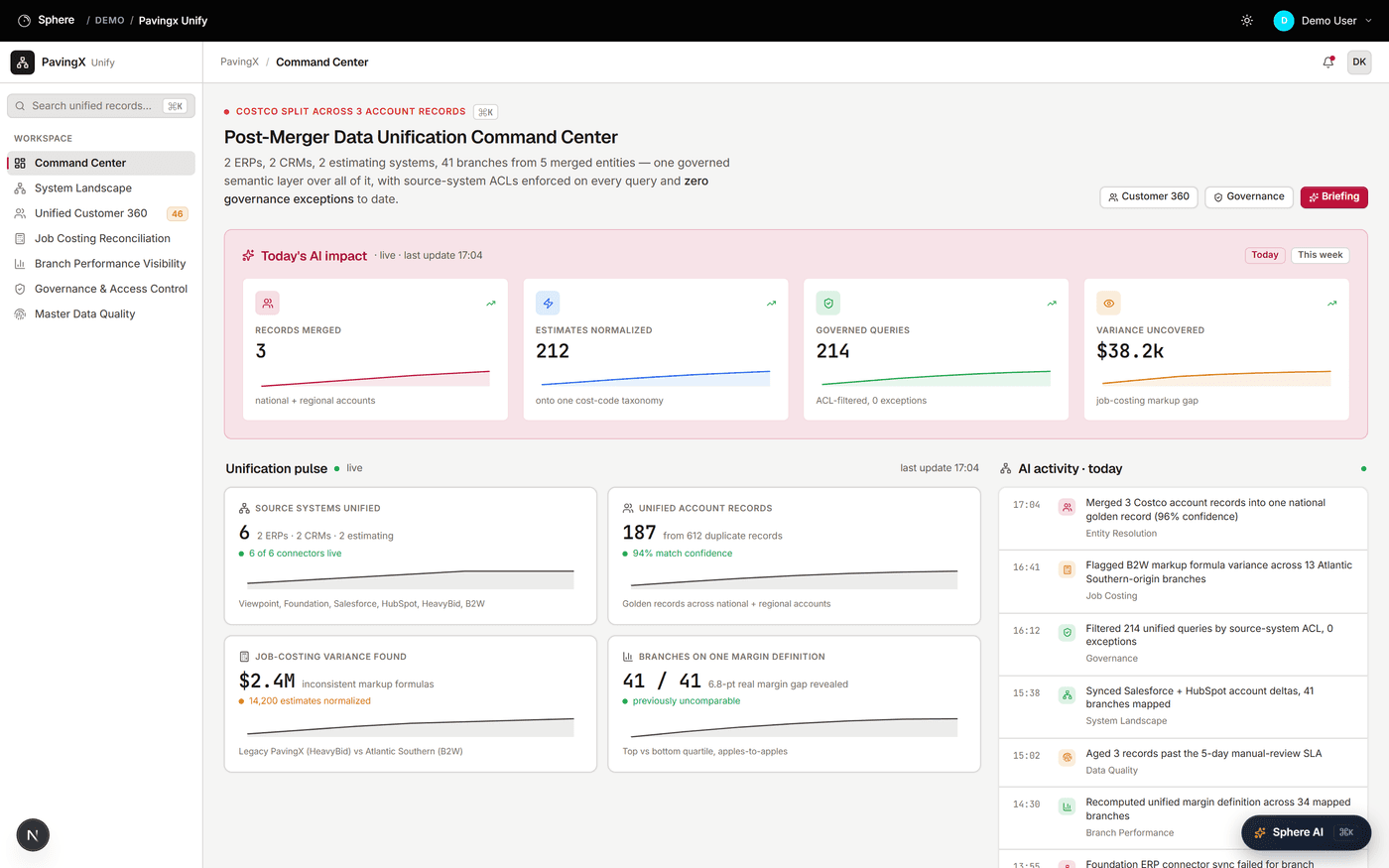
PavingX's 2024 merger and three acquisitions didn't just bring four new AP systems into the company — they brought two ERPs, two CRMs, and two separate estimating systems, each running a different branch's version of “how big is this deal” and “what's our margin.” Unify is Sphere's governed semantic layer over all of them: every mapped branch on one margin definition, most source-system connectors live (Foundation's connector is degraded, traced to a stale credential from the Unigrade handoff), syncing hourly. This morning it merged 3 more account records, normalized 212 more estimates onto one cost-code taxonomy, and answered 214 governed queries without a single access-control exception.
WarehouseCo's account, across three systems
Three separate account records — one Salesforce, two HubSpot — no single point of contact possible.
Comparing margins across multiple merged companies
Impossible — each entity's estimating system computed margin differently.
Who can see what in the unified layer
A single combined database would mean everyone sees everything, merger or not.
Our Solution
Unify resolves duplicate records, normalizes cost definitions across legacy systems, and enforces the same access-control boundaries the original systems had — on every query.
1. Unified Customer 360
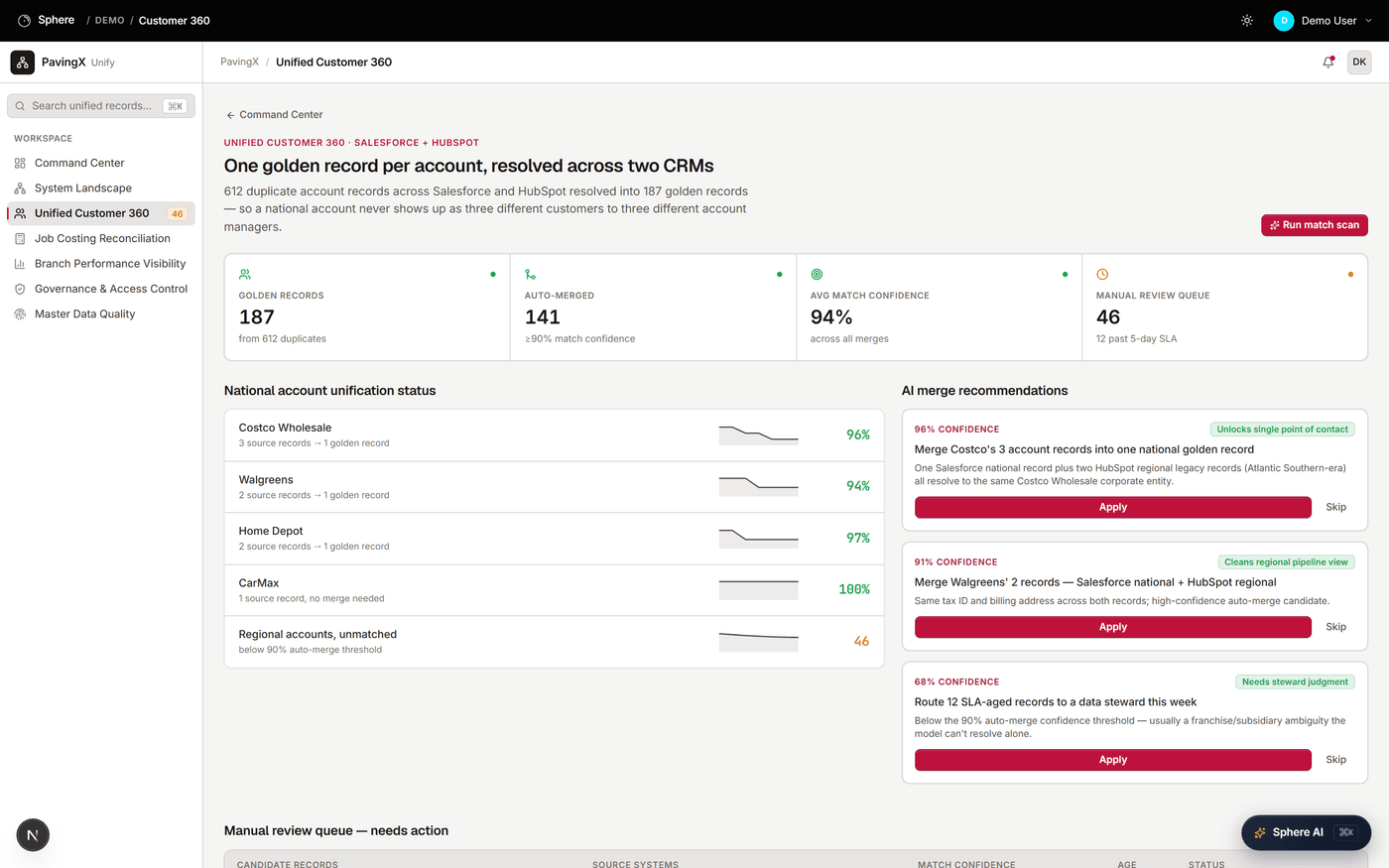
Until today, WarehouseCo existed as three different account records — one national record in Salesforce, two regional legacy records in HubSpot dating back to the Meridian acquisition — which meant no one could commit to a single point of contact for the account without checking which system they were looking at. The desk resolves all three into one golden record at 96% confidence. Across the full customer base, 612 duplicate records have become 187 golden records at 94% average match confidence; 46 remain in manual review below the auto-merge threshold, 12 of them already past the 5-business-day SLA and queued for a data steward.
2. Job Costing Reconciliation
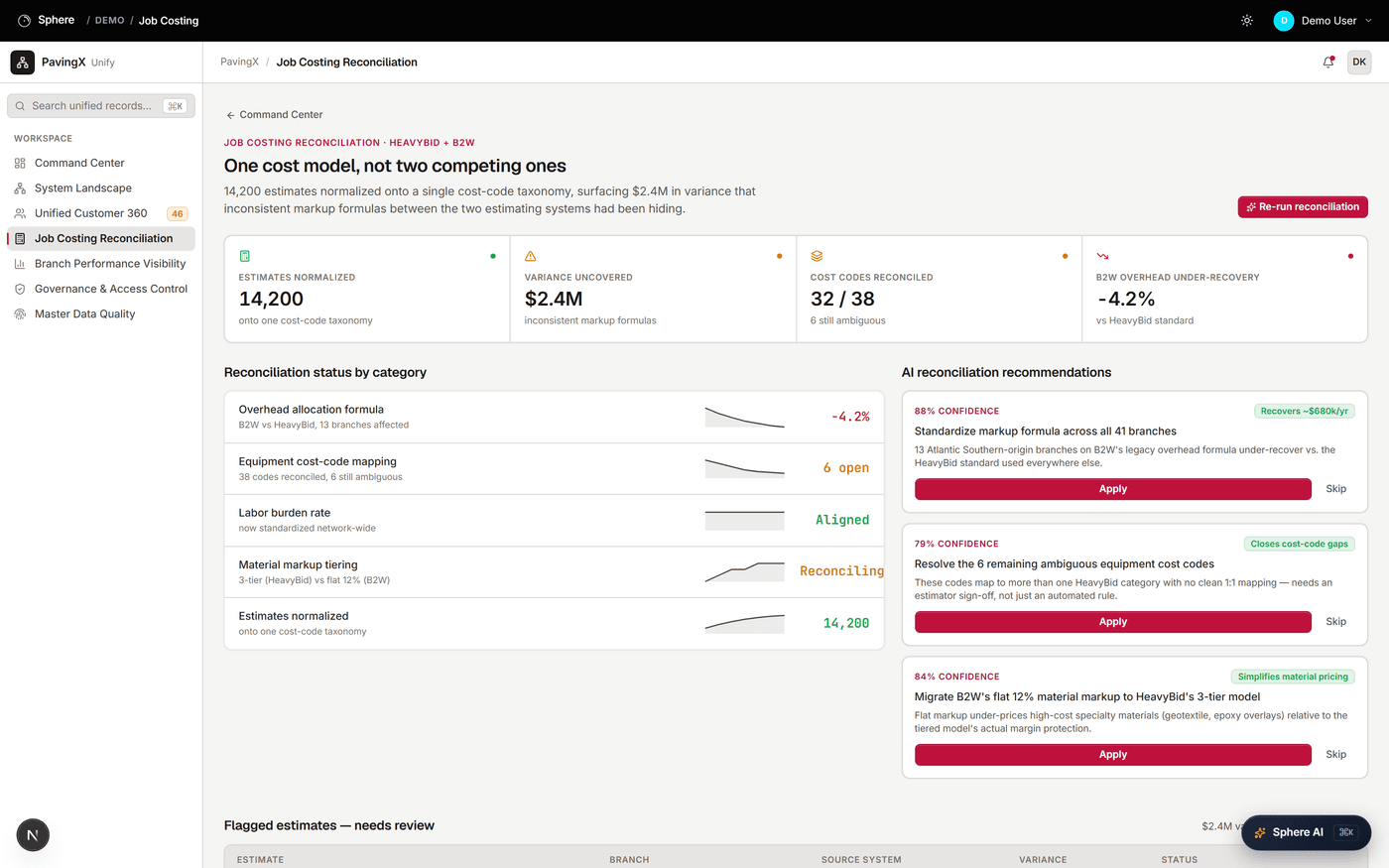
The deeper problem was harder to see: HeavyBid (PavingX's legacy estimating system) and B2W Estimate (Meridian's) compute overhead and material markup differently, and 14,000+ estimates were sitting on two incompatible cost models. Normalizing them onto one taxonomy surfaced $2.4M in variance. The single biggest finding: B2W's legacy overhead-allocation formula under-recovers by 4.2% against the HeavyBid standard, silently affecting every one of the 13 Meridian-origin branches. Standardizing the formula recovers an estimated $680k a year — not a hypothetical, a formula bug with a dollar amount attached.
Why This Matters to a Multi-Company Merger
A merger's true margin gets visible, not averaged away
41 branches on one margin definition means the 6.8-point spread is a real number, and the part of it that's a costing artifact versus an operating problem is now distinguishable.
National accounts stop looking like multiple customers
WarehouseCo, PharmacyCo, and HomeCo each resolve to one golden record instead of splitting across the systems their acquired branches happened to use.
A markup bug gets a dollar figure and an owner
$680k/yr isn't a rounding error once it's traced to a specific formula in a specific system affecting a specific 13 branches.
Access control survives the merger
Nobody gains visibility they didn't already have in their original system; the unified layer enforces the same boundaries Salesforce, HubSpot, Viewpoint, and Foundation already had.
The next acquisition has a template
The same six-system pattern (2 ERPs, 2 CRMs, 2 estimating systems) is exactly what the next acquisition will bring — this is now a repeatable playbook, not a one-time cleanup.
Results
Put together, that's what the branch-performance view finally shows honestly: a 6.8-point margin gap between the network's best and worst quartile branches, most of it real, but roughly 3.5 points of the Meridian-origin gap turns out to be a costing-methodology artifact, not an operating difference — Charlotte, Hartford, and Tampa are the clearest examples. Even after correcting for that, three branches still trail the network by 4+ points on a like-for-like basis, which is now a flagged operational question instead of a number nobody trusted. All of it stays governed: 8,240 queries this month, filtered by each user's original source-system permissions, zero exceptions in 90 days — a foundation the SOC 2 review can be built on, not just a faster spreadsheet.
Organizations around the world trust us


Hear from
our clientsHear from our clients

Lee Ebreo
VP of Engineering at Credit Ninja
These things would not have been achievable if we did not build our own in-house system and if we did not partner with Sphere to help us achieve our goals.

Selah Ben-Haim
VP of Engineering at Prominence Advisors
Our experience with Sphere and their team has been and continues to be fantastic. We keep throwing new projects at them, and they keep knocking them out of the park (including the rescue of a project that was previously bungled by another vendor).

Ben Crawford
Senior Product Manager at Enova Financial
I would expect to be delighted. It's been a really positive experience, working with Sphere, and I would expect you to have the same.

Mark Friedgan
CEO at CreditNinja
Sphere consistently prioritizes the needs of their clients, demonstrating both agility and teamwork. As an offshore team, they have been an integral part of our organization and we plan to continue growing with them.

René Pfitzner
Co-Founder at Experify
Sphere provided excellent full-stack development manpower to augment our team and help push our product forward. They are easy to work with, tech-savvy and proactive.

Bruce Burdick
Chief Information Officer at Integra Credit
We've been working with Sphere and its excellent consultants since our founding. I've found that they are true partners in the success of our business.

Jemal Swoboda
CEO at Dabble
The resources and developers that Sphere Software provides are skilled and have the required technical expertise, but more importantly, they have helped us build a culture of excellence within our team.

Arthur Tretyak
Founder and CEO at IntegraCredit
With Sphere, we were able to migrate in half the time it would take to train an additional FTE… and for a fraction of the cost. Our experience with Sphere has been exceptional.
Lee Ebreo
VP of Engineering at Credit Ninja
These things would not have been achievable if we did not build our own in-house system and if we did not partner with Sphere to help us achieve our goals.
Selah Ben-Haim
VP of Engineering at Prominence Advisors
Our experience with Sphere and their team has been and continues to be fantastic. We keep throwing new projects at them, and they keep knocking them out of the park (including the rescue of a project that was previously bungled by another vendor).

TOP AI CODE GENERATION COMPANY UNITED STATES 2025

TOP AI TEXT GENERATION COMPANY FLORIDA 2025

TOP APP DEVELOPMENT COMPANY MANUFACTURING 2025

TOP ARTIFICIAL INTELLIGENCE COMPANY UNITED STATES 2025

TOP CHATBOT COMPANY UNITED STATES 2025

TOP RECOMMENDATION SYSTEMS COMPANY UNITED STATES 2025

GLOBAL RECOGNITION AWARDS 2026

BEST IN AI FOR DOCUMENTATION VALIDATION 2026

BEST IN AI POWERED INVOICE AUDITING 2026

GLOBAL TECH WINNER 2026

MOST INNOVATIVE TECHNOLOGY CONSULTING FIRM 2026

GLOBAL GENERATIVE AI AWARD 2026 WINNER