


Author
Luke Suneja
Client Partner
31 posts by this author

Custom Software Development Services: The Complete Guide
Custom software development services cover the full lifecycle of software built for one organization: discovery, architecture, UX, engineering, QA, DevOps and post-launch support. This guide explains what each phase includes, when custom beats SaaS, how the three engagement models differ, and how to evaluate a partner before you sign.
Read the article
IT Due Diligence Checklist: Infrastructure, Security, Cloud and AI
An IT due diligence checklist for buyers of companies that run on technology: what to review across infrastructure, applications, security, data, cloud spend, contracts, the IT team and AI use, and how the findings feed the deal.
Read the article
What's Actually in a Technical Due Diligence Report (Sample Structure)
A section-by-section walk through a sample technical due diligence report: the verdict, RAG scorecard, costed findings, red flags versus fixable issues and the 100-day plan, and how deal teams put each part to work.
Read the article
AI Due Diligence: How to Evaluate an AI Company or AI Product Before You Invest
Investors are being asked to pay AI multiples for products that may be thin layers over someone else's model. Here is how to test whether a target's AI is real, owned, economically sound and compliant before you price it.
Read the article
How to Hire an AI Developer: Skills, Hiring Models, and Where to Look (Without Wasting 3 Months)
Most AI hiring mistakes happen before the first interview, when the wrong role gets posted. Here is how to define the job, test the skills that matter, run an interview that predicts performance, and pick a hiring model that fits the work and the team you already have.
Read the article
How to Audit AI Agent Decisions in Banking (A Practical Framework)
A practical, five-point framework internal audit and compliance teams can use to sample, test, and evidence AI agent decisions in banking — after the trail already exists.
Read the article
Per-Team, Per-Model Token Budgets That Actually Hold
AI spend is easy to start and hard to stop. Per-team, per-model token budgets turn an open-ended bill into an enforced allocation — limits that actually hold, with visibility into where every token went.
Read the article
Routing to the Cheapest Model That Still Passes the Eval
Using your most expensive model for every task is like taking a taxi everywhere. Cost-aware routing sends each request to the cheapest model that still meets the quality bar — saving money without a quality gamble, because the eval decides.
Read the article
AI Agent Governance in Banking: Who's Accountable When the Agent Acts?
Agentic AI in banking raises a governance question sharper than any chatbot did: when an agent acts on a system of record, who answers for it? Here's how accountability maps to the three lines of defense, and the transparency a bank has to be able to demonstrate.
Read the article
The EU AI Act Compliance Checklist for Banks Deploying LLMs
The EU AI Act is now enforceable, and most bank LLM use cases fall into its high-risk category. Here's the practical compliance checklist — and what to ask a vendor when you can't answer it yourself.
Read the article
Manufacturing's AI Control Room: A Live Operational Twin
A manufacturing control room shows you the plant as it is right now. An AI control room adds a layer that understands it — a live operational twin over real telemetry, where you can ask what's happening in plain language and get a grounded, governed answer.
Read the article
RAG for Customer Support: Reducing Ticket Volume with AI Knowledge Bases
Two deployment models, one unglamorous prerequisite, and the design decision that matters most — knowing when not to answer. How to deploy support RAG for real ROI.
Read the article
AI Tools for Market Research: A Practical Buyer's Guide
The most useful comparison for AI market research tools isn't features or price — it's what happens when a tool doesn't have a good answer. Four tests to run before you buy.
Read the article
Newsletter Monetization: Turning Your Archive into a Paid, Query-able Product
The fastest-growing newsletter monetization model isn't a new ad network — it's turning your archive into a paid, queryable product subscribers can ask questions of.
Read the article
How AI Is Automating Market Research (Where Analysts Still Need to Verify)
AI is automating retrieval, extraction, and first-draft synthesis in market research — not judgment. Here's where analysts still need to verify before trusting the output.
Read the article
Best AI-Powered Knowledge Base Approaches for Content-Heavy Teams
A framework for choosing between bolted-on AI search, purpose-built RAG platforms, and custom systems — built around what content-heavy teams should actually test before committing.
Read the article
AI Knowledge Base: What It Is and How It Works
A practical breakdown of what an AI knowledge base actually is, how retrieval-augmented generation works, and why grounding — not fluency — is what makes one trustworthy.
Read the article
RAG for Healthcare: HIPAA-Compliant AI Knowledge Systems
Clinicians trust sources, not summaries — which makes RAG a natural fit for healthcare and its hardest test. HIPAA safeguards, de-identified ingestion, and human review have to be architecture, not disclaimers.
Read the article
Institutional Memory AI for Financial Services: Domain Intelligence for Compliance-Heavy Organizations
In financial services the cost of a wrong answer is regulatory, reputational, and customer-trust cost — the answer has to be accurate, current, citable, and auditable. A Domain Intelligence Engine configured for the firm's compliance posture delivers governed answers: domain ontology, domain filters at retrieval, veteran-verified calibration, and a five-element audit trail on every query.
Read the article
RAG for Financial Services: Compliance-First AI for Banking and Insurance
In banking and insurance the question isn't only whether a RAG system works — it's whether you can explain it to an examiner. Auditability, permission control, and model risk management have to be architecture, not afterthoughts.
Read the article
Tax and Audit Firms: An AI Assistant That Shows Its Sources
Tax and audit work can't rest on an AI's unverified word — every position needs support. An assistant that shows its sources and keeps an audit trail fits how these firms already work: cite the authority, keep the workpaper, stand behind the answer.
Read the article
AI for Insurers That Underwriting and Compliance Both Trust
An AI assistant for insurance has to win over two hard audiences at once. Underwriting won't use it unless its answers are accurate, sourced, and explainable enough to stand behind. Compliance won't allow it unless it's controlled, permissioned, and auditable. Governed AI is built to satisfy both — grounded and explainable for the underwriter, controlled and recorded for compliance.
Read the article
Legal AI With a Citation You Can Defend
Legal professionals have a well-earned allergy to confident assertions without support — their discipline is built on citing authority. Legal AI that gets used is grounded in the actual documents and cites a verifiable source for every point, so every output is traceable and defensible.
Read the article
Governed AI for Banks: Chat, Retrieval, and Audit Inside the Perimeter
Banks have the strongest case for AI and the strictest constraints on how to use it. The value — instant answers over decades of policy, product, and customer knowledge — is enormous; the rules around customer data, auditability, and accountability are unforgiving. The way to have both is governed AI that runs inside the bank's own perimeter: chat and retrieval over your knowledge, every answer permissioned, every decision on a record a supervisor can read.
Read the article
Institutional Memory AI for Healthcare: Continuity of Care in a High-Turnover Industry
Healthcare turnover is structural — the continuity an institution promises patients depends on operational knowledge surviving the people who carry it. Institutional memory AI holds approved protocols, scheduling logic, staffing rules, and patient-education content addressable to whoever is on shift, scoped to operational workflows rather than clinical judgment.
Read the article
Healthcare AI That Keeps PHI Inside the Boundary
Healthcare has the clearest AI value and the least room for error. An assistant over clinical guidelines, patient records, and administrative knowledge could save enormous time — but protected health information leaking, even once, is the kind of failure that ends programs and triggers penalties. Healthcare AI that works keeps PHI inside the boundary by design: redacted at the wire, processed where the data lives, permissioned per user, and fully recorded.
Read the article
Institutional Memory AI for Professional Services: Capturing What Your Experts Know
Professional services firms sell expertise — and too much of it lives in partner memory, inboxes, and prior work product rather than any addressable system. Institutional memory AI turns those artifacts into a searchable, governed, citable expertise base, without a documentation tax on billable time.
Read the article
Company Brain for Customer Support: AI That Knows Every Answer, Every Time
Every agent knows part of the answer. The ticket system knows part of the history. The runbook knows part of the procedure. The customer waits on the line while three people are simultaneously searching for the same piece of information across three different tools — the operating reality of most enterprise support and operations teams.
Read the article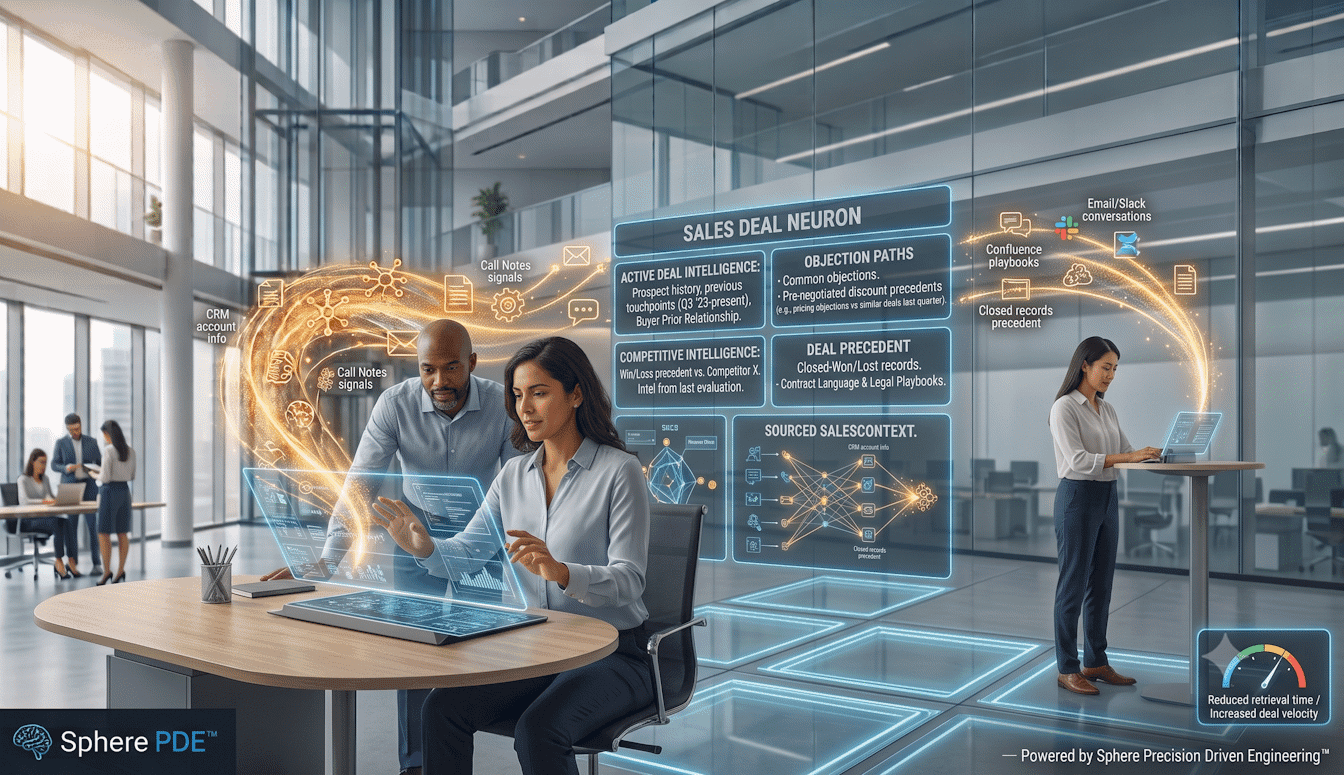
Company Brain for Sales Teams: AI That Knows Your Deals, History, and Product Better Than Any Rep
Sales organizations are sitting on more institutional knowledge than almost any other function — CRM accounts, call notes, proposals, objection history, competitive intelligence, prior-deal precedent — and the active reps can rarely retrieve it when a live deal needs it.
Read the article
The AI Silo Trap: Why Giving Everyone a Different LLM Subscription Is Making Your Company Worse at AI
Your org chart probably has more AI licenses than AI strategy. Here's the bill coming due.
Read the article
Wiring Claude Directly Into NetSuite for Analytics? Here's the Expensive Mistake Hiding in That Shortcut
A few hard-won lessons from sitting in rooms with CFOs and controllers who tried the fast way first.
Read the article