


Author
Anton Macius
Field CTO
Anton Macius is a technology and product leader with experience spanning mobility, infrastructure, AI, and enterprise software platforms. Having worked with organizations including Gett and bp pulse, Anton has led and contributed to the development of high-scale operational systems, digital products, and modernization initiatives across multiple industries. Today, he focuses on building practical, automation-driven platforms in areas such as AI, public infrastructure, property operations, and intelligent workflow systems. Anton is passionate about combining strong engineering foundations with real-world operational impact, helping organizations simplify complexity and scale technology effectively.
41 posts by this author

“It Looks Right” Is Not a Test Strategy.
A design gate we built reported every rule green on a completely blank page. A check that has only ever seen work that already passes has never demonstrated it can fail — it has only demonstrated that it agrees with you.
Read the article
Prompt Injection Defense for Enterprise LLMs: What OWASP's #1 Risk Means in Practice
OWASP ranks prompt injection as the top risk facing LLM applications — and unlike a typical vulnerability, it can't be patched away. Here's what banks need to understand about it and how to build defenses that actually hold up.
Read the article
Your AI Demo Is the Easy Part.
A twenty-step run died at step nineteen with 1.7TB free on the drive beside it. Nothing crashed, nothing was logged, and a stopped run looks exactly like a finished one — which is the failure mode a demo can never show you.
Read the article
The Prompt Isn't the Product.
AI amplified how fast I could produce a plausible answer. It did nothing to amplify how fast I could tell a plausible one from a correct one — and a type that compiled, passed review and was backwards is the smallest proof of that I have.
Read the article
LLM Guardrails for Enterprise: What "Configurable" Actually Needs to Mean
Vendors love the word "configurable." Here's the test that separates a real control plane from a marketing checkbox.
Read the article
Single Source of Truth: Why Every Team Has a Different Number (and How to Fix It)
Finance says one revenue number. Sales says another. Here's why that keeps happening, and the practical path to one number every team — and every AI system — can trust.
Read the article
RAG vs. Traditional Enterprise Search: Why Vector Search Alone Isn't the Answer
Swapping keyword search for vector search breaks what already worked. RAG and enterprise search are different tools for different jobs — and the strongest systems use both.
Read the article
Our Ledger Said It Had Been Tampered With. It Hadn't.
Our tamper-evident general ledger started reporting broken entries. Nobody had touched them: the same exchange rate was hashed one way on the way in and another on the way out. A control that raises a false alarm is not partially working — it is harmful.
Read the article
Data Residency for AI: Keeping Prompts and Embeddings In-Region
Data-residency rules don't stop applying because the processing is AI. Prompts, embeddings, and the records of both are personal data with a location — and keeping them in-region is a requirement most hosted AI quietly violates.
Read the article
Air-Gapped AI: Running a Governed Assistant With No Data Leaving the VPC
For the most sensitive environments, the only acceptable amount of data leaving the boundary is none. Air-gapped AI runs inference, retrieval, and governance entirely inside your own perimeter — a governed assistant that never phones home.
Read the article
The Model Flags. The Person Files.
Two Sphere solutions were recognised at the Global AI Awards this season. Neither is autonomous: in both, the model's authority ends before anything irreversible happens — and that constraint is the reason they were deployable at all.
Read the article
Nobody Could Say What Percentage We Checked.
Five people audited five percent of the carrier invoices and called it a process. The number that goes missing before every automation business case is coverage — what fraction of the work actually gets checked.
Read the article
RAG for Manufacturing and Engineering: Technical Documentation at Scale
Manuals, specs, CAD drawings, work orders — and the tribal knowledge that retires with your senior technicians. Multimodal, PLM/ERP-integrated RAG makes all of it queryable.
Read the article
The Copilot Pattern: Legal Redline, Sales Deal, PR, and Product-Ticket Agents
Most useful enterprise agents follow the same shape — a copilot that assists an expert inside one workflow. Templating that shape, with an evaluation baseline attached, is how you build the tenth agent in a tenth of the time.
Read the article
Continuous Evaluation and Drift Alerts: Catching the Day Your AI Quietly Got Worse
An AI agent that was correct at launch can quietly degrade — a model updates, the knowledge shifts, a connector changes. Continuous evaluation re-runs the agent's exam on a schedule and alerts you when the score drops, so you find out from a test, not a customer.
Read the article
Compiled Is Not Done: Why "It Ran" Is Not "It Works" for AI
The most dangerous word in AI development is 'done.' A system that treats 'it produced an output' as success will confidently ship things that don't work. Verifying the outcome — not the activity — is what closes the gap.
Read the article
No-Code, Still Governed: Composing an Enterprise Agent Without Losing Control
No-code AI builders make it easy to ship an agent and easy to ship an ungoverned one. The interesting problem is letting non-engineers compose agents while every governance control still applies.
Read the article
Eval-Gated Publishing: No Agent Ships Until It Passes Its Goldens
In the AI Factory, an agent can't be published until it passes evaluation against a set of known-good questions at a configured threshold. Correctness becomes a deploy gate, not a dashboard you check later.
Read the article
Institutional Memory AI for Manufacturing: Capturing Engineering and Operations Knowledge
Most of a manufacturer's load-bearing operating context lives with the senior engineer, the plant manager, and the technician who knows what broke last time — not in the ERP. Institutional memory AI indexes the equipment manuals, drawings, CMMS / EAM / QMS records, and decision trails that already encode it, with multimodal retrieval over the PDF, diagram, and photographic corpus.
Read the article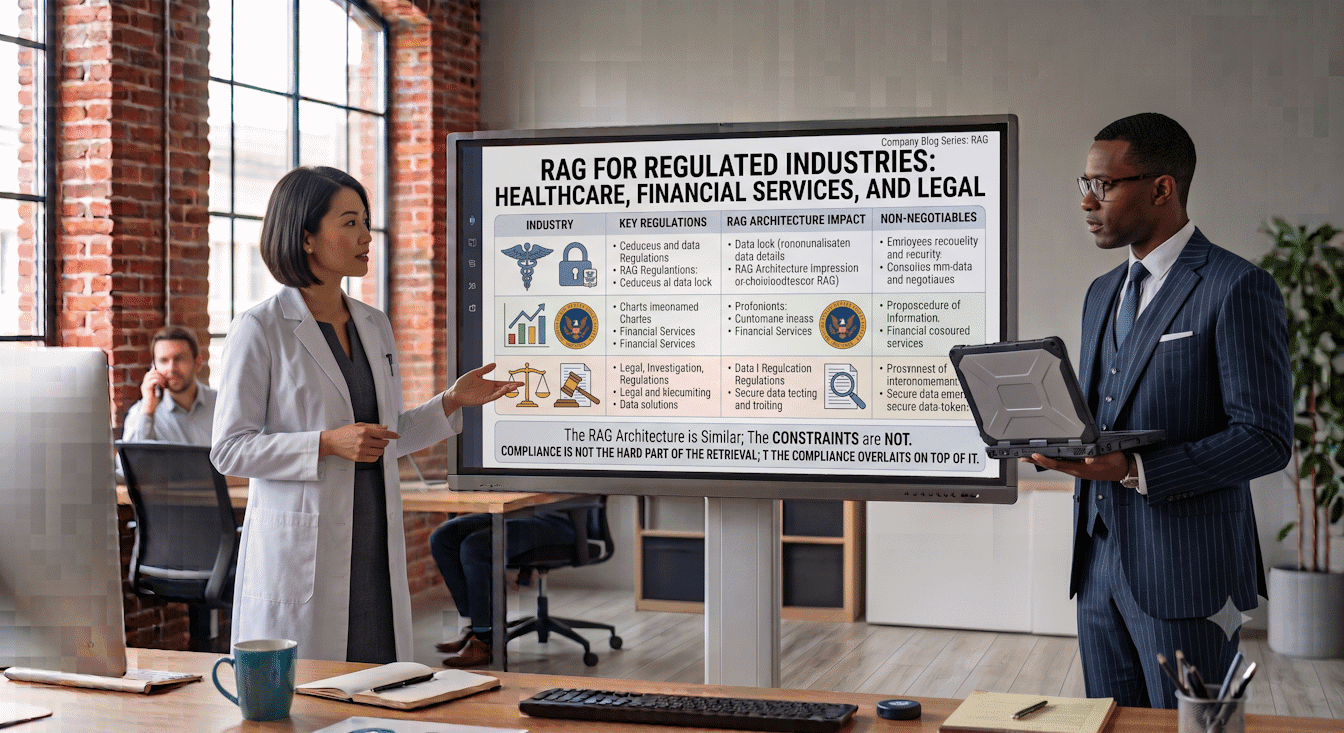
RAG for Regulated Industries: Healthcare, Financial Services, and Legal
Most RAG guides assume every enterprise is the same. For a hospital, a bank, or a law firm, the hard part isn't retrieval — it's the compliance overlay on top of it. Here's what actually changes under HIPAA, SEC/FINRA, and legal privilege, and the common thread — a tamper-evident audit trail and human-in-the-loop review — that runs through all three.
Read the article
Permission-Aware RAG: Why Your AI Must Forget What the User Can't See
The fastest way to turn a helpful AI assistant into a data breach is to let it retrieve without checking permissions. If your assistant reads every document and then answers everyone, it will eventually tell someone something they were never allowed to see. Permission-aware retrieval closes that gap: an answer can only ever be built from sources the person asking is already entitled to open.
Read the article
Data Exfiltration Through AI: The Quiet Channel Nobody Watches
Security teams spend years locking down email, USB ports, and file transfers, then connect an AI assistant to their most sensitive systems and forget it's a channel too. Every prompt is an outbound message, and an outbound message can carry data out. AI-assisted exfiltration is quiet precisely because it rides inside traffic that looks like ordinary use.
Read the article
Content Policy as Code: Turning an Acceptable-Use Policy into Enforcement
Most organizations have an AI acceptable-use policy. Almost none can show that it's enforced, because the policy lives in a document and the AI traffic lives on the wire, and the two never meet. Content policy as code closes that gap: the rules become runtime checks applied to every call, with a record that they ran.
Read the article
What a Hash-Chained AI Ledger Actually Proves to a Regulator
A hash-chained AI ledger is an append-only record where each entry is cryptographically linked to the one before it — so any change to history is detectable. To a regulator, that proves three things a pile of logs cannot: that a record exists, that it hasn't been altered, and that a specific decision happened exactly as shown.
Read the article
Guardrails That Do Not Cost You Latency
A guardrail that adds noticeable delay to every response gets turned off — quietly, by an engineer under pressure to make the product feel fast. The only guardrails that survive production are the ones cheap enough to run on every call without anyone noticing.
Read the article
Stopping Secret Leakage: Keeping API Keys Out of Prompts and Completions
A pasted stack trace, a hardcoded password, a model that echoes back a credential it retrieved — secret leakage is common and costly, and one of the most reliably catchable patterns in AI traffic.
Read the article
Jailbreak Defense That Survives the Next Clever Prompt
Jailbreaks evolve constantly, but they share recognizable shapes. Defending against them with another model is a losing arms race; defending against their structure is not. Here's how to build jailbreak defense that lasts.
Read the article
Red-Teaming Your Own AI: An Enterprise Playbook
You don't know whether your AI assistant is safe until you've tried to break it. Red-teaming turns that from a one-off exercise into a standing practice — adversarial tests run before and after every change, with the results on the record.
Read the article
Indirect Prompt Injection: The Document That Attacks Your Assistant
The most dangerous prompt injection doesn't come from the user — it hides in a document your AI retrieves. Indirect injection turns your own knowledge base into an attack surface. Here's how it works and how to neutralize it.
Read the article
Redacting PII at the Wire: Before the Prompt Ever Leaves Your Boundary
The safest place to remove personal data from an AI prompt is before it crosses your boundary. Redaction at the wire masks PII inbound and outbound as a runtime step, so the model gets the context it needs without the identifiers it doesn't.
Read the article
The 6 Attack Classes Every Enterprise LLM Faces
Enterprise AI faces a small, well-defined set of attacks on the wire: prompt injection, jailbreaks, data exfiltration, PII leakage, secret leakage, and unsafe tool calls. Here's what each looks like, and where it's caught.
Read the article
Why an AI Firewall Has to Be Deterministic, Not Another Model
An AI firewall inspects every prompt and completion crossing your boundary. For regulated enterprise AI it has to be deterministic — rule-based, repeatable, and auditable — not a second model guessing.
Read the article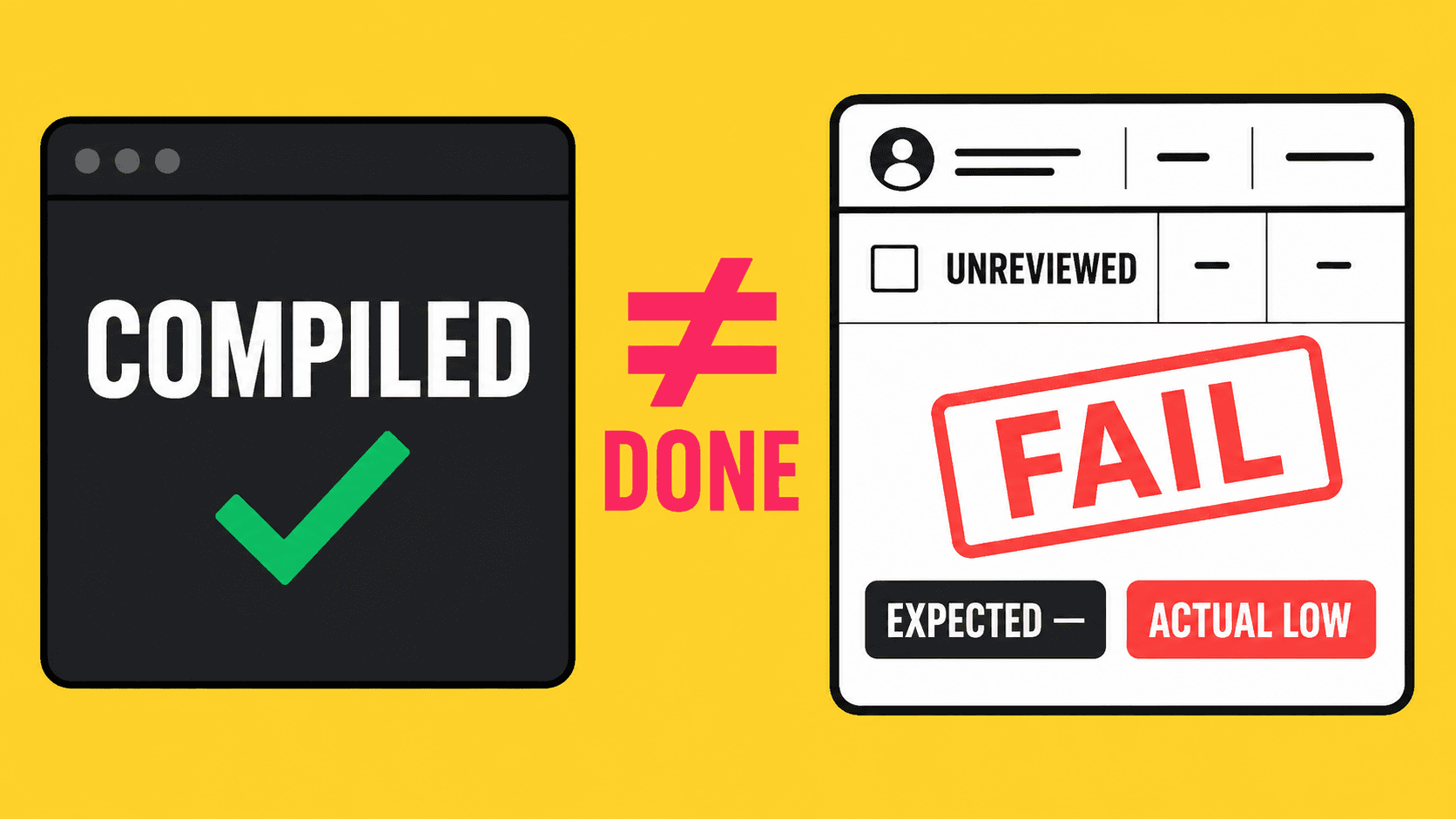
Compiled Is Not Done.
The most dangerous word in autonomous software is “done.” A system that rewards activity ships nothing that works.
Read the article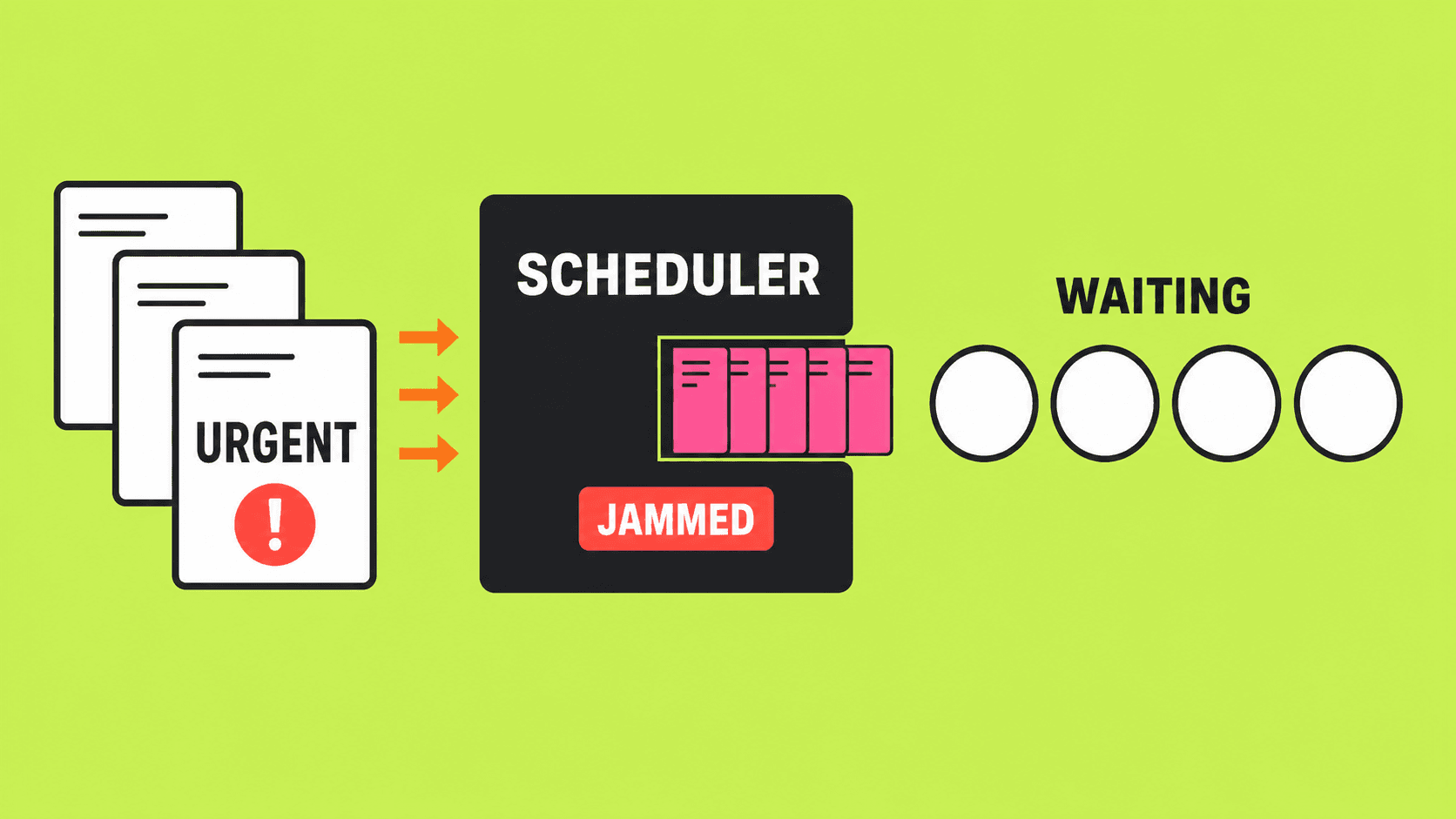
Nobody Assigned This Work.
No sprint board. No manager. The work runs hot where it matters and cools where it doesn't — and the workers follow the heat.
Read the article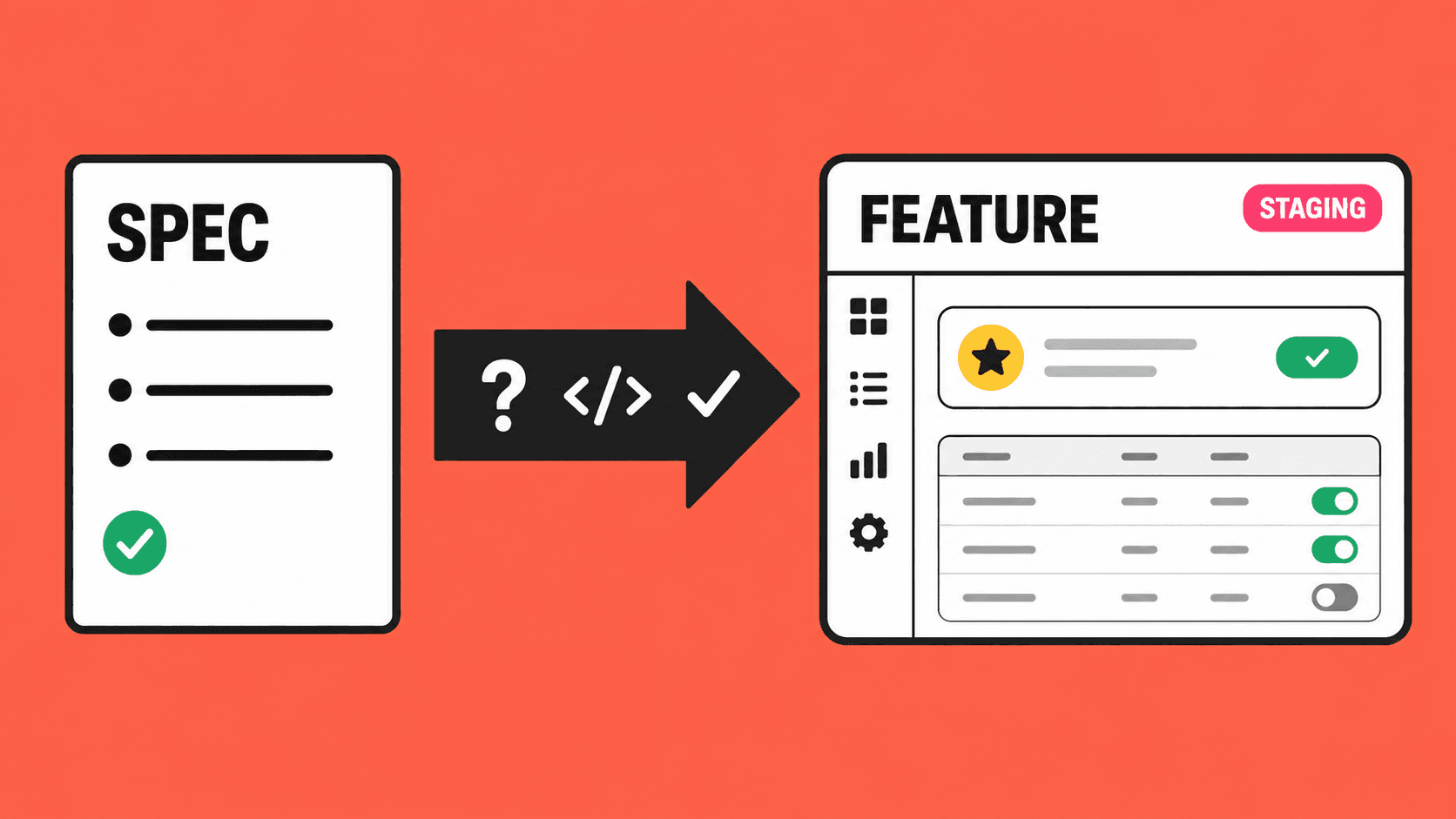
Drop a Spec. Ship a Feature.
The backlog used to be a queue of work waiting for engineers. Now it’s a queue of specifications waiting for a signature.
Read the article
The Organizational Memory Problem: Why Fast-Growing Companies Lose Their Institutional Knowledge
As an enterprise scales, the total amount it knows rises with headcount — but the share any one person can access falls. This article introduces the Knowledge Dilution Curve, names the four inflection points that concentrate knowledge risk, and explains how a Company Brain closes the gap before it becomes an operating problem.
Read the article
Enterprise RAG Implementation: The 8-Phase Deployment Playbook
An 8-phase project playbook for enterprise RAG — from use-case scoping and data audit through security review and production monitoring — based on Sphere's AI Foundry delivery path.
Read the article
RAG vs. Fine-Tuning: The Enterprise Decision Framework (2026)
An 8-criteria decision framework for choosing between RAG and fine-tuning for enterprise AI — with a real financial-services call-through.
Read the article
Compliance as Runtime — Sphere Quarterly · Issue 03
The audit binder is dead. The ledger is the binder. A field guide to making compliance a property of the runtime — every read, write, and AI decision signed by default — by the team that ships the reference implementation.
Read the article
The Self-Rewriting Site — Sphere Quarterly · Issue 02
One URL. Every visitor sees a different page. The memory belongs to them. A field guide to browser-resident engrams, declared visitor intent, and pages composed at view-time by the team that ships the reference implementation.
Read the article
Agent-Ready Sites — Sphere Quarterly · Issue 01
Your site has an API for humans (HTML). In 2026 it needs one for agents (MCP). A field guide to building marketing sites that LLM agents can actually call, by the team that ships the reference implementation.
Read the article