Case Study • AI Inventory Markdown Optimization
We caught 47 SKUs before the fire sale
- Client
- National off-price retailer
- Industry
- Off-Price Retail
- Service
- AI Solutions|Data Analytics
Overview
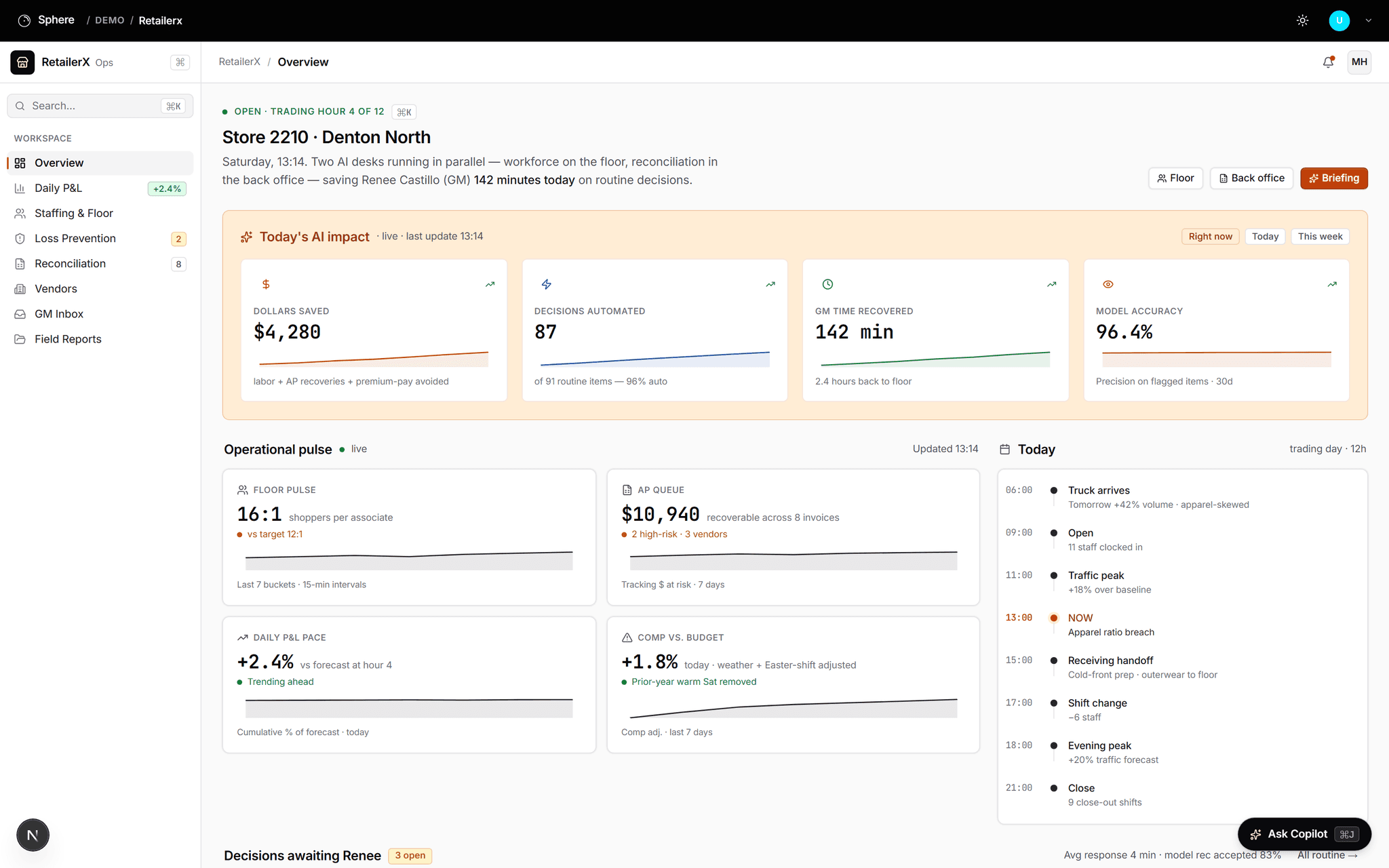
ClearanceIQ is the AI command centre Sphere built for a national off-price retailer. This representative Summer 2026 clearance season follows six stores and shows how the system catches stuck inventory weeks before it becomes a last-week, deepest-discount write-off.
Why does inventory lose margin before teams act?
The longer a unit sits, the more it costs to store and the deeper the eventual markdown has to be. Most teams do not notice a SKU is in trouble until it is already deep into markdown territory.
A SKU stops moving
Historically noticed when someone walks past the rack—often months into the season.
Markdown depth becomes guesswork
A blanket store policy gives up margin on items that never needed the deepest discount.
Six stores make six judgment calls
Regional decisions vary even when the underlying inventory problem is the same.
Our Solution
ClearanceIQ scores inventory continuously, turns every flag into a recommended action, and models the financial effect before a price tag changes.
1. Catch the SKU while there is still room to act
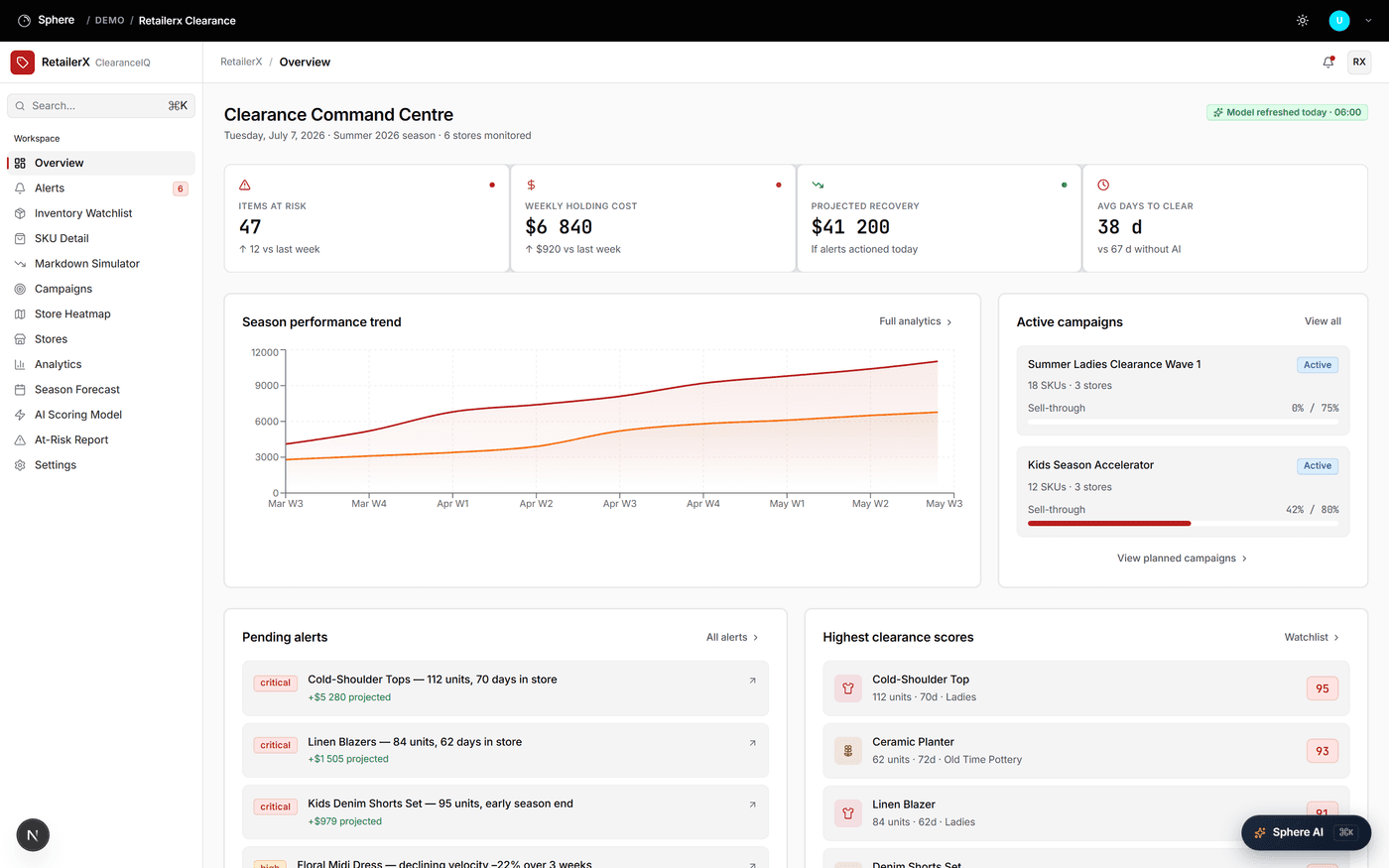
The system caught 112 cold-shoulder tops at day 70, selling at two units a week against a 21-unit peak. It recommended a 40% markdown to $9.99 and a move to the entrance display, projecting $5,280 in recovery versus doing nothing.
2. Price the markdown before approving it
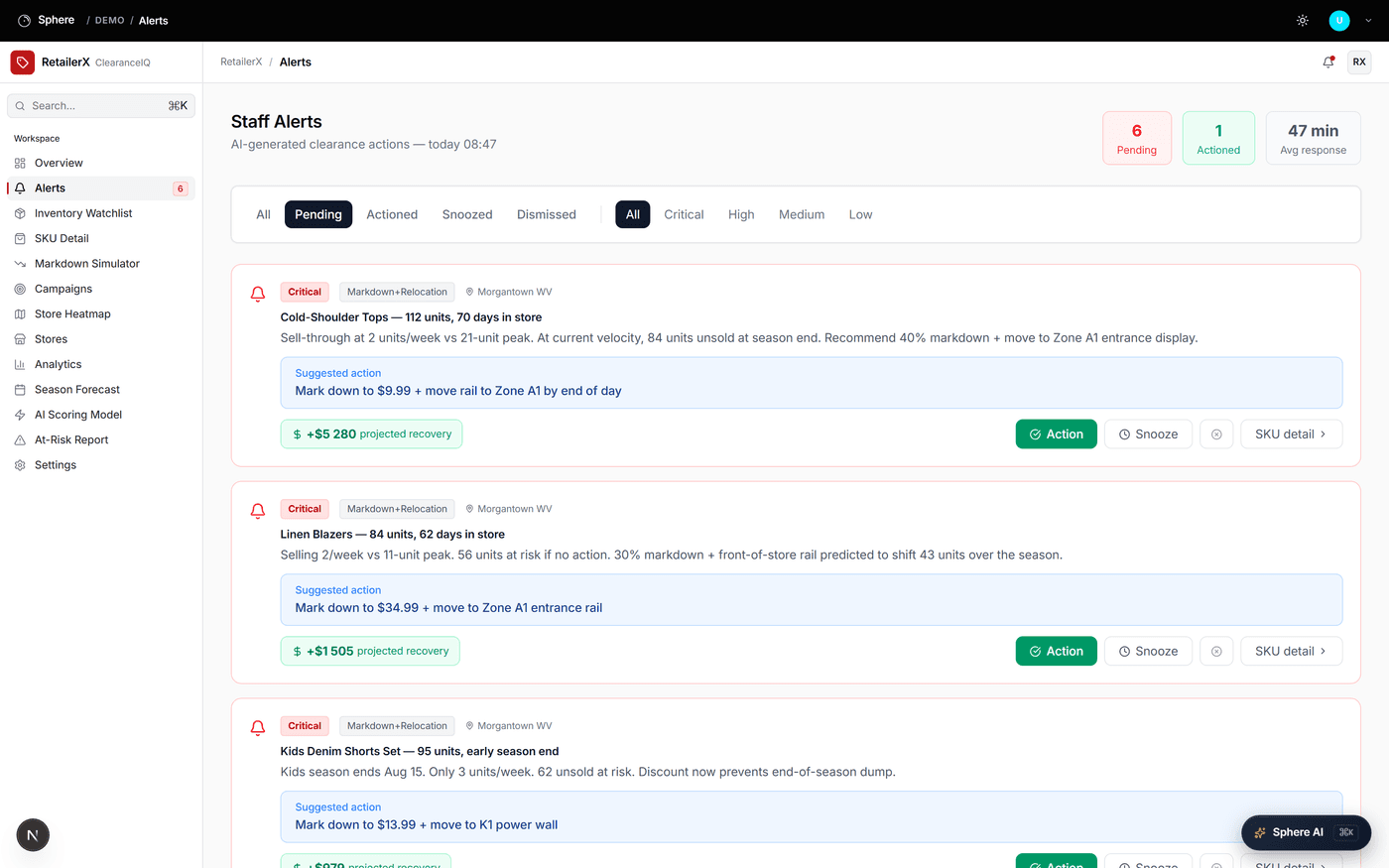
For 84 linen blazers, the Markdown Simulator tested discount depth from 0% to 60% against units sold, revenue, and margin. At the recommended 30% discount, it projected $1,505 in recovered revenue with 49% margin intact.
Key Achievements
Margin protected
Healthy sellers stay at full price while only genuinely stuck items are discounted.
Cash and space recovered faster
Inventory clears in 38 days instead of the 67-day baseline.
Losses taken earlier and smaller
The model acts before the only remaining option is a final-week fire sale.
One policy across the fleet
The same scoring and markdown math runs consistently across every store.
A defensible number before the decision
Finance sees projected recovery and remaining margin before a price changes.
Results
Across the six-store cluster, ClearanceIQ flagged 47 at-risk items and identified $41,200 in projected recovery if the recommended actions were taken that day. Average time to clear a flagged SKU fell to 38 days from a 67-day baseline—nearly halving the time inventory occupied floor and backroom space without earning.
The store cluster, season, and dates are a representative scenario run through Sphere’s anonymized RetailerX Clearance build. Figures are modeled system output, not disclosed production financials.
Organizations around the world trust us


Hear from
our clientsHear from our clients

Lee Ebreo
VP of Engineering at Credit Ninja
These things would not have been achievable if we did not build our own in-house system and if we did not partner with Sphere to help us achieve our goals.

Selah Ben-Haim
VP of Engineering at Prominence Advisors
Our experience with Sphere and their team has been and continues to be fantastic. We keep throwing new projects at them, and they keep knocking them out of the park (including the rescue of a project that was previously bungled by another vendor).

Ben Crawford
Senior Product Manager at Enova Financial
I would expect to be delighted. It's been a really positive experience, working with Sphere, and I would expect you to have the same.

Mark Friedgan
CEO at CreditNinja
Sphere consistently prioritizes the needs of their clients, demonstrating both agility and teamwork. As an offshore team, they have been an integral part of our organization and we plan to continue growing with them.

René Pfitzner
Co-Founder at Experify
Sphere provided excellent full-stack development manpower to augment our team and help push our product forward. They are easy to work with, tech-savvy and proactive.

Bruce Burdick
Chief Information Officer at Integra Credit
We've been working with Sphere and its excellent consultants since our founding. I've found that they are true partners in the success of our business.

Jemal Swoboda
CEO at Dabble
The resources and developers that Sphere Software provides are skilled and have the required technical expertise, but more importantly, they have helped us build a culture of excellence within our team.

Arthur Tretyak
Founder and CEO at IntegraCredit
With Sphere, we were able to migrate in half the time it would take to train an additional FTE… and for a fraction of the cost. Our experience with Sphere has been exceptional.
Lee Ebreo
VP of Engineering at Credit Ninja
These things would not have been achievable if we did not build our own in-house system and if we did not partner with Sphere to help us achieve our goals.
Selah Ben-Haim
VP of Engineering at Prominence Advisors
Our experience with Sphere and their team has been and continues to be fantastic. We keep throwing new projects at them, and they keep knocking them out of the park (including the rescue of a project that was previously bungled by another vendor).

TOP AI CODE GENERATION COMPANY UNITED STATES 2025

TOP AI TEXT GENERATION COMPANY FLORIDA 2025

TOP APP DEVELOPMENT COMPANY MANUFACTURING 2025

TOP ARTIFICIAL INTELLIGENCE COMPANY UNITED STATES 2025

TOP CHATBOT COMPANY UNITED STATES 2025

TOP RECOMMENDATION SYSTEMS COMPANY UNITED STATES 2025

GLOBAL RECOGNITION AWARDS 2026

BEST IN AI FOR DOCUMENTATION VALIDATION 2026

BEST IN AI POWERED INVOICE AUDITING 2026

GLOBAL TECH WINNER 2026

MOST INNOVATIVE TECHNOLOGY CONSULTING FIRM 2026

GLOBAL GENERATIVE AI AWARD 2026 WINNER