Case Study • Field Operations
The rain hit Nashville on schedule. The $38k loss didn't.
- Client
- PavingX
- Service
- AI Solutions|Data Analytics
Overview
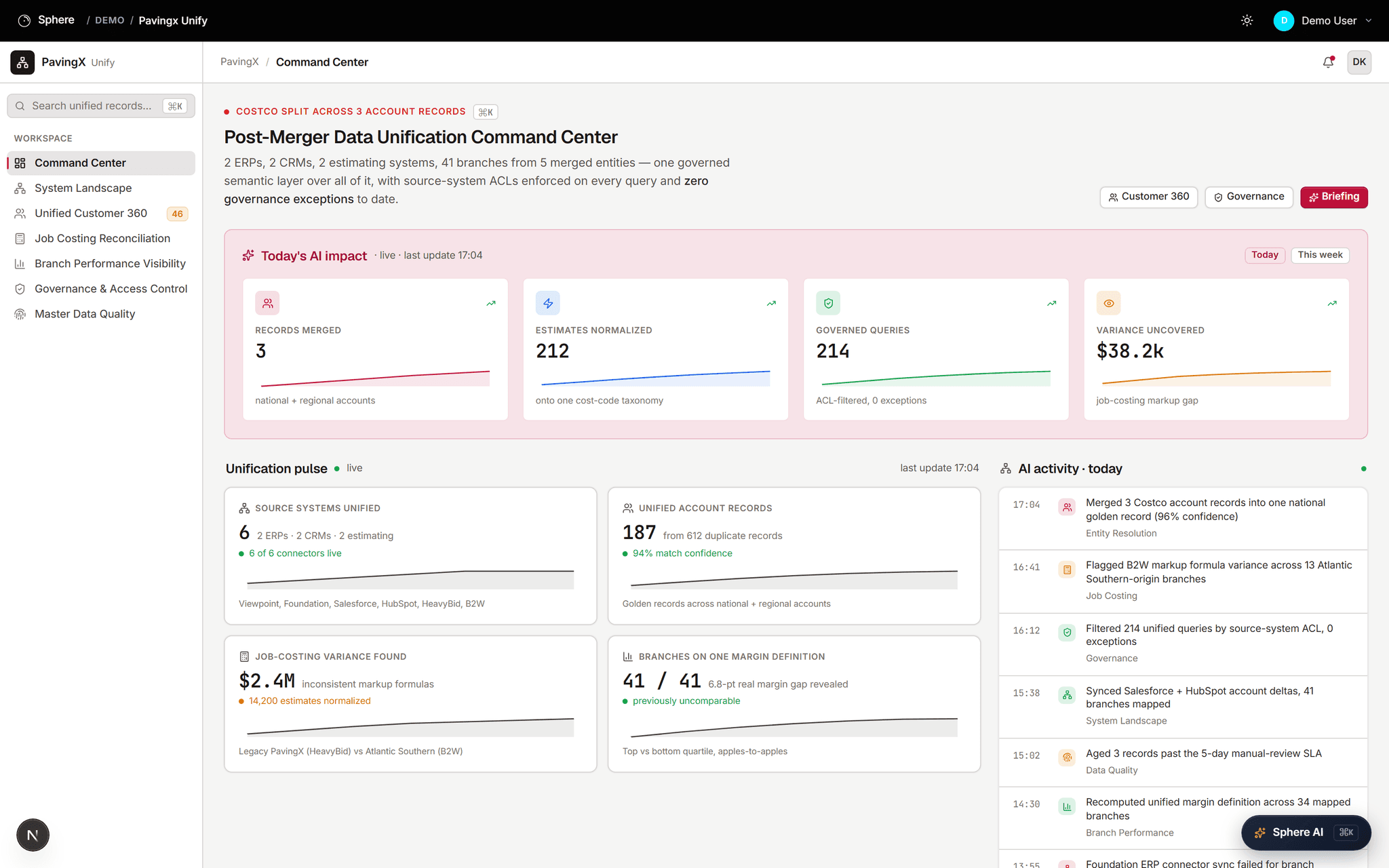
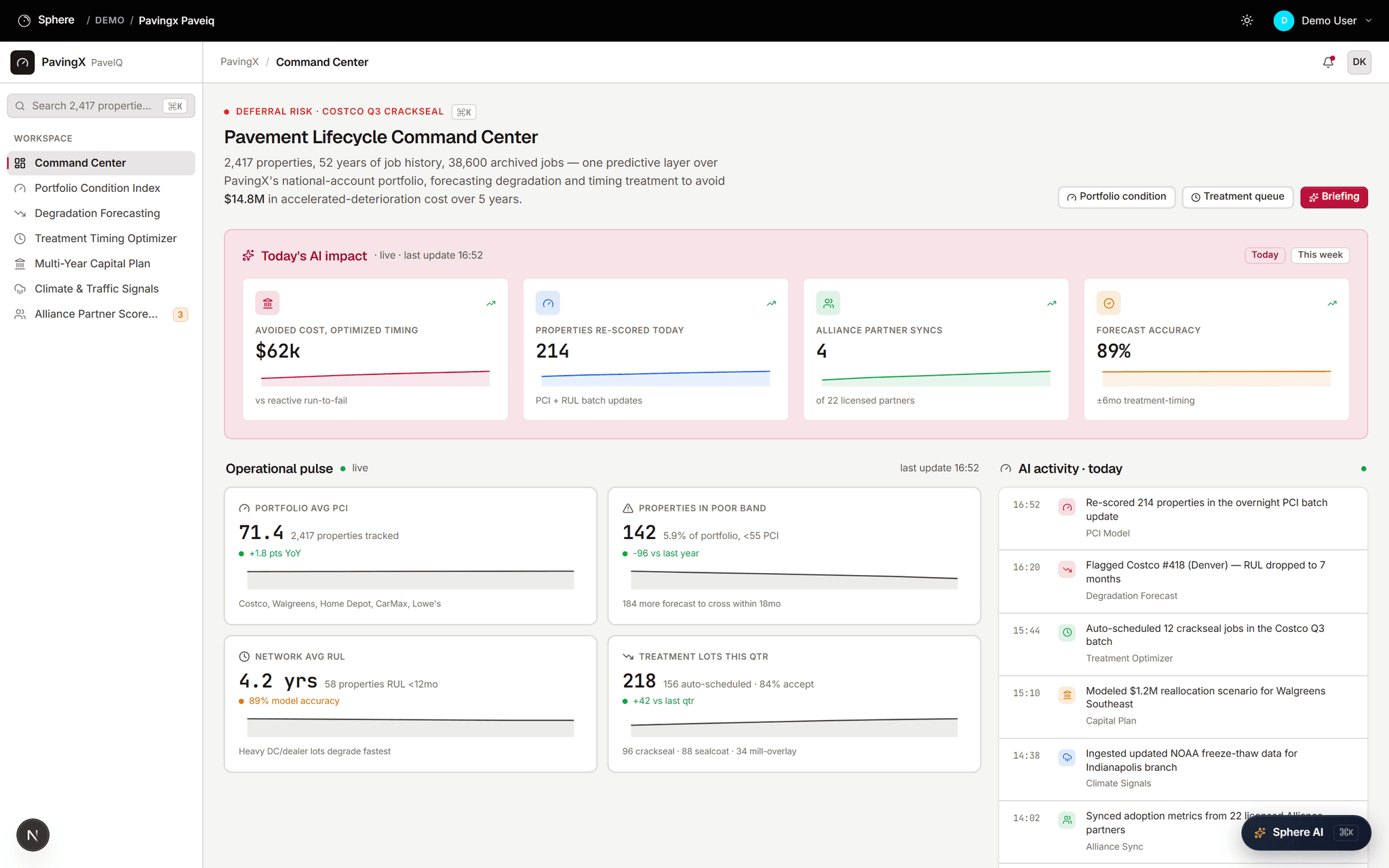
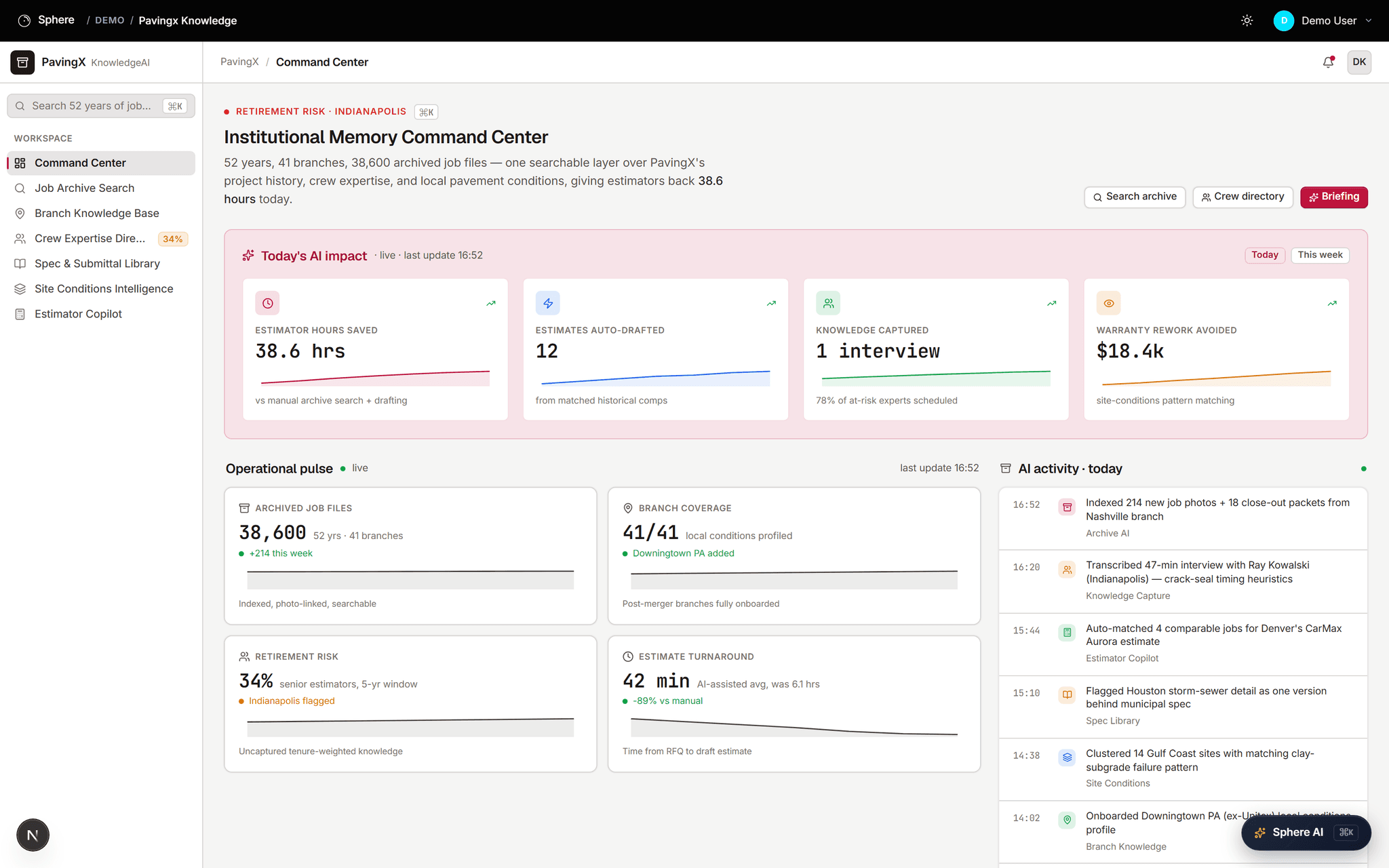
A field report on OpsAI, the operations command center Sphere built for PavingX — a national pavement management and paving contractor — narrated across one representative day across a 40+-branch, 300+-crew network: routing, weather-driven replanning, work-order intake, and the AP pipeline unifying four newly merged back-office systems into one.
The Situation
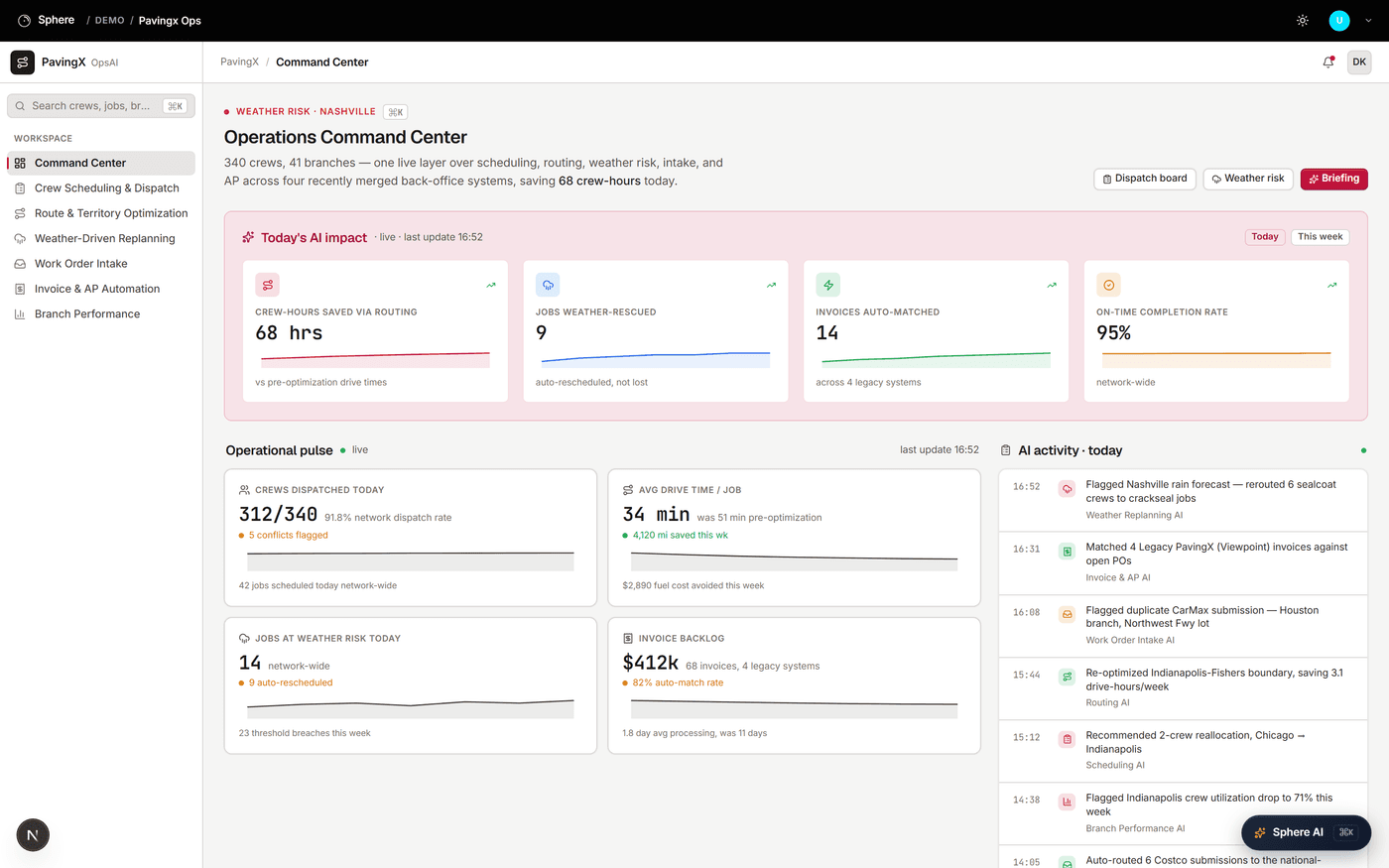
It's a weekday morning inside OpsAI, the command center running PavingX's 40+-branch network. Crews are on the books across the network; 91.8% are dispatched today, working toward roughly 10,400 jobs this year for accounts like WarehouseCo, PharmacyCo, HomeCo, AutoCo, and HardwareCo. Five schedule conflicts are already flagged this morning, average dispatch lead time sits at 14 hours, and the desk is already watching weather, routing, and an in-flight AP migration across four newly acquired companies — all before the first crew hits a jobsite.
Rain forecast hits a sealcoat schedule
Crews stand down for the day, or get shifted last-minute by phone calls.
A work order arrives from a national account
Manually triaged and routed — avg 47 minutes, sometimes to the wrong branch.
Four merged companies, four AP systems
$412k across 68 invoices stuck in translation between Sage, QuickBooks, Foundation, and Viewpoint.
Our Solution
OpsAI watches every branch simultaneously — weather thresholds, crew capacity, work-order routing, and AP matching — and acts before a dispatcher has to notice.
1. Weather-Driven Replanning
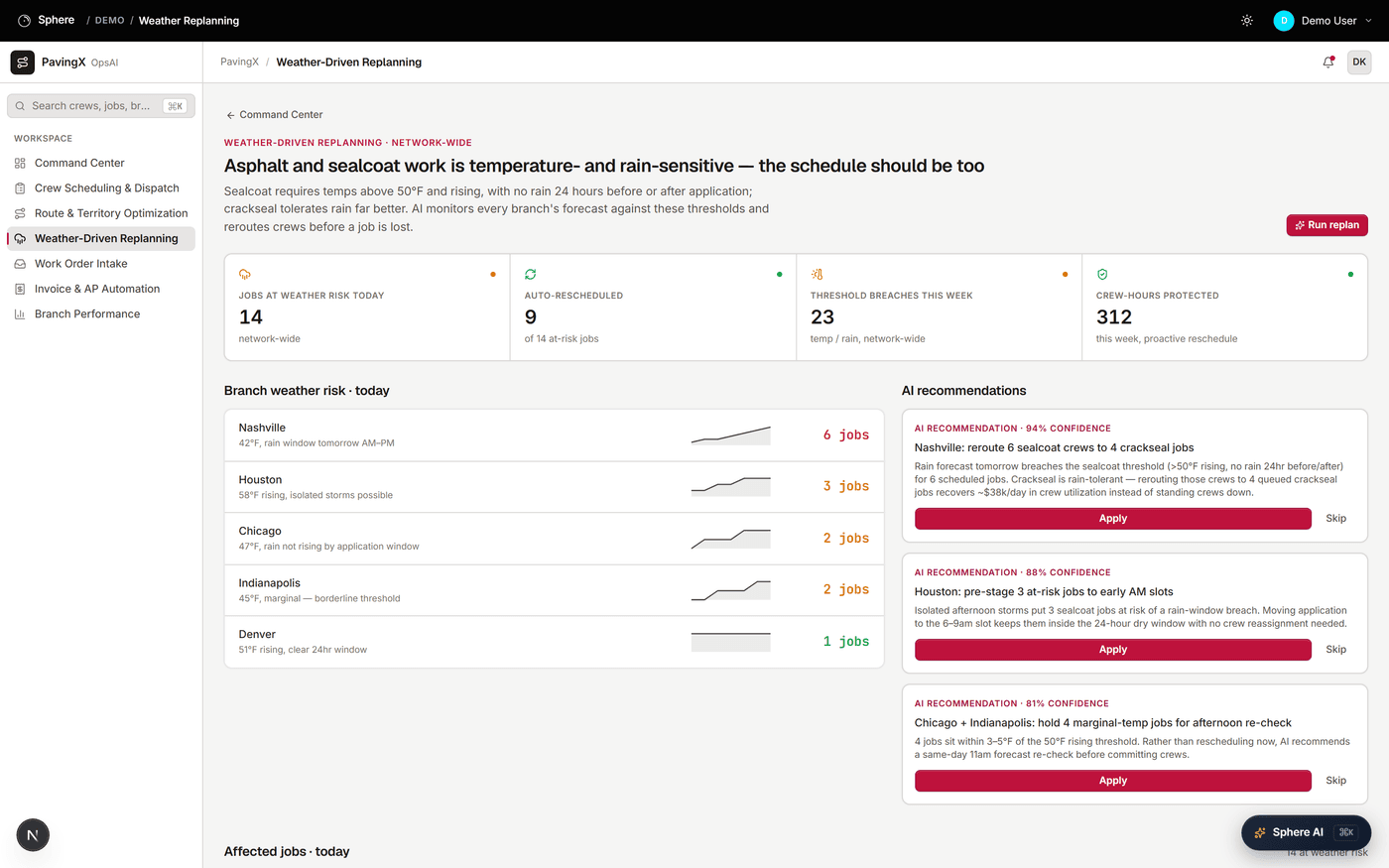
Nashville's forecast just crossed a threshold: rain tomorrow morning through afternoon, and sealcoat needs temperatures above 50°F and rising with a clean 24-hour window on both sides — crackseal tolerates rain far better. Left alone, that forecast would strand 6 scheduled sealcoat crews, including jobs for TravelCo and a PharmacyCo location. The desk doesn't wait for a dispatcher to notice: at 94% confidence, it reroutes those 6 crews to 4 already-queued crackseal jobs instead, recovering an estimated $38,000 in crew utilization that would otherwise have been lost standing crews down for a day.
2. Invoice & AP Automation
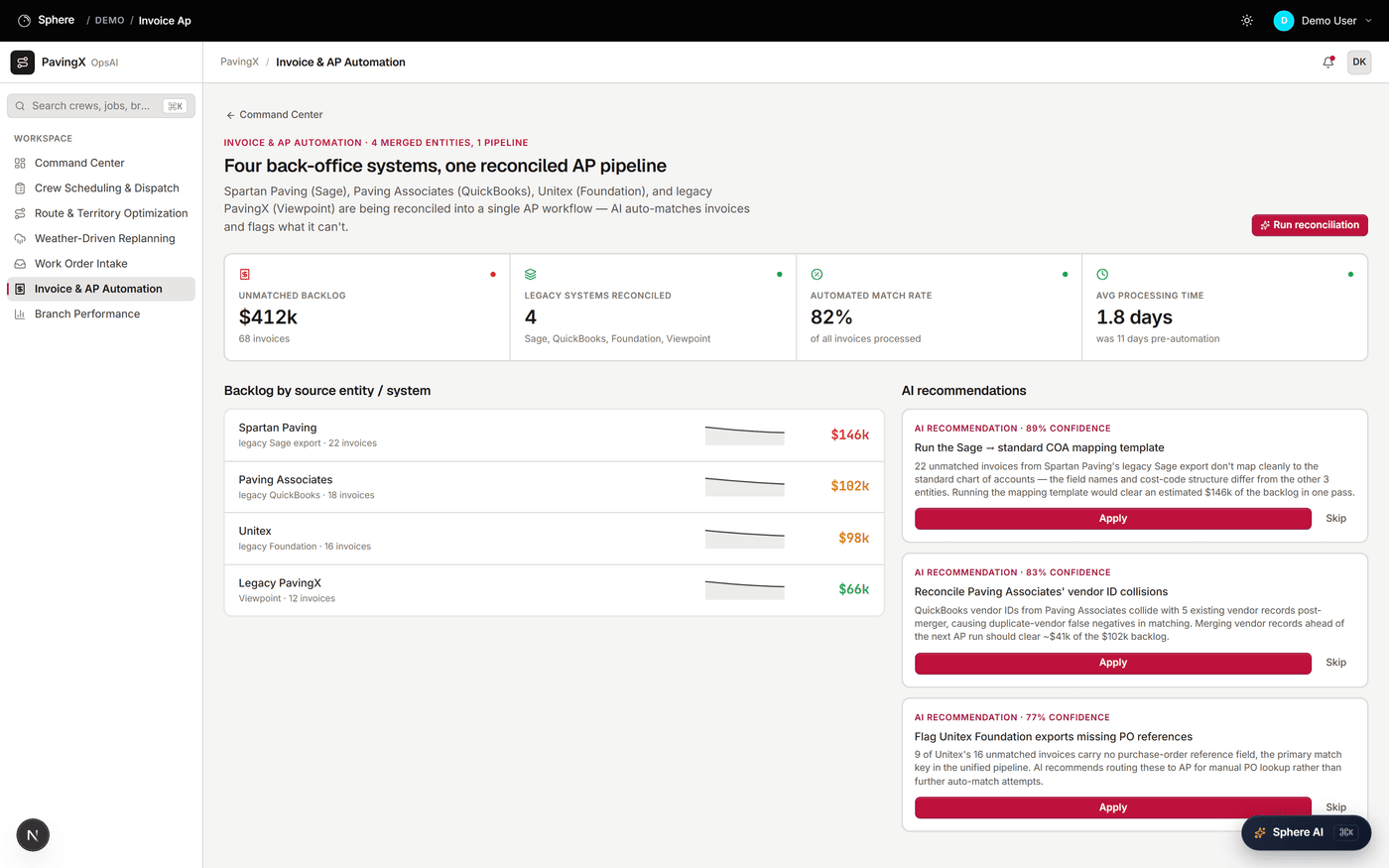
In the back office, a different kind of weather is being worked through: PavingX's 2024 merger with Meridian Paving, plus the acquisitions of Crestline Paving, Keystone Paving, and Unigrade, brought four different accounting systems into one company — Sage, QuickBooks, Foundation, and Viewpoint. $412k across 68 invoices sits unmatched across them. The desk's biggest single recommendation today: run a mapping template against Crestline Paving's 22 Sage-export invoices, clearing an estimated $146k of that backlog in one pass instead of a controller reconciling each one by hand.
Why This Matters to PavingX's P&L
Weather stops being a coin flip
Thresholds are monitored per branch, per job type, continuously; crews get rerouted to work they can still do, instead of standing down or risking a failed application.
A merger's back office gets one pipeline instead of four
Sage, QuickBooks, Foundation, and Viewpoint reconcile into a single AP process, clearing $412k of legacy backlog with one systematic pass rather than four separate reconciliations.
National accounts get routed right the first time
96% of work orders — from WarehouseCo, PharmacyCo, AutoCo and others — reach the correct branch and crew type without a human triage step.
Crews go where the headroom is, not just where the schedule says
When a 31-year foreman's pre-retirement schedule leaves Indianapolis short-staffed, the desk flags the reallocation as soon as the gap opens, before utilization visibly drops.
Field performance is visible branch by branch
Denver's 96% utilization and Indianapolis's 71% are both visible in the same view, so the gap gets a plan, not just a quarterly conversation.
Results
Across the network today, that's the pattern repeating at every branch: a schedule conflict resolved before it becomes a missed job, a work order routed before someone has to call and ask which branch it belongs to, an invoice matched before it ages another billing cycle. Rolled up over 12 months, the same desk is modeled to save 18,200 drive-hours a year from routing optimization, avoid $2.1M in weather-reschedule cost, cut AP processing time 71%, and lift on-time job completion 9 points to its current 94% — across a network that, a year ago, was four separate companies running four separate playbooks.