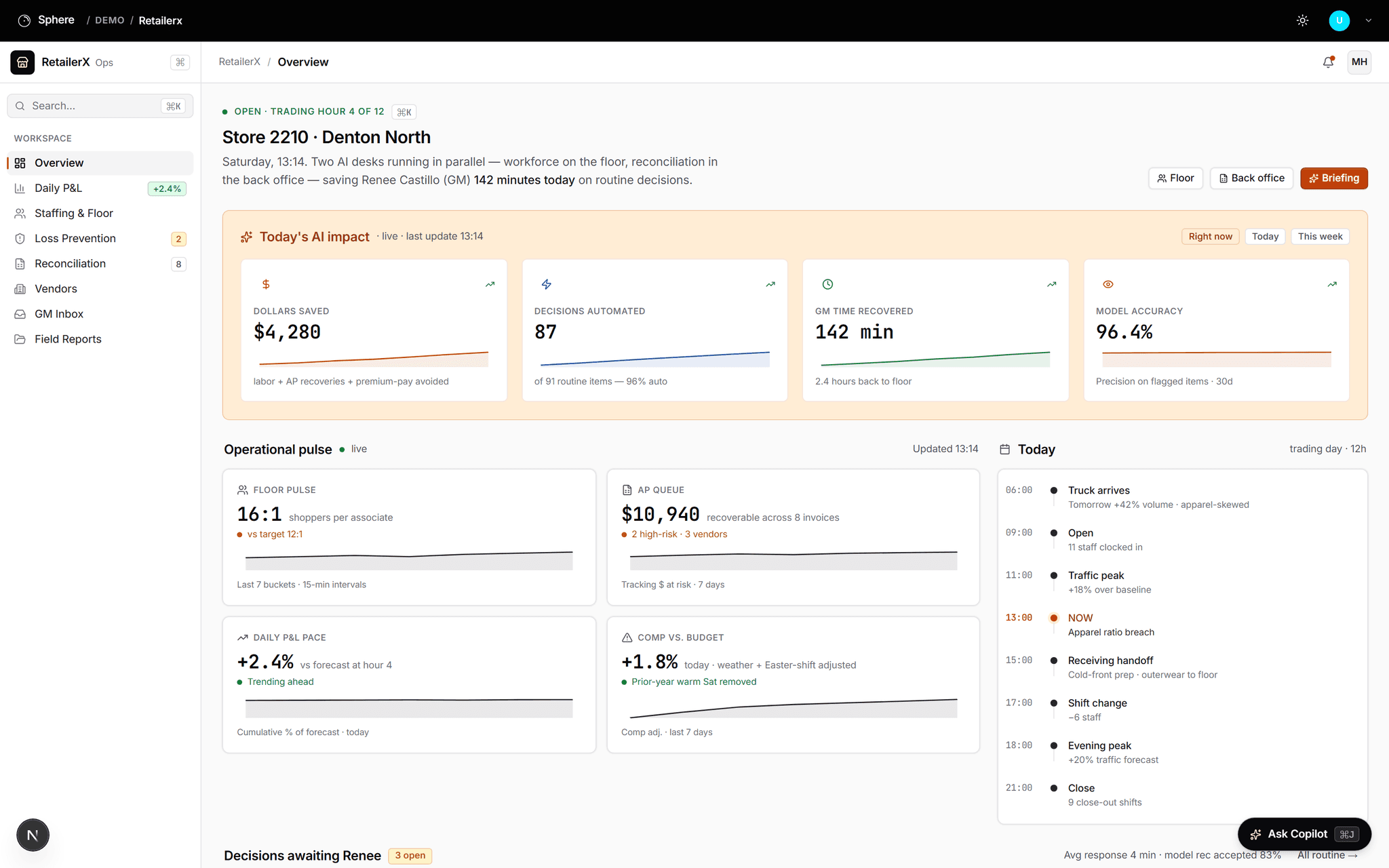
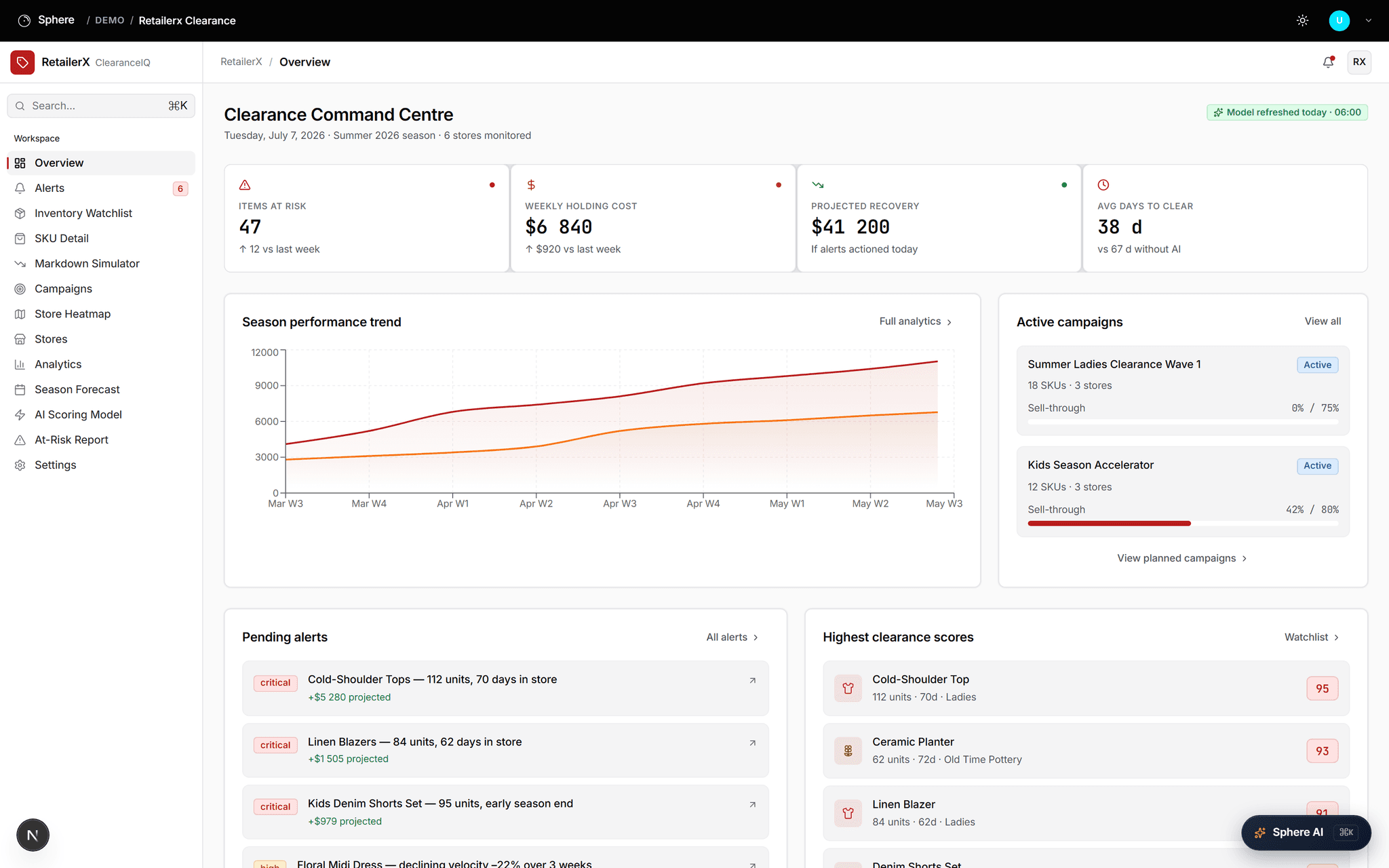
Case Study · Retail · AI Scheduling
AI break scheduling: labor violations cut 85% in 90 days.
- Client
- Confidential
- Industry
- Retail · Workforce scheduling
- Service
- Machine Learning|Sphere Delivery Pods
What actually changed, situation by situation
Chapter 01
The labor-law clock isn’t ambiguous — it’s unwatched.
Every meal-break violation costs one hour of pay. They’re recoverable because each one happens inside a window we can predict, monitor, and avoid.
California Labor Code §512 requires a 30-minute, duty-free meal period before the end of the fifth hour of work, plus a second meal before the end of the tenth hour. The duty was clarified by the California Supreme Court in Brinker Restaurant Corp. v. Superior Court (53 Cal.4th 1004, April 2012) — the employer must provide the meal and relieve the employee of duty, but need not police whether the employee takes it.
The penalty when the employer does not provide a compliant meal is one additional hour of pay at the employee’s regular rate, owed for each workday with a violation (DIR/DLSE FAQ, January 2026). Rest-break premiums are separate, with a maximum of two premiums per day. Across California retail, the typical hourly rate puts a single missed meal at $17–$22.
Multiply that across a 25-store footprint with 1,800 shifts a week and a 15–25% baseline violation rate — typical for retailers without a real-time compliance system (Legion State of the Hourly Workforce, October 2024) — and annual exposure lands in the $300k–$500k range before any actual settlement. No PAGA multiplier included in that number.
Chapter 02
Rules first, model second.
A deterministic rules engine catches every violation the law defines. The AI never re-classifies; it explains, re-times, and writes the message.
The compliance engine is deterministic. Every meal-by-fifth-hour and rest-per-four-hour rule is encoded. The AI is not allowed to re-classify what is or is not a violation. The model’s job is to propose a fix and write the message that goes with it. This split matters for audit defensibility — there is always a deterministic paper trail.
The three feeds are simple: 15-minute foot-traffic counts from a people counter (RetailNext, ShopperTrak, or Brickstream) over their JSON feed; the published schedule and live clock events from a workforce management system (Kronos UKG, Legion, or Workday); and outbound notifications via Twilio (SMS), email, and the company app. Identity is OIDC/SAML so role permissions are honored end-to-end.
Every recommendation lands in an approvals inbox. Managers approve or reject with one tap. Published research on comparable AI-assisted workflows finds approval rates settle at 85–92% once managers have two weeks of exposure to the system — high enough to be useful, low enough to retain meaningful human judgment.
Chapter 03
What a 25-store deployment looks like, on paper.
Numbers below are modeled from published industry data, not measured at a live customer. Each range reflects baseline variability across published studies.
The numbers behind the engagement
| Metric | Before | After | Delta |
|---|---|---|---|
| Meal-break violations / 1,000 shifts | 180–230 | 20–40 | −83% to −90% |
| Rest-break violations / 1,000 shifts | 80–110 | 15–25 | −75% to −85% |
| Premium-pay exposure (annualized) | $300k–$500k | $80k–$150k | −$180k to −$420k |
| Weekend conversion rate | 21–23% | +0.4 to +0.7 pts | ↑ 0.4 to 0.7 pts |
| GM hours / week on scheduling | 8–11 | 2–4 | −5 to −8 hrs |
| AI recommendation accept rate (steady state) | — | 85–92% | — |
Estimate your meal-break exposure
An estimate, not a quote. It uses the 85% reduction delivered in the engagement.
Illustrative. Based on the delivered 85% reduction; your figures will differ.
The services behind this engagement
Stay Ahead in 2026. Talk to a Sphere expert.
Tell us where scheduling costs you compliance and we will tell you what we would change first.
Chapter 04
The secondary effect we didn’t design for: turnover.
Predictable break times correlate with predictable shifts. Hourly retail loses people to schedule chaos. Stabilizing the schedule is the cheapest retention lever there is.
Legion’s 2024 study found that 76% of hourly workers cite schedule predictability as a top-three reason for staying (Legion, October 2024). National retail turnover for hourly associates ran 60%+ in 2024 (NRF, 2024). Each point of turnover saved is worth roughly $1,600 per associate in re-hire and on-board cost (Korn Ferry, 2024).
A 3–5 point reduction in 90-day voluntary turnover is a defensible expectation when break-time predictability rises and last-minute coverage asks fall. On a 25-store footprint with ~1,200 hourly associates, that is $58k–$96k in retention value per year — not included in the compliance savings above.
What is delivered, and what is context
Delivered
- Deterministic compliance engine over CA §512 (meal-by-5, rest-per-4).
- AI break re-timing with structured JSON output and priority ranking.
- Per-employee notifications in EN/ES with channel + char-budget aware drafts.
- Approvals inbox with one-tap approve/reject and decision audit.
- Scenario simulator over traffic, weather, promotions, shift edits, floaters.
- Zone-by-zone coverage map with under-cover flagging.
- Shift-swap marketplace with ranked candidate fit and SMS drafts.
- Copilot with full operating-state scope, citing record IDs.
Context
- 25-store, $400M revenue retailer with California compliance exposure.
- Baseline violation rates from
Legion 2024andDLSEclaim data. - Conversion lift modeled at
+0.4 to +0.7 ptsfrom peak-coverage meta-analysis. - Premium-pay avoidance at $17.50 blended California retail hourly rate.
- Turnover effect from
Korn Ferry 2024hourly-retail data. - No PAGA multiplier or settlement uplift in the model.
Frequently asked questions
Under California Labor Code §512, an employer who fails to provide an unpaid 30-minute meal break before the end of the fifth hour of work owes the employee one additional hour of regular pay as premium pay. The California Supreme Court confirmed in Brinker Restaurant Corp. v. Superior Court (2012) that the duty is to make the meal available and relieve the employee of duty. Each missed meal and each missed rest constitutes a separate premium owed. For a 25-store retailer at a 15–25% baseline violation rate, annual exposure typically runs $300,000–$500,000 before any PAGA settlement uplift.
Sphere builds AI-powered scheduling systems that integrate with Kronos UKG, Legion, and Workday to monitor the labor-law clock in real time and re-time breaks before violations occur. A typical Sphere deployment for a mid-market California retailer takes 90 days from contract to production. Sphere combines a deterministic rules engine (for audit defensibility) with an AI narrative and re-timing layer (for speed and manager adoption).
An AI break scheduler combines the labor-law compliance clock with forecasted foot traffic and current staff-on-floor counts. It re-times planned breaks so meal periods fall outside forecasted peaks while still landing inside their legal window. Managers approve recommendations in one tap; the system drafts and dispatches the employee notification in their preferred language. Industry research finds manager approval rates of 85–92% once trust is established.
No. Sphere’s system proposes; the manager decides. The compliance engine classifies violations deterministically — the AI cannot override that classification, only propose a fix. This separation is essential for audit defensibility and for manager trust during rollout.
Compliance metrics typically move within two weeks of integration. Conversion lift takes six to eight weeks to read above the noise. Manager-time savings show up immediately. Sphere recommends a 60-day pilot at one store before chain-wide commitment.
For a 25-store mid-market retailer, expect a one-time integration build cost shared across the footprint, plus roughly $400–$600 per store per month for inference and notification volume. Payback against avoided premium-pay exposure alone typically runs under 90 days. Sphere provides a fixed-scope deployment at a defined price — no open-ended hourly billing.
Organizations around the world trust us


Hear from
our clientsHear from our clients

Lee Ebreo
VP of Engineering at Credit Ninja
These things would not have been achievable if we did not build our own in-house system and if we did not partner with Sphere to help us achieve our goals.

Selah Ben-Haim
VP of Engineering at Prominence Advisors
Our experience with Sphere and their team has been and continues to be fantastic. We keep throwing new projects at them, and they keep knocking them out of the park (including the rescue of a project that was previously bungled by another vendor).

Ben Crawford
Senior Product Manager at Enova Financial
I would expect to be delighted. It's been a really positive experience, working with Sphere, and I would expect you to have the same.

Mark Friedgan
CEO at CreditNinja
Sphere consistently prioritizes the needs of their clients, demonstrating both agility and teamwork. As an offshore team, they have been an integral part of our organization and we plan to continue growing with them.

René Pfitzner
Co-Founder at Experify
Sphere provided excellent full-stack development manpower to augment our team and help push our product forward. They are easy to work with, tech-savvy and proactive.

Bruce Burdick
Chief Information Officer at Integra Credit
We've been working with Sphere and its excellent consultants since our founding. I've found that they are true partners in the success of our business.

Jemal Swoboda
CEO at Dabble
The resources and developers that Sphere Software provides are skilled and have the required technical expertise, but more importantly, they have helped us build a culture of excellence within our team.
Arthur Tretyak
Founder and CEO at IntegraCredit
With Sphere, we were able to migrate in half the time it would take to train an additional FTE… and for a fraction of the cost. Our experience with Sphere has been exceptional.
Lee Ebreo
VP of Engineering at Credit Ninja
These things would not have been achievable if we did not build our own in-house system and if we did not partner with Sphere to help us achieve our goals.
Selah Ben-Haim
VP of Engineering at Prominence Advisors
Our experience with Sphere and their team has been and continues to be fantastic. We keep throwing new projects at them, and they keep knocking them out of the park (including the rescue of a project that was previously bungled by another vendor).

TOP AI CODE GENERATION COMPANY UNITED STATES 2025

TOP AI TEXT GENERATION COMPANY FLORIDA 2025

TOP APP DEVELOPMENT COMPANY MANUFACTURING 2025

TOP ARTIFICIAL INTELLIGENCE COMPANY UNITED STATES 2025

TOP CHATBOT COMPANY UNITED STATES 2025

TOP RECOMMENDATION SYSTEMS COMPANY UNITED STATES 2025

GLOBAL RECOGNITION AWARDS 2026

BEST IN AI FOR DOCUMENTATION VALIDATION 2026

BEST IN AI POWERED INVOICE AUDITING 2026

GLOBAL TECH WINNER 2026
GLOBAL GENERATIVE AI AWARD 2026 WINNER