Case Study · AI Foundry
We Replaced Our Entire SaaS Stack with AI We Built Ourselves — in 20 Days
- Client
- Sphere
- Service
- Platform Reboot™|AI Foundry|Precision-Driven Engineering|Zero Vendor Lock-In
The Situation
A Growing SaaS Bill. Fragmented Systems. No Single Source of Truth.
Sphere’s team used its own AI Foundry and Precision-Driven Engineering methodology to replace CRM, marketing automation, chatbot, customer support, and lead generation — eliminating $110,000 in annual SaaS and subscription fees and going live in production in under three weeks.
Like most modern businesses, Sphere was running on a stack of best-of-breed SaaS tools — each one solving a narrow problem, none of them fully integrated, and collectively costing tens of thousands of dollars every year. We decided to practice what we preach.
🔴 The Problem
- Five separate platforms — CRM, marketing automation, chatbot, customer support, lead gen — with no unified data layer
- $110,000 per year in recurring SaaS and subscription fees with annual price escalation
- Manual handoffs between systems causing lead leakage and slow response times
- Generic AI features bolted onto legacy SaaS tools — not purpose-built for our workflows
- No proprietary data advantage; every conversation, lead, and interaction owned by a vendor
- Integration tax: constant maintenance, API limits, and sync failures across platforms
🟢 The Opportunity
- Replace all five systems with a single AI-native platform built on our own infrastructure
- Eliminate recurring SaaS fees — convert CapEx investment into long-term operational savings
- Build proprietary AI that knows our business, our voice, and our buyer journey
- Create a unified data layer: every lead, conversation, and outcome in one governed system
- Demonstrate Sphere’s AI Foundry and Precision-Driven Engineering methodology on ourselves
- Produce a working reference implementation our clients can evaluate firsthand
What We Replaced
Five Systems. One AI-Native Platform.
Each tool we retired was replaced by a purpose-built AI module — trained on our data, connected to our workflows, and owned entirely by Sphere.
Contact management, pipeline tracking, and deal intelligence — now AI-powered and integrated with every other module.
AI-drafted email sequences, dynamic segmentation, and campaign orchestration grounded in actual buyer behavior.
RAG-powered AI agent trained on Sphere’s full service catalog, case studies, and FAQs — not a scripted decision tree.
AI triage, response drafting, and resolution tracking — with human-in-the-loop escalation paths built in from day one.
AI-scored inbound leads, automated qualification sequences, and intent-based outreach — all connected to the pipeline layer.
The System in Action
See the Platform Running in Production
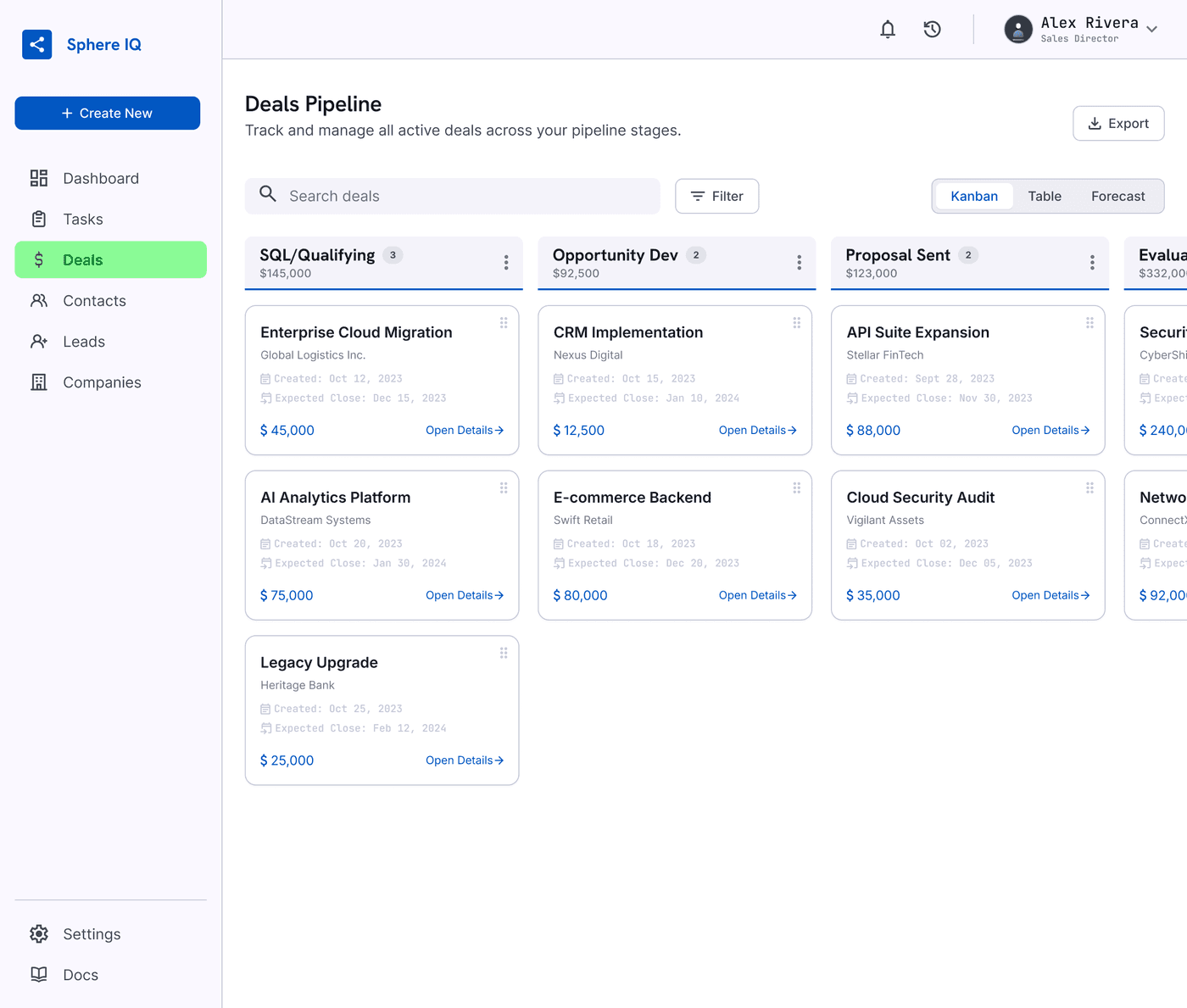
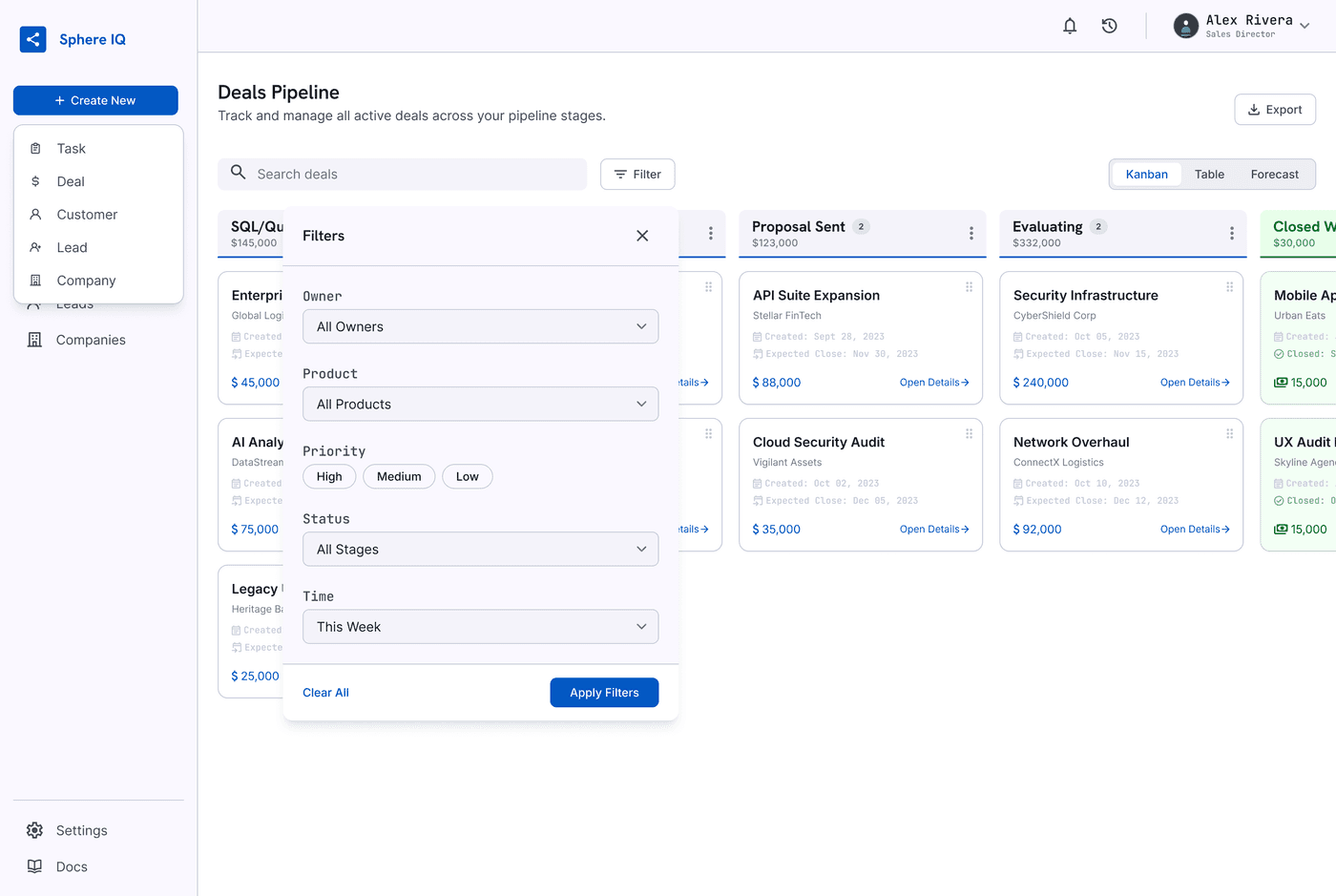
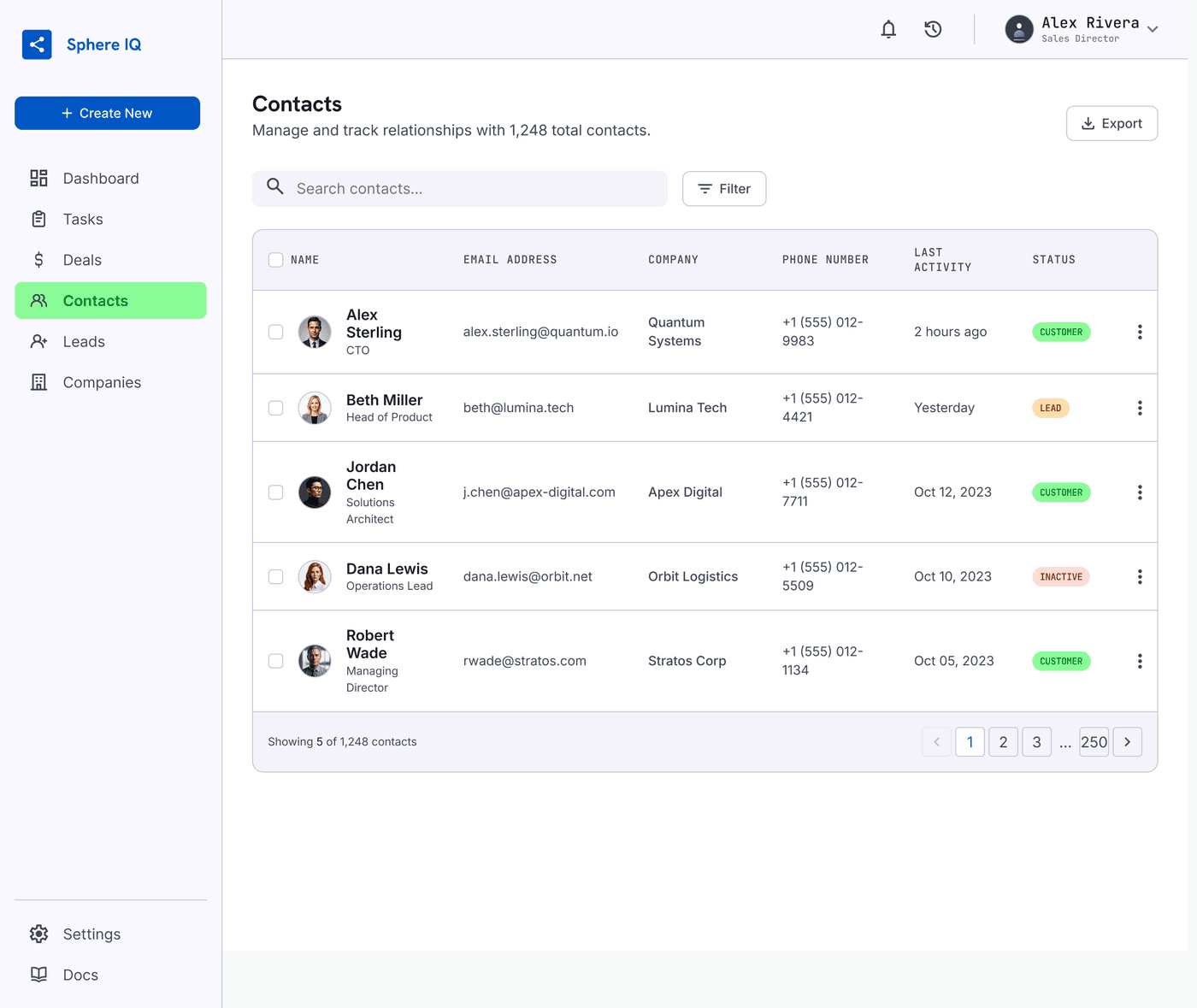
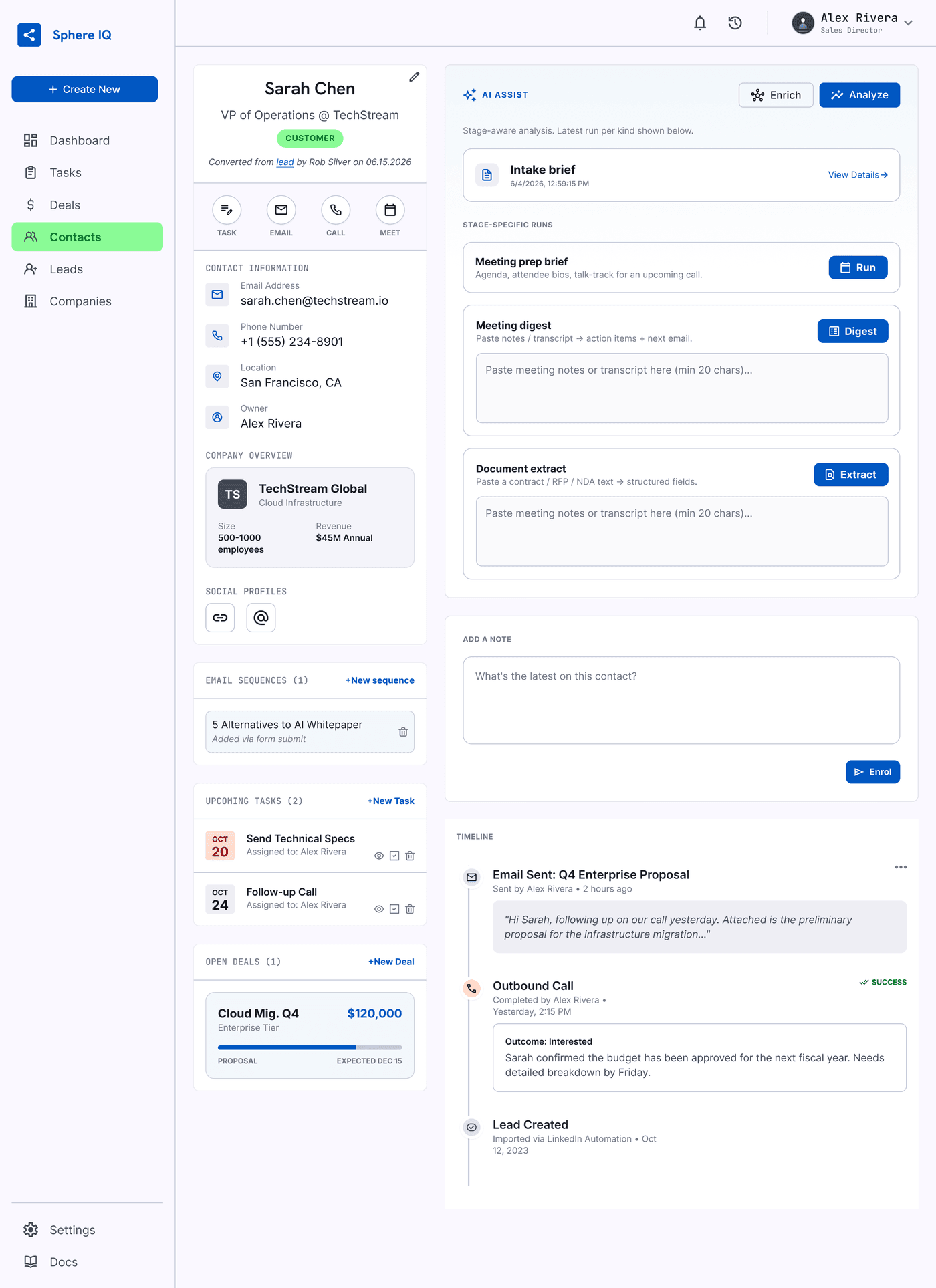
The screenshots below show the live AI-native platform Sphere built and deployed — a single, unified interface replacing five separate SaaS tools.
AI-Native CRM & Pipeline Dashboard
unified contact view, AI-scored pipeline, and deal intelligence, all in one interface.
Pipeline Segmentation & Filters
slice deals by owner, product, priority and stage in real time.
Contacts & Lead Status
every relationship in one governed list, with AI-classified status.
Contact 360 with AI Agent
the embedded agent drafts intake briefs, meeting prep, and digests, then logs every touch to a unified timeline.
How We Did It
Precision-Driven Engineering: The 20-Day Build
Sphere’s AI Foundry methodology doesn’t start with technology — it starts with workflow mapping and success metrics. Here’s exactly how we went from problem statement to production in 20 days.
Documented current-state workflows across all five platforms. Identified data flows, integration points, and human decision gates. Defined the unified data model, AI tool access scopes, and governance controls. Finalized system architecture and approved the build plan.
Stood up the unified data layer and core CRM module. Built the AI pipeline intelligence model on historical deal and contact data. Deployed the first working agent workflow with defined approval gates and audit logging. Internal demo completed on Day 7.
Built and grounded the RAG-powered website chatbot using Sphere’s full content library. Deployed the lead qualification and scoring engine. Built AI-drafted campaign sequences with human review workflows. All three modules passing quality tests by Day 12.
Deployed the AI support triage and response drafting module with HITL escalation. Connected all five modules through a unified event bus. Built monitoring, alerting, and performance dashboards across the full platform. Integration testing completed.
Ran automated eval harnesses across every AI module against real workflow paths. Measured accuracy, latency, and failure modes. Addressed regressions. Conducted final security review and access permissions audit.
Platform went live on Day 19 with full monitoring in place. SaaS subscriptions cancelled on Day 20. Zero downtime migration. The team began working in the new system with no disruption to active deals or support queues.
Precision-Driven Engineering
Why 20 Days — Not 6 Months
Traditional software projects take months because they plan for everything before building anything. Sphere’s Precision-Driven Engineering methodology inverts this: start with production-grade pilots, validate in real workflows, then scale.
Workflow mapping, tool access definition, human control points, and success metrics before a single line of code is written. This eliminates the rework that kills traditional projects.
Three focused sprints, each ending with working software in the team’s hands. AI Foundry pods own delivery — no handoffs, no coordination overhead, no dependency on third parties.
Automated test harnesses prove quality before release. Monitoring and governance controls are built in — not bolted on. Production on Day 19. Vendor cancellation on Day 20.
We didn’t build this to prove a point. We built it because we were paying $110,000 a year for tools that didn’t talk to each other, that held our data hostage, and that couldn’t actually learn how we work. The AI Foundry methodology we use for clients — we ran it on ourselves. Twenty days later, we had a platform that’s genuinely better than what it replaced.
The Numbers After 20 Days
Every lead, conversation, and outcome in Sphere’s own governed data layer — no vendor holds our data.
Portable architecture. If a model or API provider changes, the system adapts without rebuilding core workflows.
Every prospective client can see the platform live. We built it. We run it. We can build yours.
Is This Right For You?
You’re a Candidate If…
Sphere’s Platform Reboot™ and AI Foundry services are built for organizations that are tired of paying for tools that don’t integrate, don’t learn, and don’t compound.
You’re paying recurring SaaS fees for…
- 🔴 CRM tools you’ve outgrown or under-customized
- 🔴 Marketing automation with generic AI features
- 🔴 Chatbots that run decision trees, not intelligence
- 🔴 Support tools that require manual triage
- 🔴 Lead gen tools that don’t connect to your pipeline
What you get with Sphere instead:
- ✓ AI purpose-built for your actual workflows
- ✓ A single platform — not five disconnected tools
- ✓ Your data, in your environment, under your governance
- ✓ Production-grade delivery in weeks, not months
- ✓ Elimination of recurring SaaS fees — permanent savings
The Services Behind This Case Study
Two Sphere service lines made this possible. Both are available to enterprise clients today.
Frequently asked questions
Twenty days, from kickoff to production. Sphere replaced five systems — CRM, marketing automation, chatbot, customer support, and lead generation — with a single AI-native platform built on its own AI Foundry.
Roughly $110,000 in annual SaaS and subscription fees were eliminated, with $0 in recurring vendor fees going forward, by replacing best-of-breed subscriptions with software Sphere built and owns.
It is Sphere’s in-house platform and Precision-Driven Engineering methodology for designing, building, and shipping production AI-native systems — used here to rebuild Sphere’s own operational stack with zero vendor lock-in.
One platform replaced five separate tools: CRM, marketing automation, the website chatbot, customer support, and lead generation — unifying them into a single source of truth.
Organizations around the world trust us


Hear from
our clientsHear from our clients

Lee Ebreo
VP of Engineering at Credit Ninja
These things would not have been achievable if we did not build our own in-house system and if we did not partner with Sphere to help us achieve our goals.

Selah Ben-Haim
VP of Engineering at Prominence Advisors
Our experience with Sphere and their team has been and continues to be fantastic. We keep throwing new projects at them, and they keep knocking them out of the park (including the rescue of a project that was previously bungled by another vendor).

Ben Crawford
Senior Product Manager at Enova Financial
I would expect to be delighted. It's been a really positive experience, working with Sphere, and I would expect you to have the same.

Mark Friedgan
CEO at CreditNinja
Sphere consistently prioritizes the needs of their clients, demonstrating both agility and teamwork. As an offshore team, they have been an integral part of our organization and we plan to continue growing with them.

René Pfitzner
Co-Founder at Experify
Sphere provided excellent full-stack development manpower to augment our team and help push our product forward. They are easy to work with, tech-savvy and proactive.

Bruce Burdick
Chief Information Officer at Integra Credit
We've been working with Sphere and its excellent consultants since our founding. I've found that they are true partners in the success of our business.

Jemal Swoboda
CEO at Dabble
The resources and developers that Sphere Software provides are skilled and have the required technical expertise, but more importantly, they have helped us build a culture of excellence within our team.

Arthur Tretyak
Founder and CEO at IntegraCredit
With Sphere, we were able to migrate in half the time it would take to train an additional FTE… and for a fraction of the cost. Our experience with Sphere has been exceptional.
Lee Ebreo
VP of Engineering at Credit Ninja
These things would not have been achievable if we did not build our own in-house system and if we did not partner with Sphere to help us achieve our goals.
Selah Ben-Haim
VP of Engineering at Prominence Advisors
Our experience with Sphere and their team has been and continues to be fantastic. We keep throwing new projects at them, and they keep knocking them out of the park (including the rescue of a project that was previously bungled by another vendor).

TOP AI CODE GENERATION COMPANY UNITED STATES 2025

TOP AI TEXT GENERATION COMPANY FLORIDA 2025

TOP APP DEVELOPMENT COMPANY MANUFACTURING 2025

TOP ARTIFICIAL INTELLIGENCE COMPANY UNITED STATES 2025

TOP CHATBOT COMPANY UNITED STATES 2025

TOP RECOMMENDATION SYSTEMS COMPANY UNITED STATES 2025

GLOBAL RECOGNITION AWARDS 2026

BEST IN AI FOR DOCUMENTATION VALIDATION 2026

BEST IN AI POWERED INVOICE AUDITING 2026

GLOBAL TECH WINNER 2026
MOST INNOVATIVE TECHNOLOGY CONSULTING FIRM 2026
GLOBAL GENERATIVE AI AWARD 2026 WINNER